03.06.2026
807
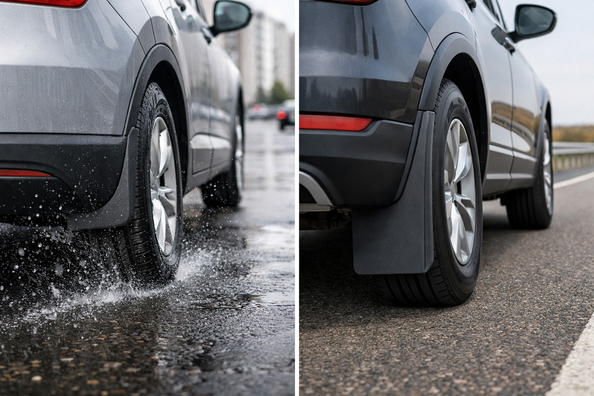
If your car spends most of its time in the city, short mud flaps are almost always more practical: they’re less likely to catch on curbs, snow, and parking stops. If you regularly drive on the highway, face winter conditions, dirt roads, run wider tires, or have increased wheel offset, long ones provide better coverage against water, salt, and small stones. It’s also useful to look at vehicle-specific mud flaps and universal mud flaps to understand which format fits your car best.
The key point isn’t only “short or long.” Real-world results depend on wheel geometry, ground clearance, the flap material, and whether the kit fits factory mounting points without drilling. That’s what determines whether a mud flap helps—or starts annoying you after a week.
A mud flap works as a barrier to the spray thrown by the tire. The longer and wider it is, the better the chance it will intercept water, slush, and small stones earlier. But it can’t completely eliminate the mist behind the car, so “as long as possible” doesn’t always mean “as smart as possible.”
For a stock passenger car or crossover with normal wheel offset, a short option is often enough to keep the sills and arches cleaner. For a vehicle with a lift, spacers, wider tires, or aggressive wheel offset, a short flap often no longer covers the dirt trajectory—then a long one becomes a genuinely functional part rather than just decoration.
Also check the geometry after installation. If the lower edge sits too low, the risk of scraping obstacles rises sharply; as a practical guideline, you don’t want ground clearance to be right on the limit. On the rear axle, clearance to the exhaust is also important so the flap doesn’t melt or rub.
| Option | Strengths | Weaknesses | Who it’s for |
|---|---|---|---|
| Short | Convenient in the city, less likely to catch, easier day to day, less noticeable | Worse at controlling slush, gravel, and dirt with wide tires or wheels that stick out | Owners of stock cars and crossovers who often park near curbs and drive mostly in the city |
| Long | Better coverage against water, salt, and stones; useful on the highway, in winter, on dirt roads, and on cars with greater wheel offset | Scrape obstacles more often, more demanding on clearance, installation, and material; can create noise if mounted poorly | Those who often drive on the highway, in winter, run wide tires, have a lift, or own a work/heavy-duty vehicle |
Within the same brand, price differences are more often driven not by a few extra centimeters, but by shape accuracy, brackets, and material. So you should compare not only “short vs long,” but “properly chosen vs poorly installed.”
DD Tuning expert comment: the most common mistake is choosing the longest kit without measuring real clearance and how far the tire protrudes from the arch. As a result, the mud flap starts working against the curb, not against the dirt. Before ordering, it’s enough to check three things: how far the wheel sits outward, what the loaded ground clearance is, and whether there are factory mounting points without drilling.
This is the most sensible option for city driving if the car isn’t lifted and the wheels are close to stock geometry. A short flap doesn’t hang down unnecessarily, so it suffers less when parking, entering courtyards, going over speed bumps, and in wet snow. In daily use, this is often more important than maximum coverage.
The downside is simple: when the tire is wider, has more offset, or the car sits higher than standard, the short length is no longer enough. Dirt flies past the edge of the flap onto the sill and lower part of the doors. So the short option is good not by itself, but when it matches the real spray trajectory from under the wheel.
Long mud flaps shine where coverage is the priority: highway driving in rain, winter slush, gravel, work trips, wider tires, spacers, lifts. On such cars, the difference in length is felt not visually, but in how clean the sills and rear arches stay and in the amount of fine sand on the body.
But a long option makes sense only under two conditions. First, there’s enough ground clearance—so the lower edge won’t live in contact with every curb. Second, the material and mounting are solid: a stiff long flap in freezing weather or with a weak bracket usually loses to a flexible one, even if on paper it covers more.
For a purely city car, the answer is simple: short. They catch less often, don’t force you to constantly think about curbs, and don’t create extra hassles in winter in parking lots. If the car is low, this is almost the default scenario.
For mixed use, it all comes down to how much highway driving you do. If the city dominates, the short option is more practical. If you have regular long trips on wet highways, especially in winter, it’s worth looking toward longer solutions—but only after checking clearance.
For cars with wide tires, spacers, or a lift, long mud flaps are usually justified. Here short ones often simply can’t cover the spray, because the wheel throws dirt farther and wider. For vans, pickups, and work vehicles, the long version is also more logical: the extra protection area genuinely pays off.
| Scenario | What’s better to choose | Why |
|---|---|---|
| Low sedan or hatchback, daily curbs and courtyards | Short | Less chance of catching an obstacle; enough for stock wheel geometry |
| Crossover in the city, occasional highway trips, stock tires | Short | A good balance of protection and convenience without extra hang-down |
| Frequent highway driving in rain and snow | Long | Better at controlling water, slush, and stones—especially at higher speeds |
| Wide tires, spacers, lift, or aggressive wheel offset | Long | More coverage is needed in height and width; otherwise a short flap lets the spray pass by |
| Van, pickup, or work vehicle with high mileage | Long | Extra protection area is justified here both in practice and by operating conditions |
A higher-priced solution is justified when you need precise shaping, proper material, and drilling-free installation. In that case, it makes sense to consider vehicle-specific mud flaps, original kits, or universal mud flaps only when you knowingly accept that fitting may be required.
Paying extra makes sense on a new car, on a vehicle with tight arch clearances, for winter use, and where mounting durability matters. A cheap long kit often loses not because it’s long, but because it’s hard to position correctly: it either rubs, or sits too high and becomes pointless.
If you need an additional practical selection approach, it’s also useful to compare vehicle-specific mud flaps with your trim’s parameters and evaluate whether installation without modifications is better than saving money on a universal set.
From a customer’s experience: the owner of a city crossover wanted the longest mud flaps because they often drive on wet highways. After measuring, it turned out the lower edge on their car would sit too close to the ground due to daily parking by high curbs, so they chose a shorter but flexible vehicle-specific kit. As a result, the sills stayed noticeably cleaner, and the flaps didn’t start scraping within the first week.
In short: for the city, short mud flaps are more practical; for highways, winter, wide tires, and work vehicles—long. If you’re unsure, don’t look at photos—look at wheel geometry, ground clearance, material, and mounting type. That’s what determines whether you’ll see real benefits in everyday use.
The material is based on real selection experience, practical knowledge, and real-world use cases. In daily city driving, convenience wins; in harsher conditions, extra coverage wins. The worst choice here isn’t short or long, but the one that doesn’t account for your suspension, tires, and route.
| ✔ | Short mud flaps are more convenient for city driving: there is less risk of catching curbs, snow, or speed bumps, so they don’t get in the way during daily parking and maneuvers. |
| ✔ | For stock cars and crossovers, the short version is often enough to reduce dirt on the sills and wheel arches without unnecessary downward overhang. |
| ✔ | Long mud flaps better block water, salt, slush, and stones, so they are useful on the highway, in winter, on dirt roads, and for cars with wide tires or greater wheel offset. |
| ✔ | Flexible material, especially polyurethane, withstands cold and impacts better, and therefore lasts longer in winter conditions and puts less stress on the mounts. |
| ✔ | If the set fits into the factory points without drilling, installation is simpler and safer for the paint than in the case of modifications and fitting. |
| ✘ | Long mud flaps rub against obstacles more often, so on low cars they can quickly start catching curbs, ice chunks, or ramps. |
| ✘ | Short mud flaps work worse with wide tires, a lift, or spacers: dirt and water fly past them onto the sills and lower part of the doors. |
| ✘ | Noise usually appears not because of the length itself, but due to a rigid material, weak mounting, or contact with the wheel arch liner, tire, or snow. |
| ✘ | Cheap universal long sets may require drilling, trimming, and modifications, which means the savings on purchase partially or completely disappear. |
Shipping to EU
Wholesale and retail
Own warehouse
Опис продукту
Подарунки не надаються при оформленні покупки у кредит під 0,01% або при покупці частинами.