28.08.2026
71
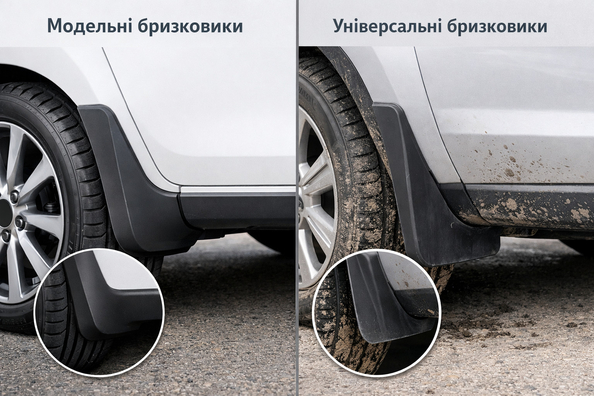
If there’s a proper vehicle-specific kit for your car, that’s usually the first option to consider: it follows the wheel-arch contour, more often mounts to factory points, and less often hangs at the wrong angle. That’s why vehicle-specific mud flaps generally fit better and are less likely to get torn off by water/snow spray or during full steering lock.
Universal mud flaps aren’t worse by themselves. You need them when there’s no ready-made solution for a specific vehicle, when wider tires are fitted, the suspension is lifted, wheel offset is changed, or more coverage is required for working use. But here, the result depends almost entirely on the size, material, and how exactly they’re installed.
The main question isn’t what’s written on the box, but how the mud flap sits relative to the arch, the tire, and the road. A vehicle-specific option usually wins on fitment: it’s closer to the body shape, doesn’t stick out sideways, and puts less unnecessary load on the mounting points. That matters not only for looks, but also for durability.
A universal option wins where a non-standard width or length is needed. For larger wheels, a commercial vehicle, or a modified car, it can even be more practical. But buying a universal kit without understanding where the holes will go, what the clearance to the tire will be, and whether the mounting will be stiff enough is the shortest path to a crooked install or a tear-off.
| Option | Strengths | Weaknesses | Who it’s for |
|---|---|---|---|
| Vehicle-specific | More precise fit, often factory mounting points, lower risk of misalignment and tear-off | Not every kit installs without drilling; with non-standard wheels, rubbing is possible | Owners of stock vehicles without major modifications |
| Basic universal | Low entry cost, can be adapted to different cars, easy to find a replacement | Often sold without fasteners, require a template, holes, and precise fitting | Those who don’t have a vehicle-specific solution or need a budget option |
| Flexible or reinforced universal | Handle mud, snow, and non-standard wheels better, you can choose a larger size | More expensive, and without proper installation they can still rub or hang incorrectly | For off-road use, wide tires, lifted suspension, work vehicles |
DD Tuning expert comment: most often, people don’t make the wrong choice of mud flap type—they make the wrong assumption that any kit will fit without checking clearances. If the car already has wider tires or a changed offset, even a good vehicle-specific option should be test-fitted at full lock. With universal kits, the mistake is even more costly: weak mounting or an overly long flap almost guarantees misalignment or contact with the wheel.
Vehicle-specific mud flaps. Their strong point is predictability. If a kit is made for a specific body, it usually sits closer to the liner, doesn’t require rough trimming, and interferes less with the body. But there’s an important nuance: “vehicle-specific” doesn’t always mean fully drill-free installation. Some crossovers and pickups may need additional holes, so you should verify this before purchase, not after unboxing.
Universal mud flaps. Their advantage is freedom of size. You can choose a longer or wider option if a standard kit doesn’t cover the tire’s mud spray. The downside is that fitting isn’t a bonus—it’s a mandatory part of the job: you must set the height, symmetry, angle, and mounting stiffness. If you don’t, a universal mud flap can sit crooked, make noise while driving, or catch on snow and ruts.
Flexible and reinforced universal solutions. This is a separate sub-group that shouldn’t be mixed up with cheap basic kits. They make sense where a regular mud flap is constantly working at the limit: lots of mud, big tires, winter slush, regular trips onto dirt. These solutions cost more, but they handle hits from snow and mud better and allow you to fine-tune coverage for a specific vehicle setup.
For a typical passenger car, crossover, or family wagon without modifications, it almost always makes more sense to choose a vehicle-specific kit. Here, clean sills, simple installation, and no geometry surprises matter. The extra cost pays off because the mud flap fits correctly right away and doesn’t demand rework.
If the vehicle is used for deliveries, drives on construction sites, or has non-standard wheels, you should look not only at the type, but also at coverage and clearance. In these scenarios, a well-chosen universal or reinforced option may be more practical than a regular vehicle-specific kit, because it provides more length, width, and room around the wheel.
For winter and road salt, material flexibility matters. Overly rigid solutions lose more often in мороз and when ice builds up. But even a flexible mud flap won’t help if it’s mounted too low or too close to the tire.
| Scenario | What to choose | Why |
|---|---|---|
| Stock sedan or hatchback for city driving | Vehicle-specific | Better fit, faster installation, lower chance of misalignment and rubbing |
| Crossover for city, highway, and winter | Vehicle-specific made of flexible material | Hold shape better, easier to maintain, fewer issues with snow and slush |
| Pickup or SUV with wide tires | Reinforced universal or special solutions with more clearance | A standard vehicle-specific kit may be too small or too close to the wheel |
| A car with no exact kit available | Universal | The only realistic path, but only with precise fitting and proper fasteners |
| Work vehicle for mud and dirt roads | Longer universal or reinforced | Coverage, easy replacement, and durability matter more than looks |
Paying extra is justified in three cases: when the car is stock and you want minimal installation hassle; when non-standard wheels are fitted and extra clearance is needed; when the vehicle truly works in mud rather than just occasionally leaving the city. In the first case, it’s worth looking toward original mud flaps; in the second, compare not the name but the geometry and wheel clearance; and in the third, read the guide for choosing for your roads first, and only then select universal mud flaps of the required length and material. A more expensive option makes sense when it reduces the amount of rework and the risk of having to buy again.
From a customer’s experience: a crossover owner first wanted to save money and installed a universal kit without accurately matching the width. After a few trips in slush, one mud flap started coming loose, and at full lock there was contact with the wheel. After switching to a vehicle-specific kit, the problem disappeared, and the installation took less time than the first rework.
In short, vehicle-specific mud flaps more often fit better and tear off less often because their geometry is closer to a particular car and the mounting is usually more predictable. Universal ones make sense where a non-standard size, more coverage, or no direct compatibility is needed—but they must be chosen much more carefully.
So the right approach is simple: for a stock car without modifications, start with a vehicle-specific option; for a modified vehicle or harsh conditions, start with measurements, clearances, and material—not price. This material is based on real selection experience, hands-on practice, and real use cases, so the main takeaway is this: the mud flap that tears off less isn’t the one that’s more expensive or marketed louder—it’s the one that’s correctly chosen for a specific vehicle and properly installed.
| ✔ | Model mud flaps usually better match the wheel arch shape and more often fit the factory mounting points. Because of this, they are less likely to sit crooked and are less at risk of coming off while driving. |
| ✔ | For a production car with no modifications, a model-specific kit offers more predictable installation. It is easier to fit without extra adjustment, which reduces the chance of mistakes during installation. |
| ✔ | Universal mud flaps are useful when there is no ready-made solution for a specific car. They can be chosen for wider tires, a lifted suspension, or a larger coverage area. |
| ✔ | Flexible and reinforced universal versions are better suited for mud, snow, and gravel roads. They are more practical for work vehicles or cars with a non-standard wheel setup. |
| ✔ | Universal models give more freedom in size. If a standard kit does not cover the spray properly, you can choose a longer or wider option. |
| ✘ | Universal mud flaps depend almost entirely on the quality of fitment and installation. If the angle, height, and symmetry are not set correctly, they may sit crooked or touch the wheel. |
| ✘ | A model-specific kit is not always installed completely without drilling. For some cars, additional holes or minor modification may still be required. |
| ✘ | Basic universal mud flaps often come without proper mounting hardware. Because of this, they need to be selected and installed more precisely, and a mistake can end in misalignment or detachment. |
| ✘ | Too stiff or too low-mounted mud flaps handle winter, snow, and ice poorly. In freezing weather, they more often create problems than help. |
Shipping to EU
Wholesale and retail
Own warehouse
Опис продукту
Подарунки не надаються при оформленні покупки у кредит під 0,01% або при покупці частинами.