31.07.2026
281
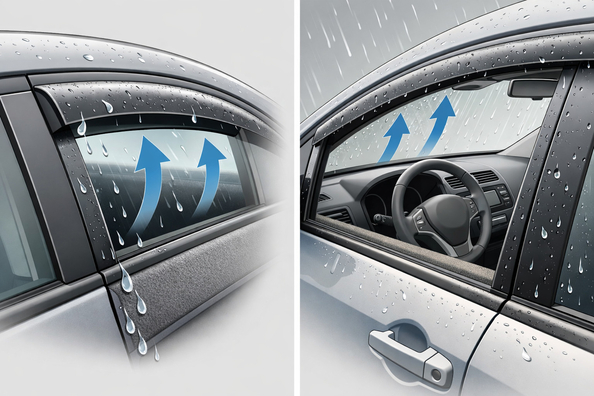
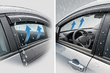
Droplets on the door trim during rain don’t appear because the cabin can’t be ventilated at all, but because the window is opened in the wrong way or the car lacks an element that diverts water away from the top edge of the glass. In most cases, a simple combination works: a very small glass gap, fresh outside air, and proper airflow across the glass.
If water gets inside even with the windows fully closed, it’s no longer a ventilation issue. Then you need to check the glass fitment, pressure against the seal, and the drains—because no window deflector will fix that kind of problem.
When a side window is slightly open, water running from the roof and the upper door frame flows along the outside surface of the glass. If the opening is too large or the frame shape doesn’t guide water away to the side, droplets break off into the cabin and hit the upper part of the door panel.
The second part of the problem isn’t about rain but cabin humidity. If the climate system is set to recirculation, moisture from people, wet clothes, and floor mats stays inside, the glass fogs up, and the driver opens the window more than necessary. At that point, water can easily blow into the cabin.
DD Tuning expert comment: The most common mistake is installing a universal deflector and then opening the window almost a finger-width, expecting full rain protection. In practice, an exact model-specific product and a small gap work better than a wide opening. The second typical mistake is leaving recirculation on—people end up fighting the symptom (fogged glass) instead of the cause.
| Symptom | Likely cause | What to do |
|---|---|---|
| Droplets hit the trim right after opening the window | Gap is too large or there is no deflector | Reduce the opening to the minimum and use a deflector |
| It’s fine in the city, but on the highway in the rain water still gets thrown in | Crosswind and aerodynamic characteristics | Reduce the gap even more or switch to climate ventilation without opening the window |
| The glass fogs up quickly, you have to open the windows wider | Recirculation and excess moisture in the cabin | Use outside air, windshield airflow, and A/C for dehumidifying |
| After deflector installation, a whistle appears or the glass doesn’t close properly | Poor deflector fitment or interference with the glass channel | Reinstall, check compatibility, and if needed adapt the window regulator |
| The trim is wet even with windows closed | Poor glass sealing, bad weatherstrip contact, or clogged drains | Look for a door leak instead of spending money on a deflector |
The first solution is model-specific window deflectors and a small window opening. They divert droplets away from the upper edge of the opening, but only while the glass stays within the effective zone. If you lower it too far, water will still go inside.
The second is the correct climate mode. In rain, it’s better to ventilate the cabin with outside air rather than recirculation. For fast dehumidifying, windshield defrost/airflow with A/C is useful: it lowers humidity and removes the need to open the window wide.
If the car has a sunroof, sometimes the rear-tilt position helps as an additional air outlet. But it’s only a supplementary option, not a replacement for properly using the windows and climate control.
What hardly works is simply opening the window wider and hoping the airflow will push water outward on its own. In rain it usually has the opposite effect: air pulls droplets inside even more actively.
Cheap universal deflectors with an imprecise fit give weak results. They may reduce some spray, but often add whistling, leave adhesive marks, or let water through edge gaps.
Rain repellent on the glass is useful for visibility, but it doesn’t solve droplets on the trim with a slightly open window. Likewise, don’t expect a deflector to eliminate noise completely—it only reduces it.
If you regularly ventilate the cabin in the rain, wait with people in the car, or often drive with the windows slightly open, it makes sense to look at window deflectors. To avoid fitment mistakes, it helps to understand the difference between model-specific deflectors and universal options, as well as between thin and wide deflectors for your rain and speed scenario.
Replacing or repairing parts is needed in a different situation: when water enters the cabin with the windows closed, the glass sits unevenly, the seal doesn’t press along the full length, or there are signs of drainage issues. Here, an accessory doesn’t mask the problem—it only delays proper diagnosis.
| Solution | When it works | When it’s not worth spending money |
|---|---|---|
| Model-specific window deflector | When you need constant slight ventilation in the rain | When you’re used to opening the window wide or water gets in even with the glass closed |
| Switch to outside air and windshield airflow | When the main problem is moisture and fogging | When droplets physically fly in through an opening that’s too large |
| Channel-type deflector with correct installation | When it’s exactly compatible with the car and doesn’t interfere with glass travel | When after installation the glass binds, bounces back, or the product sits crooked |
| Diagnosis of glass, seals, and drains | When the cabin gets wet even without opening the windows | When the issue appears only during intentional rain ventilation |
| Using the sunroof in tilt mode | When you need an extra air outlet and the car allows it | When the rain is heavy or you expect the sunroof to replace a proper side-window solution |
From a customer’s experience: a typical story looks like this—someone complains that in the rain they either have to endure stuffiness or wipe the door panel. After choosing model-specific deflectors and switching from recirculation to outside air, it turns out that for everyday driving a very small glass gap is enough. Most often, satisfaction comes not from the accessory itself, but from the fact that the cabin stops getting damp and you no longer have to constantly fiddle with window opening.
For ventilating the cabin in the rain without droplets on the trim, what works best isn’t one magic solution, but the right combination: a small window opening, a model-specific deflector, and outside-air mode with glass dehumidifying. If water gets in with the windows closed, you need to look for a fault in the door, glass, or drainage—not buy an accessory at random. This material is based on real selection experience, hands-on practice, and real usage scenarios, so the key takeaway is simple: a deflector helps when the problem is truly the way you ventilate, not the car’s sealing.
Shipping to EU
Wholesale and retail
Own warehouse
Опис продукту
Подарунки не надаються при оформленні покупки у кредит під 0,01% або при покупці частинами.