23.04.2026
823
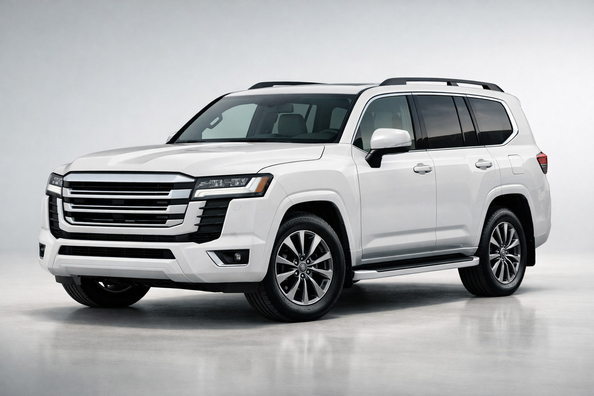

Toyota Land Cruiser 300 Hybrid isn’t an attempt to make a big SUV “economical” — it’s a power-oriented version for those who need pulling force, towing ability, reserve shove for overtaking, and control off-road. The hybrid uses a 3.5-liter gasoline V6 with twin turbocharging and an electric motor; together that’s 341 kW and 790 N·m, plus a 10-speed automatic transmission and full-time all-wheel drive.
The key point: this isn’t a separate generation, but a new Land Cruiser 300 variant announced for 2026. So some practical conclusions already apply to the hybrid itself, while others relate to the LC300 platform in general, which by then has had time to show its strengths and typical weak spots.
The Land Cruiser 300 Hybrid sits at the top end of the large body-on-frame SUV segment. Its direct benchmarks are the Nissan Patrol and Lexus LX: the first leans on a big naturally aspirated engine and conceptual simplicity, the second on a more expensive execution on the same base. The hybrid LC300 stands out by focusing not on minimum fuel use, but on strong low-end torque, sharper throttle response, and preserving true off-road capability.
Who it suits: people who genuinely tow a trailer, travel long distances, carry heavy gear, or want a big SUV without diesel character. Who it won’t suit: those looking for 7 seats, a lower entry price, or clearly better fuel economy versus diesel alternatives.
The Land Cruiser 300 arrived in 2021 as the successor to the 200 Series. The 300 Series became the new foundation for the current full-size Land Cruiser, and the hybrid version is the next stage of this model’s development — not a generational change.
For Europe, the performance hybrid was announced from January 2026 in VX, ZX, and GR SPORT trims. For Australia, the launch is also stated for the first half of 2026. Importantly, the hybrid versions are specified as five-seaters, meaning there is no third row in this configuration.
In the Land Cruiser 300 Hybrid, the key point is that this version effectively comes with one powertrain. It’s a 3.5-liter gasoline V6 (3345 cm³) with twin turbocharging, paired with an electric motor in a parallel layout. The engine itself produces 305 kW and 650 N·m, while total system output is 341 kW and 790 N·m.
The transmission is a 10-speed automatic, and the drivetrain is full-time 4WD. The battery is nickel-metal hydride, 1.87 kWh, and allows short electric-only movement at low speeds — up to 30 km/h. This isn’t for an “EV mode” as such, but for creeping maneuvering, precise torque metering, and slow progress over difficult terrain.
| Parameter | Value |
|---|---|
| Hybrid version production years | launch announced for 2026 depending on market |
| Generation | 300 Series, in production since 2021 |
| Engine | 3.5 L V6 gasoline, twin turbocharging |
| Displacement | 3345 cm³ |
| ICE power | 305 kW |
| ICE torque | 650 N·m |
| Total system power | 341 kW |
| Total system torque | 790 N·m |
| Transmission | 10-speed automatic |
| Drive | full-time all-wheel drive |
| Fuel tank | 98 L |
| Official combined consumption | 10.0 L/100 km |
| Braked towing | up to 3500 kg |
By size, it’s a large SUV: 5005 mm long, 1980 mm wide, 1945 mm tall, with a 2850 mm wheelbase. Ground clearance for the LC300 Series is stated at 235 mm, with approach and departure angles of 32° and 25° respectively; for the hybrid, separate figures aren’t always listed, but they’re said to be on par with the diesel versions.
The front suspension is independent double-wishbone, while the rear is a solid axle with a multi-link locating setup. In everyday driving, this means a combination of long suspension travel, load durability, and calm highway manners. Wading depth is 700 mm, and the hybrid system has dedicated protection so this off-road capability isn’t lost.
There’s an important caveat with the cargo area. For the Land Cruiser 300 overall, a reference figure of up to 800 L is often mentioned, but an official number specifically for the hybrid isn’t published everywhere. What’s known is that the battery slightly raises the cargo floor, so cargo practicality hasn’t become critically worse, but it is less convenient than in non-hybrid versions.
The LC300 Hybrid cabin is built for long trips: lots of space, quiet powertrain operation, a settled ride, and fewer diesel vibrations. This is where the hybrid feels best: the vehicle isn’t nervous, but it picks up very eagerly from low speeds and doesn’t require you to constantly “rev it out.”
On safety, the package is predictably rich: up to 10 airbags, blind-spot monitoring, rear cross-traffic alert, panoramic view, and on higher trims — off-road assist modes for slow driving. The weak spot isn’t the cabin concept, but the fact that across the LC300 Series there have already been complaints about the infotainment and occasional electronic glitches, so for complex tech, software updates and proper diagnostics matter.
In daily driving, this hybrid makes sense if you understand the scale of the vehicle. Official combined consumption is 10.0 L/100 km, and early real-world trips recorded around 9.1 L/100 km. For this size, weight, and power, that’s a good result — but don’t expect passenger-car-like economy.
The 98-liter tank provides long range, and the ability to drive briefly on electric power helps in traffic, parking, and on tricky surfaces. On the other hand, an 11.8 m turning circle and dimensions over 5 meters remind you this isn’t a city crossover. For families, another point is obvious: if you need a third row, the hybrid version is off the table.
For towing, the potential is very serious: up to 3500 kg braked. But this is also where a practical warning appears: on the LC300 Series there have already been reports of rear-end sag under heavy load, so for trailer work this vehicle should be judged not only by the spec sheet, but by real weight, load distribution, and suspension setup.
The main advantage of the Land Cruiser 300 Hybrid is that it gives the LC300 even more torque and smoothness without losing its off-road essence. The main drawback is the compromises for this layout: higher price, only five seats, and fuel savings that aren’t as impressive as the word “hybrid” might suggest.
| Pros | Cons |
|---|---|
| 790 N·m and very strong pull under load | five-seat cabin with no third row |
| up to 3500 kg braked towing | price will be high even within its class |
| better throttle response than diesel versions | fuel consumption doesn’t make it an “economy” vehicle |
| 700 mm wading depth and preserved off-road capability | cargo floor slightly raised due to the battery |
| quieter, smoother operation in the city and on the highway | the LC300 Series already has questions around infotainment and electronics |
From an owner’s perspective, this is a very strong choice for long highway runs, trailers, boats, caravans, or trips to places where a regular big crossover is already asking you to stop. If your main scenario is the city, shopping-mall parking garages, and the need for 7 seats, the rationality of the purchase is far less obvious.
For the Land Cruiser 300 Hybrid, the point of tuning isn’t to “add power” — there’s plenty of it already. It’s much smarter to start with things that improve everyday convenience and real-world use: protecting the interior and cargo area, making entry easier, and carrying gear on the roof. Those are the accessories that best match the model’s character.
If the vehicle will be used with a trailer, fishing, outdoor trips, or long journeys, it’s worth choosing accessories for a specific scenario rather than just “by the checklist.” For the hybrid version, it’s especially important not to complicate access to the cargo area and not to overload the rear end without real need.
Toyota Land Cruiser 300 Hybrid really does look like a step forward for the 300 Series — but not toward maximum efficiency, rather toward torque, smoothness, and versatility for heavy-duty scenarios. If you need a large SUV for towing, long routes, and off-road use, it’s one of the most interesting LC300 versions. If your priorities are 7 seats, a lower price, and a simpler design, it makes more sense to look elsewhere. This piece is based on real selection experience, hands-on practice, and real-world use cases, with the caveat that long-term mass experience specifically with the hybrid version is only just taking shape.
| ✔ | A combined 341 kW and 790 N·m deliver very strong torque under load. This is useful for overtaking, towing, and driving over challenging terrain. |
| ✔ | The hybrid setup improves throttle response and makes the ride quieter and smoother than the diesel versions. In the city and on the highway, the vehicle is less noisy and more comfortable. |
| ✔ | A towing capacity of up to 3500 kg with brakes is suitable for a trailer, boat, or caravan. For a large body-on-frame SUV, this is a practically important advantage. |
| ✔ | The off-road capabilities are preserved: permanent all-wheel drive, 235 mm ground clearance, and the ability to ford up to 700 mm. The hybrid system is separately protected, so the model does not lose its core character. |
| ✔ | The official combined fuel consumption of 10.0 l/100 km for such a large and powerful vehicle looks acceptable. In real-world driving, around 9.1 l/100 km is mentioned, which is also not bad for this class. |
| ✘ | The hybrid version is only stated as a five-seater, without a third row. If you need 7 seats, this configuration will not work. |
| ✘ | Because of the battery, the boot floor is slightly raised. This reduces cargo-area convenience compared with the non-hybrid versions. |
| ✘ | The car is not economical in the literal sense: for a large SUV, the fuel consumption is normal, but there is no “passenger-car” economy here. In other words, the word hybrid does not mean a sharp drop in fuel costs. |
| ✘ | For the LC300 series, there are already mentions of complaints about the multimedia system and some electronic glitches. In complex machinery, this means the need to carefully monitor updates and diagnostics. |
Shipping to EU
Wholesale and retail
Own warehouse
Опис продукту
Подарунки не надаються при оформленні покупки у кредит під 0,01% або при покупці частинами.