30.06.2026
489
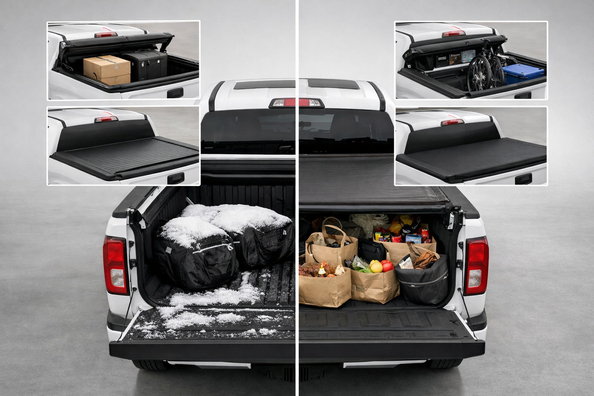
If you look at everyday use without the romance, a soft tonneau usually wins on practicality: it’s cheaper, lighter, quicker to install, and less annoying when you need to open the bed frequently for loading. A hard tonneau pays off where security, highway stability, winter use, and regular transport of valuable items matter more.
The biggest mistake here is looking for the “best type overall.” In reality, the choice depends on your routine: city or highway, tools or household cargo, frequent bed access or long outdoor parking. The same pickup can require completely different solutions for two different owners.
The point isn’t that a soft tonneau is “simpler” and a hard one is “more serious.” It’s about the trade-off between convenient access to the bed and the level of cargo protection. For daily routine—when you’re constantly putting things in, taking them out, hauling bulky loads—a soft design usually gets in the way less. But if you often keep tools, gear, or equipment in the bed, a hard cover provides a very different level of peace of mind.
Second, not all soft and not all hard models are the same in how they open. A soft roll-up can give full access to the bed, while a soft tri-fold may offer only partial access. A hard sectional cover can sometimes open the bed fully too, but it weighs more and costs more to buy.
You shouldn’t compare by a single word like “hard” or “soft,” but by specific criteria.
| Option | Strengths | Weaknesses | Who it’s for |
|---|---|---|---|
| Soft tonneau | Lower price, lighter weight, quick installation, convenient day-to-day opening, roll-up versions can provide full bed access | Weaker theft protection, sensitive to tension and wind, some models have limited bed access due to the folding design | For those who load the bed often, drive mostly in the city, don’t want a big budget, and don’t constantly carry valuable cargo |
| Hard tonneau | Better protection for items, higher rigidity, more stable behavior on the highway, better resistance to snow and the ability to handle higher loads on the cover | Higher price, heavier weight, you must carefully check compatibility with rails, racks, and additional equipment | For those who carry tools or gear, often leave the vehicle outdoors, drive a lot on the highway, or want a stiffer construction |
DD Tuning expert comment: Most often, people make mistakes when they look only at price or only at the word “hard.” If you need to open the bed several times a day, what matters is not the cover’s type on paper, but how quickly it clears the entire opening. The second typical issue is buying a cover and only then remembering about sports bars, racks, or winter use.
Its main strength is simplicity. Price guidance is usually around $150–300, so the entry point is relatively easy. These covers are made from heavy-duty vinyl or a similar fabric on an aluminum frame, which makes them lighter and less burdensome in everyday use.
For city driving, this is often the most convenient format. Roll-up versions provide full access to the bed, which matters if you regularly haul boxes, bags, long items, or use the bed as an open platform. But you need to understand the limits: a soft tonneau is more about concealing cargo than truly protecting it from break-ins.
In terms of noise and longevity, soft models depend heavily on the specific design and installation. A properly tensioned cover can be calm at speed, but with weak tension or worn latches you’ll get flutter and noise. At the same time, there are plenty of durable examples where soft covers serve for years without critical issues.
Its main advantage isn’t hype—it’s functional reserve. The typical budget is different: roughly $400–1,000 and up depending on the design. In return, you get rigid panels or slats, better resistance to cutting, better shape at speed, and a much higher allowable distributed load—on some models this is already hundreds of kilograms, not tens.
That’s why a hard tonneau makes sense for tools, touring gear, winter trips, and long highway runs. It handles wind better, is less nervy at speed, and overall feels closer to a closed cargo compartment. But that doesn’t mean every hard cover is automatically more convenient: some models are heavier to operate, and compatibility with additional equipment should be checked before purchase.
In winter, a hard construction isn’t all-powerful either. If there’s ice or wet snow on the panels, you can’t force it open. The winner here isn’t the one who bought the more expensive option, but the one who truly understands their usage pattern.
For a city pace and frequent loading, a soft tonneau is usually better. It opens faster, weighs less, and doesn’t make every bag or box feel like a separate operation.
For highway driving, winter, and regular transport of valuable items, a hard one tends to win. Here, what matters is not seconds to open, but stability, protection, and peace of mind when the vehicle is parked outside or stays overnight without a garage.
If the budget is limited but you just need to cover the bed from weather and prying eyes, a soft cover offers the best cost-to-benefit ratio. But if you’re building a pickup as a work tool or an expedition vehicle, a hard cover more often fits that logic better.
| Scenario | Best choice | Why |
|---|---|---|
| Daily city use, frequent loading | Soft tonneau | Lighter, easier to open, cheaper, and usually more practical in routine use |
| You constantly carry expensive tools or gear | Hard tonneau | Provides a higher level of protection and is better for overnight outdoor parking |
| Long highway trips, lots of wind, winter | Hard tonneau | Holds its shape more steadily, handles snow load better, and is less sensitive aerodynamically |
| You need full bed access for oversized cargo | More often a soft roll-up | The easiest way to quickly clear the entire opening without extra weight or extra steps |
| One-time or irregular bed use, limited budget | Soft tonneau | No need to overpay for a capability reserve you won’t use every day |
Paying extra for a hard tonneau makes sense when it addresses a specific risk or task: expensive tools in the bed, frequent overnight street parking, long highway trips, winter use, the need for a stiffer surface, or a higher load reserve. If your scenario is simpler, a higher price by itself doesn’t make the purchase more practical.
To avoid overpaying in the wrong direction, look at the pickup as a system. If you just need to close the bed, start with the tonneau covers category. If you also plan overhead load or additional equipment, immediately check compatibility with sports bars. And when the key goal is getting the most enclosed volume for gear or work items, sometimes it’s more logical to compare a hard tonneau with a canopy as well, not only with a soft cover.
From a customer’s experience: the pickup owner initially wanted a hard cover because it felt more reliable, but in conversation it turned out he hauls tall boxes and building materials several times a week. In the end, he chose a soft roll-up tonneau because quick opening and full bed access were more important to him. Satisfaction came not from the “cheaper option,” but from the fact that the cover doesn’t interfere with day-to-day work.
In everyday life, a soft tonneau is more often the practical choice: it costs less, is easier to live with under constant loading, and is simpler to justify if the bed is used as a working space. A hard cover wins when security, highway driving, winter, valuable contents, and a bigger strength reserve matter more.
So the right choice here isn’t between “cheap” and “expensive,” but between “open often” and “protect better.” This material is based on real selection experience, hands-on practice, and real usage scenarios: the best solution is the one that matches your routine—not simply the one with the louder construction.
| ✔ | A soft tonneau cover usually costs less, is lighter, and is quicker to install, so it doesn’t complicate everyday use. It’s especially convenient if you need to open the bed several times a day. |
| ✔ | With roll-up soft versions, you can get full access to the bed without extra effort. This is practical for bulky cargo, boxes, or long items. |
| ✔ | A hard tonneau cover better protects your belongings and behaves more steadily at speed. It is a better fit for tools, gear, and highway trips. |
| ✔ | For winter and outdoor parking, a hard design looks more reliable. It handles wind and snow loads better if used carefully. |
| ✔ | A soft tonneau cover offers the best price-to-benefit ratio when you just need to protect the bed from weather and prying eyes. It’s a sensible choice with a limited budget. |
| ✘ | A soft tonneau cover protects against theft less effectively than a hard one. It mainly hides cargo from view rather than providing a serious security barrier. |
| ✘ | In soft models, dependence on the tension of the fabric, hardware, and installation quality is more noticeable. If something is off, noise and flapping can appear at speed. |
| ✘ | A hard tonneau cover is more expensive and heavier, so it is not always justified for simple everyday use. If the bed is opened often, it may be less convenient in routine use. |
| ✘ | Not all hard and soft models are equally convenient in terms of opening mechanism and compatibility with equipment. Before buying, you need to separately check rails, boxes, bars, and bed side features. |
Shipping to EU
Wholesale and retail
Own warehouse
Опис продукту
Подарунки не надаються при оформленні покупки у кредит під 0,01% або при покупці частинами.