18.06.2026
632
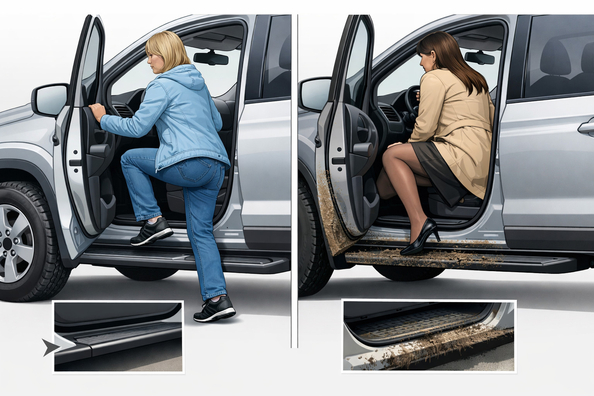
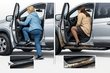
In a tall crossover or minivan, the problem is usually not the body height itself but the entry geometry: the first step is too high, the sill edge is wide or dirty, and your foot and pant leg move almost along the same path as the body. That’s why, when getting out, a person either reaches down without support or slides along the sill edge and quickly soils their clothes.
Not just any side step works, but one that truly reduces step height, isn’t slippery, and doesn’t stick into the leg’s path. If the platform is narrow, hangs too low, or gets packed with snow and mud, it may not help and can even snag your pant leg and create extra problems.
Entry/exit comfort is most affected by the height of the sill from the ground, the sill width, and seat height. With tall bodies, getting out is almost always harder than getting in: you can pull yourself in, but to get out you must transfer your weight down in a controlled way and avoid rubbing against the body.
If the door opening isn’t very tall relative to the seating position, body lean adds to it. Then you don’t step straight down but with a sideways shift, and your pant leg rubs against the dirty sill edge or the side step itself. Because of this, clothes wear out even when the vehicle is technically sound.
DD Tuning expert comment: the most common mistake is installing a narrow decorative tube and expecting it to work like a step. If you can’t confidently place your foot on the side step, you’ll still step past it and dirty your pants. The second typical mistake is not accounting for winter: retractable mechanisms are convenient, but without regular hinge cleaning in snow and salt, their advantage quickly disappears.
| Symptom | Likely cause | What to do |
|---|---|---|
| Pant leg gets dirty along the outer seam | The leg passes too close to the dirty sill edge or side step | Check your exit path, move your body slightly farther from the vehicle, and if needed install a wider non-slip support |
| Only the toe lands on the side step | The platform is too narrow or sits too close to the body | Look for a support with real working width; for a tall body, narrow decorative tubes are usually a weak solution |
| Getting out is harder than getting in | First step too high and no intermediate support | Add a side step that reduces step height, or change your exit technique using the grab handle for support |
| After slush, clothes get dirty much faster | Wet dirt accumulates on the sill and side step | Regularly clean the stepping surface; if it’s a retractable mechanism, watch the hinges and don’t blast the actuator with a direct strong jet |
| Side steps catch ruts, curbs, or snow | A fixed element is installed too low | Assess the loss of ground clearance; for frequent off-road use, a different type of steps is better, or skip low platforms |
The best effect comes from a wide, non-slip step you can place your foot on without searching for a contact point. For a tall body, the working depth of the support shouldn’t be purely decorative: the practical lower limit is about 100 mm, and it’s even more comfortable when the platform is wider.
The second thing that really works is the correct exit trajectory. If you fully open the door, brace on the grab handle, and move your body slightly farther from the vehicle, your pant leg is less likely to catch the sill edge. This doesn’t replace a side step, but it’s a good way to check whether the problem is truly geometry.
In harsh conditions, it’s not only the accessory itself but also maintenance that helps. In winter and mud, retractable steps need regular cleaning—otherwise entry convenience quickly turns into sticking, delayed operation, and dirty clothes.
Narrow decorative tubes without a proper platform often look like a solution, but they change little for real entry/exit. If you can’t place your whole foot on them, people use them only occasionally—or not at all.
A one-time wash also doesn’t solve the problem for long. In slush, any protrusion on the side of the body quickly collects dirt, so without regular cleaning even a proper side step will start dirtying pants.
Installing any fixed step isn’t always justified for a vehicle that often drives in ruts or over rocks. If the vehicle lives off asphalt, a low-mounted element can bring more downsides than benefits.
If the main issue is the high step in everyday city use, it’s worth looking at side steps with a wide non-slip platform. If the vehicle regularly runs in ruts, on rocks, or in deep snow, it makes more sense to consider heavy-duty rock sliders: they’re more appropriate where a standard platform is easy to damage or snag.
For a minivan with active use of the side entry, the problem is sometimes not the driver’s seating position but the constantly scuffed and dirty edge of the opening. In that scenario, it’s useful to look at a sliding door sill protector: it doesn’t reduce step height, but it takes the daily shoe contact and helps avoid wearing out the opening edge.
| Solution | When it works | When it’s not worth spending money |
|---|---|---|
| Wide fixed side steps | When the vehicle is used daily in the city and entry is hard for children, older passengers, or people who find it difficult to lift the leg high | When the vehicle often uses full ground clearance: fixed steps can take away about 51–127 mm of clearance |
| Retractable power steps | When you need entry comfort without a constant loss of clearance when folded | When the vehicle constantly sees ice, salt, and mud, and the owner isn’t ready to regularly clean the mechanism |
| Heavy-duty rock sliders | When you need protection and strength on poor roads or light off-road | When the goal is only to make entry softer: they aren’t always the most convenient as a step |
| Sliding door sill protection | When, in a minivan, the passenger side entry is what gets scuffed and dirty | When the main problem is a high step at the front doors, not wear on the opening edge |
| Changing entry/exit technique | When the problem is moderate and the main issue is incorrect body movement near the vehicle | When, without an intermediate support, it’s physically hard to lift the leg or safely step down |
From a customer’s experience: people often come in after a simple everyday issue—after rain on a tall crossover, the pant leg keeps touching the dirty sill edge. In such a case, a narrow decorative step is usually rejected in favor of a wide ribbed platform you can properly stand on. If the vehicle also goes onto bad roads, overly low fixed solutions are avoided to prevent losing extra ground clearance.
In short, entry/exit problems in a tall body come from a combination of step height, sill width, leg trajectory, and operating conditions. What really helps is either a wide non-slip side step or a retractable solution that doesn’t get under your pant leg and doesn’t compromise clearance; what doesn’t work is narrow decorative elements and any option that ignores mud, snow, and how the vehicle is used. This material is based on real selection experience, hands-on practice, and real daily-use scenarios, so the main advice is simple: first determine exactly where you lose support or snag your clothing, and only then choose an accessory.
| ✔ | A wide non-slip step really makes getting into a tall SUV or van easier, because it provides a proper intermediate foothold instead of forcing you to reach the ground right away. For everyday city use, this is especially useful when children, older passengers, or people with limited mobility get in often. |
| ✔ | Retractable electric side steps are convenient because they can help with getting in without permanently reducing ground clearance when folded away. It’s a practical option if the vehicle often needs to be comfortable in the city, but you don’t want to sacrifice clearance all the time. |
| ✔ | The right exit path also reduces contact between the trouser leg and the bodywork or dirty edge of the sill. If you open the door fully, hold onto the handle, and move your body slightly away from the car, the clothing rubs less against the metal or the step. |
| ✔ | For a minibus, sill protection for sliding doors is especially useful when the wear is concentrated on the edge of the side entry. It takes on daily shoe contact and helps avoid further damaging the dirty edge of the opening. |
| ✔ | Changing the way you get in and out can help if the problem is not critical and the main cause is poor body movement near the vehicle. It’s a free way to check whether an accessory is really needed or whether adjusting your entry is enough. |
| ✘ | Narrow decorative pipes often do not solve the problem, because you cannot confidently place your whole foot on them. In that case, the person still steps past them and keeps dirtying their trousers. |
| ✘ | Any step or sill quickly loses its usefulness in slush if wet dirt builds up on it. Without regular cleaning, even a decent solution starts dirtying clothes and may work worse. |
| ✘ | Low-mounted fixed side steps can get in the way off-road, in ruts, on rocks, or in deep snow. In such conditions, they reduce ground clearance and add the risk of catching a curb or snow. |
| ✘ | Retractable mechanisms are not very suitable for cars that constantly see ice, salt, and mud if the owner is not ready to look after them. Without cleaning the hinges, their advantage quickly disappears, and the mechanism itself may start sticking. |
Shipping to EU
Wholesale and retail
Own warehouse
Опис продукту
Подарунки не надаються при оформленні покупки у кредит під 0,01% або при покупці частинами.