11.05.2026
400
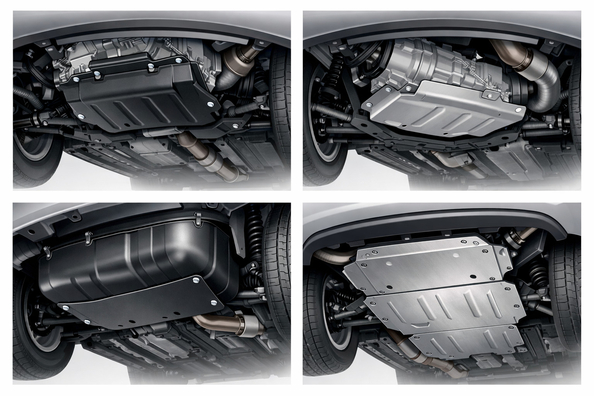
In short: in most cases, the first thing should not be a full underbody kit, but protection for the components that can stop the car immediately after an impact. Usually that’s the engine crankcase/oil pan area and the transmission or transfer case zone. Fuel tank protection makes sense next if the tank hangs low, the car often bottoms out on a ridge, or the route is rocky.
The problem is that the underside is designed differently on different vehicles. On one car the lowest point is the engine oil pan, on another it’s the automatic transmission pan, the transfer case, or the fuel tank. So the correct order is determined not by the part name, but by the geometry of your specific vehicle, the surface type, the season, and the speed at which the car takes the hit.
Owners often think simply: install one thing and be done. But one skid plate doesn’t cover the entire underside. Even if you protect the crankcase, the gearbox, transfer case, or fuel tank may still remain vulnerable.
The second reason is the difference between city driving and real routes. On asphalt the hazards are one thing; in ruts, on rocks, on icy ridges, or on broken dirt roads it’s another. There, what matters isn’t what looks lowest in a photo, but what actually shows real contact marks.
DD Tuning expert comment: the most common mistake is buying only an engine skid plate because the name is familiar, and not checking that on a specific vehicle the automatic transmission pan or the fuel tank sits lower. The second typical mistake is installing a universal plate without proper mounting points. The right order always starts with checking the lowest component and the real contact marks.
| Symptom | Likely cause | What to do |
|---|---|---|
| Fresh scratches and dents under the engine | The front lower zone is taking the hits; the crankcase or oil pan is vulnerable | Install the engine skid plate first; inspect the oil pan and mounts |
| Impacts and scuffing in the middle of the underbody | The transmission or transfer case is getting hit on ridges or rocks | Inspect the center of the vehicle; then prioritize transmission protection |
| Contact marks near the fuel tank or its brackets | The tank hangs low or the rear often rides over rocks | Add fuel tank protection; check lines and mounts |
| Oil smell after an impact, leaks underneath | Oil pan damage or fluid leak | Stop, do not continue driving, diagnose the leak |
| Shift delay, vibration, grinding after underbody contact | The impact reached the transmission or its mounts | Have the transmission checked at a service center and don’t delay protecting the central zone |
| Rattling after installing a skid plate | Bent mount, poor fitment, or the plate has already taken a hit | Reinstall or replace with a vehicle-specific plate using factory mounting points |
For most vehicles, the practical logic is: first cover the engine crankcase area and the transmission or transfer case zone, because an impact there most often ends with a tow truck. This is the basic level of protection if the car goes beyond smooth asphalt.
The second step is the fuel tank if it sits low, the vehicle has a long wheelbase, or the route includes rocks, ruts, and sharp terrain breaks. On some routes, the tank collects the most contact marks, even if at first it seems the main risk is up front.
Full underbody protection makes sense when it’s already clear that the vehicle regularly contacts multiple zones. A modular approach also works: install plates step by step rather than buying a whole set at random. Separately, it’s important that the plate doesn’t interfere with cooling or service access.
If the factory shield is thin, already bent, or there are regular contact marks underneath, it makes sense to move to dedicated solutions: engine skid plate for the front lower section, transmission protection for the center of the vehicle, and fuel tank protection if the rear regularly bottoms out on rocks or ridges. The right choice is a vehicle-specific plate that uses factory mounting points and doesn’t conflict with cooling or service access.
Replacing an already bent part is also justified if it starts causing vibrations, touching other components, or has lost its shape after an impact. But if the problem is that the car is simply going too fast through deep ruts, a new plate alone won’t solve it.
| Solution | When it works | When it’s not worth spending money |
|---|---|---|
| Engine skid plate | Low-mounted oil pan, broken roads, winter ridges, frequent front contacts | If the front zone is already well protected and impacts are actually happening in the middle or rear |
| Transmission or transfer case protection | Scuffing in the middle of the underbody, the car bottoms out on a ridge, the transmission or transfer case is noticeably lower | If the central section is tucked above structural elements and the route is mild |
| Fuel tank protection | Low tank, long wheelbase, rocky outings, frequent marks in the rear underbody | If the tank is mounted high and the car rarely leaves asphalt |
| Full underbody protection kit | Regular trips on demanding routes, contacts in multiple zones, expedition-style use | For a city car without real underbody impacts |
| Replacement of a bent factory shield or brackets | Rattling, loss of rigidity, the plate no longer holds its shape | When the main issue isn’t the plate, but low ground clearance and excessive speed |
From a customer’s experience: after two trips on forest roads, the owner wanted to cover the entire underbody at once. After inspection, it turned out the impact marks were only under the engine and in the transmission area, while the tank was clean. They installed engine and transmission protection first and postponed the fuel tank protection; for the season that was enough, because the route almost never made the rear contact.
There’s no universal answer for all vehicles, but in most cases a practical order is: first the engine crankcase area and the transmission or transfer case zone, then the fuel tank, and only after that full underbody protection—if it’s truly needed. You should base the decision on the lowest components, real contact marks, and your driving scenario, not the desire to cover everything at once. This material is based on real selection experience, hands-on practice, and real usage scenarios, so the main advice is simple: inspect and set priorities first, then buy the metal.
| ✔ | You can start by protecting the most vulnerable components — the oil pan and the area around the transmission or transfer case — so the car doesn’t become disabled after the first serious impact. That’s more practical than buying a full underbody kit right away. |
| ✔ | The protection order is tied to the actual geometry of a specific vehicle, so the solution can be chosen based on what really hangs lowest. This reduces the risk of spending money on the wrong component. |
| ✔ | There is a clear inspection algorithm: check the underside, look for fresh scratches and dents, and analyze the contact point and symptoms after impact. This makes it easier to determine what should be installed first in your case. |
| ✔ | A modular approach allows protection to be installed step by step: first the front section, then the center or the fuel tank, if there are signs of contact. This is useful when the route or budget does not require a full kit right away. |
| ✘ | One shield does not cover the entire underside, so after protecting the oil pan, the transmission, transfer case, or fuel tank may remain vulnerable. If you don’t look at the specific vehicle, you can protect the wrong area. |
| ✘ | Universal shields with random mounting points can rattle or work worse than vehicle-specific solutions. In that case, the protection itself becomes the source of problems. |
| ✘ | A full underbody protection kit for a city car is often an unnecessary expense if the vehicle does not drive over rocks, ridges, or ruts. So without real impacts, the whole kit may not pay off in practice. |
| ✘ | Even the right shield won’t solve the problem if the car is regularly driven too fast over rough ruts or has low ground clearance. Then not only protection is needed, but also a change in driving style or operating conditions. |
Shipping to EU
Wholesale and retail
Own warehouse
Опис продукту
Подарунки не надаються при оформленні покупки у кредит під 0,01% або при покупці частинами.