06.08.2026
104
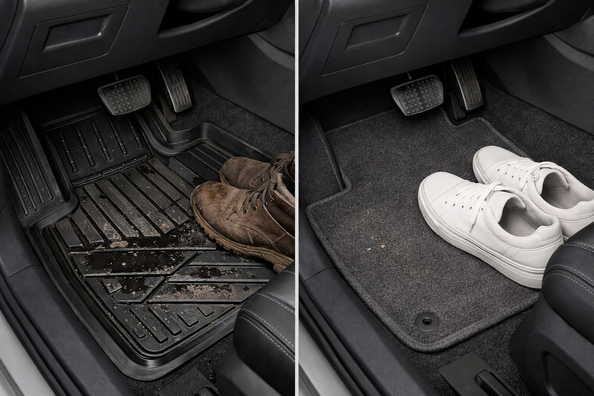
If you need one practical everyday answer, rubber or all-season model-specific floor mats usually win in the cabin. They don’t absorb water, are easier to wash, and hold back snow, salt, and dirt better, so they put less strain on interior maintenance.
Textile mats make sense in a dry city routine, when a softer feel underfoot and a neat look matter more and you’re ready for regular cleaning and drying. But regardless of material, the decisive factors for safety remain a precise fit, OEM retainers, and no second layer of mats under the driver’s feet.
The main difference is simple: rubber mats protect the car’s floor better from moisture and dirt, while textile mats fit better into a calm, dry usage pattern. So it’s not a choice between “better” and “worse,” but between two different use scenarios.
Practicality depends not only on the material. A model-specific set for your exact car is almost always more useful than a universal one: fewer gaps, less chance of shifting, less water under the mat, and less risk that an edge will interfere with the pedals.
| Option | Strengths | Weaknesses | Who it suits |
|---|---|---|---|
| Rubber mats | Don’t absorb water, easy to wash, hold dirt, snow, and salt better, more practical for daily use | Less soft to the touch, cheap sets may have an odor or mediocre fit | Those who drive every day, park outside, carry kids or pets, or often deal with wet shoes |
| Textile mats | Neater look, softer cabin feel, more pleasant for dry urban use | Absorb moisture, require vacuuming, cleaners, and full drying, handle slush worse | Those who mostly drive around the city in the dry season and are ready to care for the interior more attentively |
DD Tuning expert comment: The most common mistake isn’t choosing the “wrong” material, but underestimating fit. A universal mat, even made from good material, can shift or leave exposed areas near the sills. If the car is used daily, first solve geometry and fastening—only then choose between rubber and textile.
Their strength is protection. Water, snow, sand, de-icing chemicals, and dirt stay on the surface instead of soaking into the factory floor carpet. For a car that’s driven daily in any weather, this is the simplest way to keep the interior in working order without extra care.
As for installation, rubber mats depend heavily on shape. A quality model-specific set with raised edges and retainers works much better than a thin universal one. This is where both safety and practicality are decided: less chance an edge will lift and water will run under the mat.
In terms of noise and comfort, rubber doesn’t always lose, but it feels firmer. Also, not all “rubber smell” is the same: it’s more about the specific manufacturer than the mat type itself.
Textile works well where a lot of moisture isn’t brought into the cabin. It’s nicer in everyday contact, looks calmer, and suits those who like a dry, tidy interior without a utilitarian vibe.
But textile practicality ends where the wet season begins. If a mat regularly soaks up water, it needs more than a shake-out—it requires proper cleaning and drying. Otherwise, the cabin stays damp longer, and the set loses its neat look faster.
In terms of service life, textile isn’t necessarily weaker, but its durability depends more on the usage pattern. In a dry city it can last a long time, while in winter or a dirty cycle the load on it is much higher.
For most daily driving, especially in winter, rain, on the highway, or with frequent in-and-out, rubber mats are better. They clean up faster and require less attention after each trip.
For a dry city, short routes, and careful use, textile mats are perfectly justified. They don’t create an extra “workhorse” atmosphere in the cabin—provided you don’t forget regular care.
If you want the most common-sense approach, the best is seasonal: one set for the dry period, another for the wet. But use them separately, not one on top of the other.
| Scenario | What’s better to choose | Why |
|---|---|---|
| City, dry weather, short trips | Textile mats | More comfortable in everyday dry use and don’t overload the cabin with a utilitarian feel |
| Winter, slush, snow, de-icers | Rubber mats | Contain water and dirt better, wash faster, lower risk to the factory floor covering |
| Family car, kids, frequent trips out of town | Rubber mats | Easier to clean after wet shoes, sand, crumbs, and small debris |
| Weekend car or careful urban use | Textile mats | When there’s little moisture, you can get a nicer cabin feel without obvious trade-offs |
| Need one set for the whole year | Rubber mats | They handle a wider range of conditions better and don’t require constant drying |
Paying extra is justified when you need not just a different material, but a precise fit, better fastening, and more edge protection. For that scenario, it makes sense to look either at a model-specific rubber set for Toyota Yaris, or more broadly at rubber mats for Yaris if you need a practicality buffer for daily use.
More expensive textile makes sense in a different case: when the car is mostly kept dry, you want the interior to look as neat as possible, and maintenance doesn’t bother you. Then it’s worth considering textile mats for Yaris as a separate seasonal set rather than a one-size-fits-all replacement for every time of year.
From a customer’s experience: A common scenario is this—someone first looks for textile because they drive in the city and want a tidy interior, but after the first winter they return to model-specific rubber. Most satisfied are those who either choose a rubber set for daily use right away or honestly split usage into dry and wet seasons. Then there’s no disappointment either from maintenance or from a cabin that’s constantly damp.
If you focus on practicality, then for most real-world scenarios rubber mats win inside the cabin: they handle water, snow, salt, and frequent cleaning better. Textile is worth buying when the car mostly lives in a dry urban routine and cabin feel and visual neatness matter more to you.
The smartest choice isn’t built on the words “rubber” or “textile,” but on three questions: is the fit exact, are there retainers, and how much moisture the cabin actually sees. This material is based on real selection experience, practice, and real usage scenarios, so the conclusion is simple: for daily use rubber is usually more practical, and for a dry, tidy routine textile also makes sense.
| ✔ | Rubber mats are less soft to the touch and may feel less comfortable than textile ones. Cheaper sets can also have an odor or only a mediocre fit. |
| ✔ | Textile mats absorb moisture, so after wet weather it is not enough to simply shake them out. They need to be vacuumed, cleaned, and fully dried; otherwise, the cabin stays damp for longer. |
| ✔ | In slush, winter, and during frequent wet conditions, textile mats lose their neat appearance faster and handle wear worse. For daily use in such conditions, they are less practical. |
| ✔ | Universal mats of any material can be problematic if they do not match the shape of the car floor. This creates gaps, shifting, and the risk that the edge will interfere with the pedals. |
| ✘ | Rubber mats do not absorb water and better hold back snow, salt, and dirt, so they are easier to keep clean during everyday driving. This is especially convenient in rainy or winter weather, when the cabin gets dirty quickly. |
| ✘ | They are quicker to wash and do not require full drying after every wet trip. This saves time and reduces the amount of cabin care needed. |
| ✘ | A model-specific rubber set with precise fit, raised edges, and retainers better protects the car floor from moisture and shifting. For the driver, it is also safer, because there is less risk of the mat interfering with the pedals. |
| ✘ | Textile mats are more pleasant to the touch and look neater, so they are a good fit for dry city driving. In this scenario, they give a more comfortable feel in the cabin. |
| ✘ | As a seasonal option, textile makes sense if the car is mostly driven in dry weather and care is not an issue. In this mode, it can last a long time without any obvious loss of practicality. |
Shipping to EU
Wholesale and retail
Own warehouse
Опис продукту
Подарунки не надаються при оформленні покупки у кредит під 0,01% або при покупці частинами.