06.08.2026
330
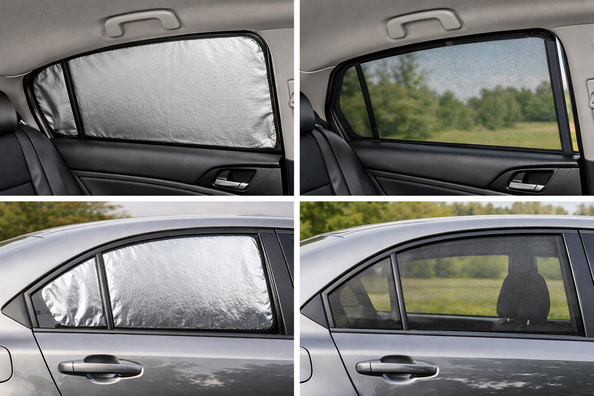
For everyday driving, the choice is simple: if your car spends a lot of time in the sun and you need maximum tint and privacy, a dense, vehicle-specific mirrored sunshade is the better option. If it’s more important to open the window daily, keep normal outward visibility, and remove the shade without extra hassle, a magnetic mesh shade is more practical.
The problem is that these two options are often compared as if they deliver the same result. In reality, a dense shade is stronger when parked and during long stops, while a mesh shade is more convenient on the move and in city use. So you should look not at the name, but at installation, noise, durability, everyday convenience, and how exactly you use your car.
A dense, vehicle-specific mirrored sunshade works when you need to block direct light as much as possible, reduce cabin heat, and hide the car’s interior from prying eyes. It’s an option for cars parked outdoors, for long trips with sunny stops, for sleeping in the car, or simply for those who find excess light in the cabin annoying.
A magnetic mesh shade doesn’t try to create full darkness. Its point is a compromise: fewer glare reflections, shade for passengers, better visibility outward, and the ability to use the window without constant removal. For a daily city routine, this is often more important than maximum darkening.
| Option | Strengths | Weaknesses | Who it’s for |
|---|---|---|---|
| Dense vehicle-specific mirrored sunshade | Blocks direct sun better, darkens the cabin more, provides more privacy, useful when parked and during long stops | More expensive, bulkier, less convenient for frequent daily removal, sometimes leaves small gaps at the edges | For those who often leave the car in the sun, want maximum darkening, or use the car for отдых and overnight stays |
| Magnetic mesh sunshade | Quick to install and remove, preserves better visibility, lets you use the window, convenient for rear passengers | Doesn’t provide full darkening, depends on magnet strength and the door frame, some models may create noise or detach | For those who drive daily in the city, carry kids or passengers, and want shade without losing convenience |
DD Tuning expert comment: The most common mistake is buying a universal shade that’s “roughly the right size” and expecting it to behave like a vehicle-specific product. The second typical mistake is choosing mesh for complete darkness, even though its real job is different: reduce harsh glare, provide shade, and not interfere with daily window opening. If the car is used every day, precise fit matters more than a flashy name or bright packaging.
Their main advantage is a real barrier against the sun. They noticeably darken the cabin better, reduce heat build-up, and provide more privacy. That’s why they’re more often chosen not for a short trip around the neighborhood, but when the car sits for a long time in an open parking lot or when you need to cover the cabin almost completely.
The weak point is daily routine. These shades are often bulkier, slower to fold, and less convenient if you need to remove them several times a day. Even with vehicle-specific solutions, small gaps near the edges or mirrors can occur, and that’s not always a defect but a fit characteristic for a particular body shape.
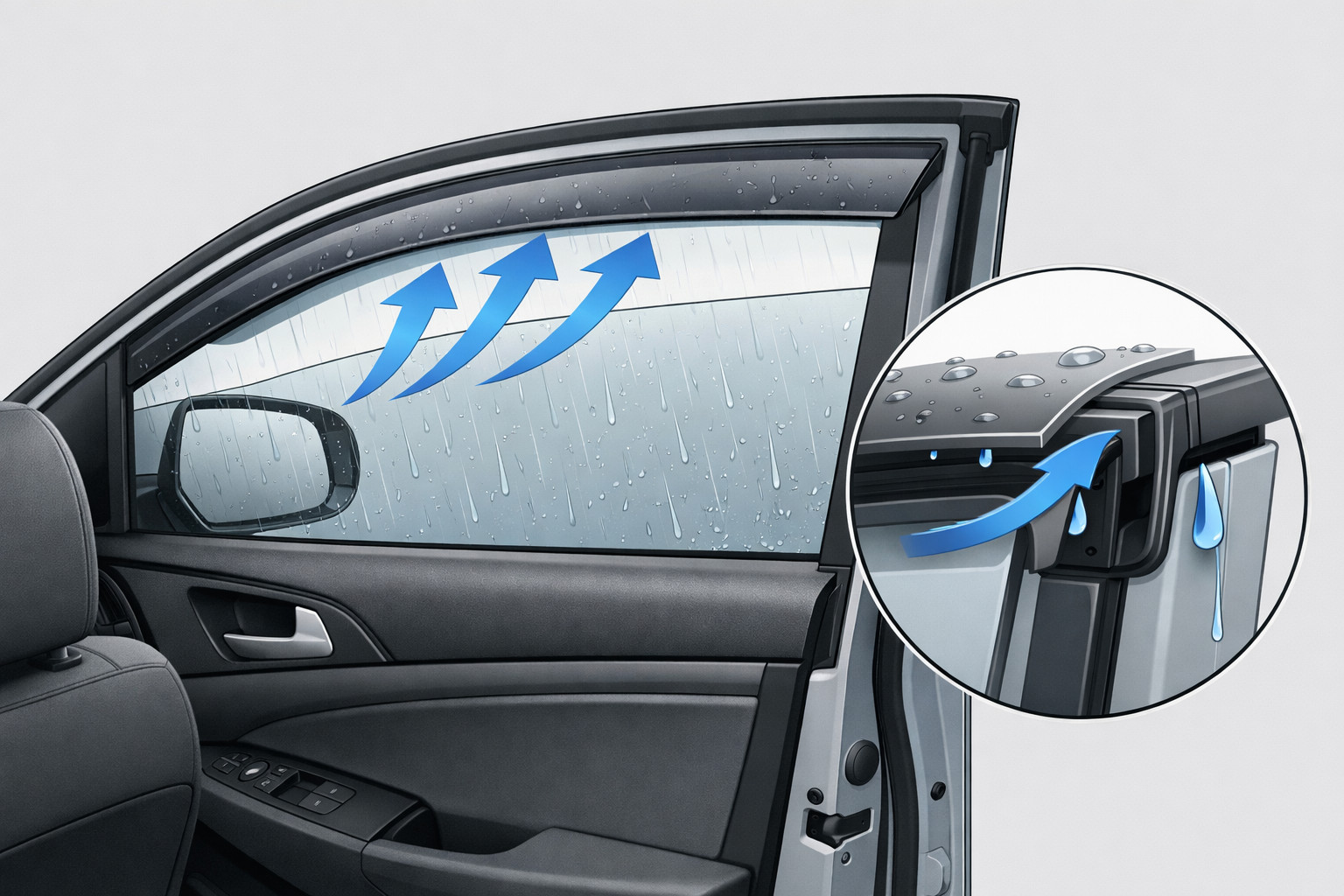
They’re valued because they don’t make life harder. A good vehicle-specific mesh installs quickly, doesn’t require long folding, and keeps better visibility for passengers. If you need to ventilate the cabin a bit or occasionally lower the window, this is a much more logical option for everyday use.
But a lot depends on the car’s design and the quality of the shade itself. If the magnets are weak and the door frame doesn’t provide proper hold, you get play, wind noise, and the feeling of a random add-on rather than an OEM-like accessory. That’s why the difference between a good vehicle-specific mesh and a cheap universal product is felt immediately.
If your main scenario is morning and evening city driving, a child or passengers in the back, periodically opening the window, and not wanting to fuss with removal, magnetic mesh usually causes the least everyday irritation. It’s not the darkest, but it doesn’t force you to think each time where to store it.
If the car often sits under direct sun near the office, the yard, or on the highway during stops, a dense mirrored shade looks stronger. It gives exactly the effect people usually expect from the word “protection”: less light, less overheating, more cabin privacy.
There’s also a mixed scenario. If you need protection primarily for the rear row while driving, not for the whole cabin while parked, it’s better not to overpay for excessive darkening. But if the car is used both for daily trips and for long summer stops, sometimes it makes sense to buy a more expensive vehicle-specific set specifically for a stable, precise fit.
| Scenario | Best choice | Why |
|---|---|---|
| Daily city driving, rear passengers | Magnetic mesh | Better visibility, quick removal, fewer inconveniences in daily use |
| Car often parked in the sun | Dense vehicle-specific mirrored | Blocks direct light more strongly and darkens the cabin better |
| You often crack the windows open | Magnetic mesh | In a quality version, it’s better suited for ventilation and driving with the window slightly open |
| You need cabin privacy | Dense vehicle-specific mirrored | Mesh provides shade, but doesn’t block visibility as tightly |
| You need a shade only occasionally, with no high requirements | Magnetic mesh | Easier to use and usually cheaper to start with |
Paying extra is justified when the shade is needed not for one week of heat, but every day: precise fit, stable mounting, less noise, and a predictable result without constant hand adjustments. A more expensive solution also makes sense if cabin privacy, strong darkening are critical for you, or you’ve already had a bad experience with universal products.
If you want to look right away at purpose-built models rather than random options, start with the sunshade catalog. To understand the difference between types, it’s useful to read the breakdown on how sun shades actually work, and if the main issue is overheating while parked, also check the article about cabin overheating.
From a customer’s experience: someone was looking for the darkest possible option for the rear doors, but the main scenario turned out to be different—daily city driving with a child and constantly cracking the window open. After подбор, they chose a vehicle-specific magnetic mesh because it didn’t require long daily removal and didn’t get in the way of using the window. In the end, satisfaction came not from the darkest solution, but from the one that doesn’t annoy you on every trip.
For everyday driving, a magnetic mesh shade more often wins on convenience, visibility, and behavior in typical city use. A dense vehicle-specific mirrored shade is stronger where parking in the sun, privacy, and maximum darkening come first. The key is not to buy “something similar,” but to choose for your real scenario. This conclusion is based on real fitting experience, practice, and real usage scenarios—not on promises on the packaging.
| ✔ | A dense custom mirror sunshade blocks direct sunlight better, darkens the cabin more strongly, and adds privacy. This is especially useful when the car is often parked in an open lot or in the sun during long stops. |
| ✔ | A magnetic mesh sunshade is more convenient for everyday city use because it is quicker to put on and take off. It gets in the way less if the window needs to be opened or lowered from time to time. |
| ✔ | The mesh version preserves visibility better for passengers and does not create a feeling of complete cabin isolation. For trips with children or rear passengers, this is more practical than maximum darkening. |
| ✔ | A dense custom sunshade is more durable and stable if it is fitted to a specific car. Its construction is stiffer, so it is better suited for scenarios with long periods of parking. |
| ✔ | A magnetic mesh is usually cheaper upfront, so it is easier to choose for infrequent or less demanding use. If you only need shade and fewer reflections, it is a more economical option. |
| ✘ | A dense custom mirror sunshade is bulkier and less convenient if it needs to be folded and removed often. In everyday use, this quickly starts to get annoying. |
| ✘ | Even custom dense sunshades can leave small gaps along the edges or near the mirror. That means complete sealing and perfect darkening will not always be achieved. |
| ✘ | A magnetic mesh sunshade does not provide full darkening and does not replace dense sun protection. If you specifically need privacy or maximum light blocking, its capabilities may not be enough. |
| ✘ | Mesh sunshades depend a lot on the strength of the magnets, the door frame, and the quality of the model itself. In an unsuccessful design, play, wind noise, or detachment from the mount may occur. |
Shipping to EU
Wholesale and retail
Own warehouse
Опис продукту
Подарунки не надаються при оформленні покупки у кредит під 0,01% або при покупці частинами.