28.07.2026
335
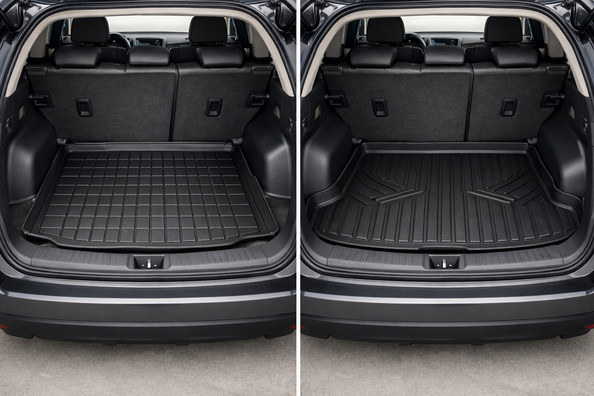
If you need a trunk mat for everyday use, the right choice for most cars is a vehicle-specific (custom-fit) one. It covers the floor without gaps, holds water and dirt better, shifts less, and doesn’t force you to reach for scissors. A universal mat makes sense when the main goal is to save money, quickly cover the trunk, or adapt one option to a car where it’s hard to find a ready-made solution.
The main mistake isn’t that someone chooses the cheaper or the more expensive option—it’s comparing them only by price. In reality, other things decide: trunk shape, lip height, whether there’s an upper or lower load floor, 5 or 7 seats, how often you carry wet items, tools, strollers, or pets.
A universal trunk mat is a compromise. Its advantage is that it’s cheaper and more flexible: you can adapt it to different cars, sometimes even move it from one vehicle to another. But you pay for that with fit accuracy. After trimming, you usually can’t return the product, and edge gaps or exposed corners are fairly common.
A vehicle-specific mat is made for a particular trunk geometry. That’s why it wins not because of a nicer name, but in practice: it covers more area, has a higher lip, and shifts less often. If the trunk has a complex shape, an adjustable floor, or you regularly carry something dirty and wet, the difference becomes noticeable within the first week.
| Option | Strengths | Weaknesses | Who it’s for |
|---|---|---|---|
| Universal cut-to-fit | Lower price, can be adapted to different cars, a quick solution without a long search | Requires trimming, possible edge gaps, lower lip, risk of sliding | Those who want to save money, rarely use the trunk, or need a temporary option |
| Vehicle-specific | Precise fit, fuller coverage, higher lip, better retention, less movement of dirt and water | Higher price, you must match the exact year, body style, seat count, and floor level | Those who use the trunk regularly, carry dirty or heavy cargo, and don’t want fit compromises |
DD Tuning expert comment: Most often, the mistake isn’t the material—it’s the trunk configuration: 5 or 7 seats, upper or lower load floor, organizer, rails, subwoofer. If you choose a universal option, first make a simple cardboard template and check that you won’t cover access panels and hinges. If you choose a vehicle-specific mat, verify not only the car name, but also the year and all compatibility notes.
The strong side of a universal mat is the price and freedom to adapt. The market offers simple cut-to-fit models that can be trimmed with regular scissors, as well as more expensive universal options with a non-slip backing or a softer multi-layer construction. It’s a good path when you change cars, don’t use the trunk every day, or don’t want to invest in an exact vehicle-specific item.
The weak point is fit. A trunk is rarely a simple rectangle, so after trimming you may still have exposed areas near wheel arches, pockets, or the seatback. If the edges press in the wrong places, they curl up, and cargo starts moving more. For light groceries it’s not critical, but for wet boots, jerry cans, or tools it is.
A vehicle-specific mat isn’t bought for status—it’s bought for geometry. It works better where full coverage really matters: snow, sand, a dog after a walk, a child stroller, small construction items, bags with liquids. A higher lip and a more precise contour reduce the chance that dirt will get under the trunk floor.
But there are nuances here too. “Vehicle-specific” doesn’t automatically mean compatible with every version of the same car. Different floor levels, 5- and 7-seat versions, separate lower compartments, or trunk options may require a different part number. So a vehicle-specific mat is better not by itself, but only when it’s selected precisely.
For city driving and a calm routine—when the trunk mostly holds shopping bags, gym gear, or the occasional trip to the countryside—a universal solution is often enough. You cover the main area, don’t spend extra, and don’t overpay for exact geometry you may not need every day.
For active use, the picture is different. If there’s water, snow, sand, tools, stroller wheels, or heavy boxes in the trunk, a vehicle-specific mat is noticeably more convenient. It doesn’t make cargo immovable on its own, but it contains dirt around the perimeter better and slides less often. This is especially important on rough roads and in crossovers with complex trunk contours.
A separate scenario is a car with an adjustable load floor or multiple seating configurations. Here a universal mat may seem simpler, but a vehicle-specific mat matched to the correct configuration almost always wins. Because the issue isn’t the mat’s general shape—it’s whether it matches your exact trunk version.
| Scenario | Best choice | Why |
|---|---|---|
| Infrequent trips, grocery bags, minimal dirt | Universal | Covers basic needs without a big overpay |
| Winter, wet shoes, snow, sand, child stroller | Vehicle-specific | Holds moisture and debris inside the raised lip better |
| Work vehicle, tools, frequent hauling | Vehicle-specific | Fewer gaps, better retention, less dirt under the mat |
| Need one mat for different cars or temporarily | Universal | More flexible to adapt and cheaper upfront |
| Car with upper or lower load floor, 5 or 7 seats | Vehicle-specific, but only after precise verification | Only this delivers the right fit without warping |
Paying extra for a vehicle-specific mat is justified when you use the trunk not occasionally but regularly: you carry wet items, tools, a pet, a stroller, or you drive in winter and on highways. In these conditions, the pricier option pays back not by magic, but through less mess, a more precise fit, and no constant small compromises. If you want to see what it looks like on specific vehicles, take a look at vehicle-specific rubber trunk mats for Ford Edge, EVA trunk mats for Fiat 500X, and for comparison the universal cut-to-fit mat. This contrast shows best what you’re paying for: shape, lip, and a lower chance of buying the wrong thing.
From a customer’s experience: A common scenario is a crossover owner who first buys a universal mat because the trunk is only needed for shopping and gym trips. After winter, when wet shoes, sand, and a folded stroller appear in the trunk, they switch to a vehicle-specific option because they get tired of cleaning the edges under the floor. The satisfaction isn’t that the item is more expensive—it’s that it covers the zones that actually get dirty.
In short: for most cars and most real-world tasks, the better choice is a vehicle-specific trunk mat. A universal one is worth buying when budget, purchase speed, or a temporary solution is critical. The final decision should be based not on the name or ads, but on trunk configuration, lip height, installation method, and what you actually carry every week. This material is based on real selection experience, hands-on practice, and real usage scenarios, so the main advice is simple: if you just want to cover the floor, a universal mat will do; if you want to properly protect the trunk without compromises—choose a vehicle-specific one.
| ✔ | A model-specific trunk mat covers the trunk floor better, with no gaps, and is less likely to shift during trips. This is especially noticeable when the trunk is often used for wet or dirty items. |
| ✔ | The model-specific version has a higher edge and better fixation, so water, snow, and dirt spread less through the trunk. For winter, a stroller, tools, or pets, it is more practical than a universal solution. |
| ✔ | A universal trunk mat is cheaper and solves the task faster if you just need to cover the trunk without a long selection process. It can be adjusted for different cars and sometimes even moved between vehicles. |
| ✔ | A model-specific trunk mat does not require trimming and usually just fits right into place. This reduces the risk of getting the size wrong or leaving open areas after cutting. |
| ✔ | For cars with a complex trunk shape, an upper or lower floor, and different seat configurations, the model-specific option provides a more precise fit. In such cases, it matches the actual shape of the trunk better than a universal one. |
| ✘ | A universal mat often has to be measured, cut, and adjusted by hand. After trimming, it is harder to restore, and gaps or open corners may remain along the edges. |
| ✘ | A model-specific mat costs more, and it is important to match the vehicle configuration exactly. If you get the year, number of seats, or floor level wrong, the fit may turn out incorrect. |
| ✘ | A universal option holds its shape worse in a complex trunk and may slide or rustle more if it does not sit tightly. For heavy, wet, or slippery items, this is a noticeable drawback. |
| ✘ | The format itself does not guarantee durability: both universal and model-specific mats depend heavily on the material. So a cheaper or more expensive option does not automatically mean better longevity. |
Shipping to EU
Wholesale and retail
Own warehouse
Опис продукту
Подарунки не надаються при оформленні покупки у кредит під 0,01% або при покупці частинами.