
27.06.2026
350
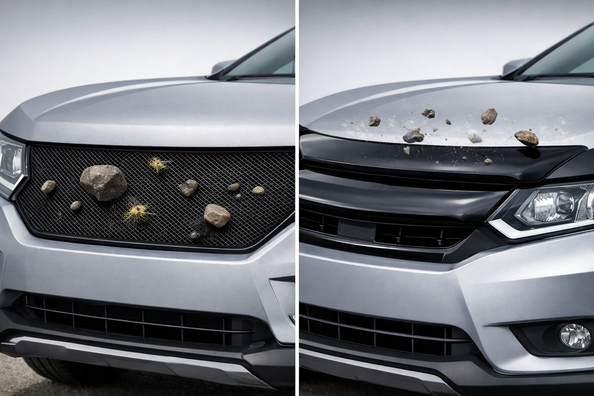

If the goal is to protect the radiator, condenser, or intercooler specifically from stones, gravel, and road debris, a grille mesh is more often the better choice. It works as a physical barrier in front of the cooling pack. A hood deflector solves a different task: it redirects airflow higher over the hood, reduces insects and some fine dirt, but it does not replace protection in front of the radiator.
So the choice here is not about design, but about what exactly you want to preserve: the cooling components at the front of the car, or a cleaner hood and lower part of the windshield. For highways, gravel, long trips, and cars with large open air intakes, a mesh usually makes more sense. For urban driving, where insects and dirt on the hood edge are annoying, a deflector may be enough—but it doesn’t guarantee protection from chips.
Mesh and deflector are not direct equivalents. The mesh sits in the debris impact zone before anything reaches the delicate radiator or condenser fins. The deflector changes the direction of airflow over the front edge of the hood, so its benefit is more noticeable against insects and some fine airborne dirt, not against stones flying into the grille.
Because of this, the answer to “what’s better” depends on the scenario. If your car has an expensive cooling pack, you often drive on the highway, or you tow, the risk of damaging the fins is more real than the inconvenience of washing off bugs. If the car is mostly used in the city and the front end doesn’t have large open openings, a deflector can be a simpler, more straightforward solution.
| Option | Strengths | Weaknesses | Who it’s for |
|---|---|---|---|
| Grille mesh | Better at catching stones, gravel, leaves, and debris before contact with the radiator; especially useful on the highway and on cars with large air intakes | Requires accurate selection and proper installation; can reduce airflow if the cell size is too small or the mesh is clogged with dirt | Those who often drive on highways, rough roads, in heat, with high thermal load |
| Hood deflector | Easier installation; can reduce the number of insects and small debris on the hood and the lower part of the windshield | Doesn’t provide reliable radiator protection; the effect against stones is partial; sometimes noise or vibration appears | Those who want a simple solution for city and highway driving without interfering with the car’s front end |
DD Tuning expert comment: the most common mistake is to buy any universal mesh “so it’s finer” and mount it almost flush to the radiator. As a result, you don’t get protection—you get extra airflow resistance and difficult access for maintenance. With deflectors, the opposite extreme happens: people expect it to prevent chips the same way as a physical barrier in the grille, even though these are different tasks.
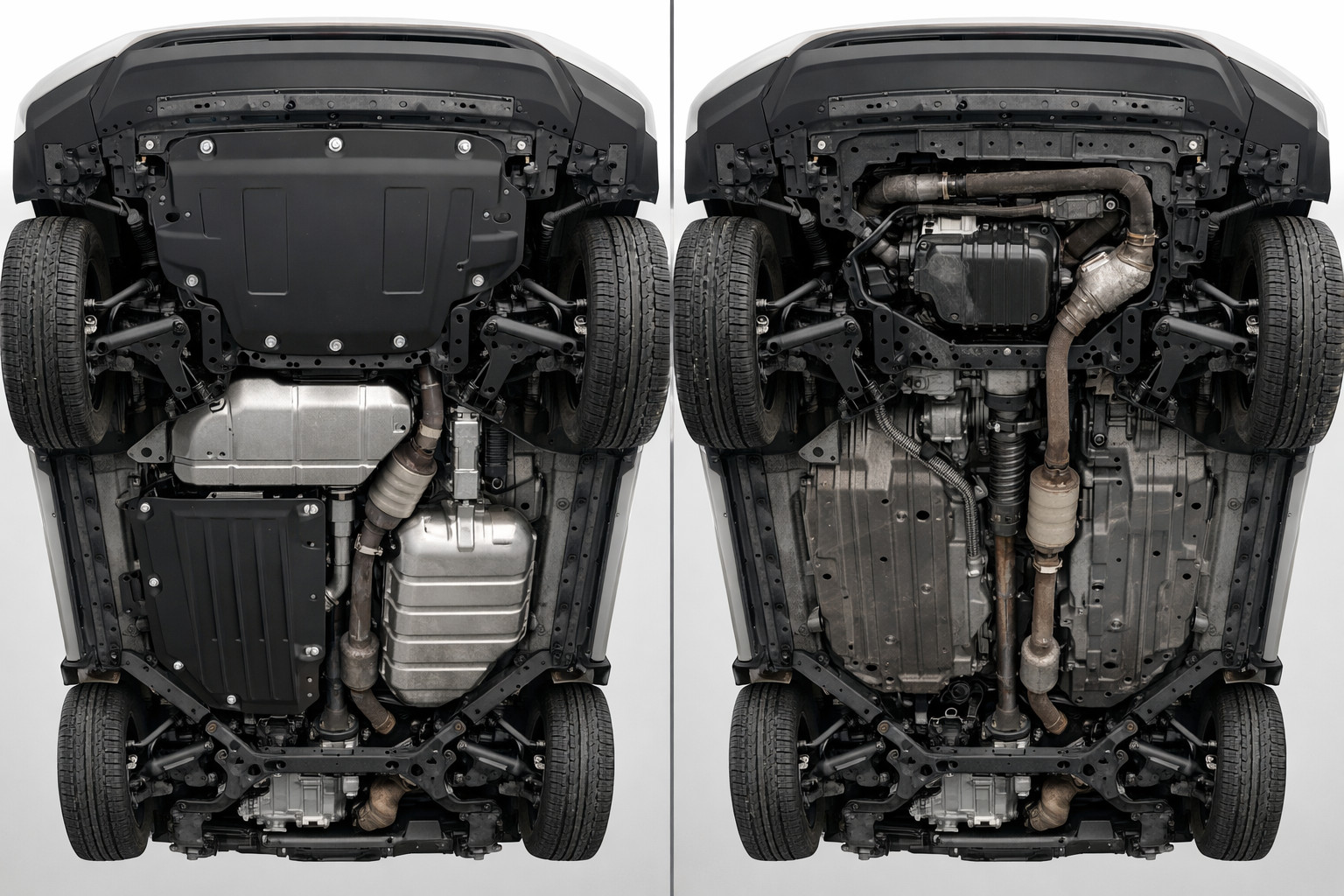
The main advantage of a mesh is that it sits exactly where the problem actually occurs. A small stone, stud, piece of asphalt, or leaf hits the front of the car first—and if the factory grille has large openings, all of it keeps flying straight into the fins. That’s why a mesh works better against damage to the cooling pack.
But there’s a condition: it must be chosen for the specific car and not be too dense. On cars with a turbo engine, towing, spirited driving, or frequent hot weather, cooling headroom matters. If you install a fine mesh, place it close to the radiator, and then don’t wash it, the “protection” gradually turns into an airflow restriction.
Another point is installation. On modern cars, the front end often has sensors, cameras, radars, and active shutters. Because of this, a universal mesh often leaves gaps, conflicts with bumper geometry, or starts to vibrate. This is where the difference between “just a sheet of mesh” and a properly thought-out solution is the biggest.
The deflector’s strong point is simplicity. If it’s made for the model, it’s usually installed without drilling, and the owner quickly gets a change in airflow over the hood edge. In real use, that can mean fewer insects on the hood and the lower glass area.
But against stones, a deflector is less convincing. A high profile redirects the flow more actively; a low profile affects the look less and is often quieter, but in any case it isn’t a direct screen in front of the radiator. So you shouldn’t expect the same effect from a deflector as from a mesh.
The deflector is also sensitive to mounting quality and hood shape. On some cars it works quietly; on others, at speed it can add noise or slight vibration. If what you need is protection for the front components, the deflector should be seen as an additional accessory, not a replacement for the mesh.
For highways, gravel sections, long trips, and cars with large lower openings, the logic is simple: the risk to the radiator is higher, so the mesh gets priority. This is especially relevant where even minor fin damage can end in an expensive repair.
For city driving, the picture is different. If the main request is fewer insects on the front edge of the hood, easy installation, and minimal intervention, a deflector can cover the need. But if the car often goes on the highway, even in an urban cycle you shouldn’t overestimate its capabilities against gravel.
On hot-running engines, when towing, or in heat, a mesh also remains useful—but only if the cell size is correct and it’s maintained regularly. Here you can’t install the densest option on the “the finer, the better” principle.
| Scenario | What’s better to choose | Why |
|---|---|---|
| Frequent highway trips | Grille mesh | Better protects the radiator and condenser from gravel and debris at speed |
| City, short routes, main issue is insects | Hood deflector | Easier installation and more noticeable benefit specifically on the hood and lower part of the windshield |
| Gravel roads or poor surface | Grille mesh | A physical barrier in front of the cooling pack is more important here than changing airflow over the hood |
| Turbo engine, towing, heat | Mesh, but without an overly fine cell size | Protection is needed, but you can’t sacrifice cooling due to incorrect selection |
| Need quick installation without disassembling the front end | Hood deflector | Usually installs more easily and doesn’t require the same level of intervention as precise mesh fitment |
A more expensive solution is justified when a mistake costs more than the accessory: an expensive radiator pack, a complex front end with sensors, frequent highway driving, towing, or high thermal load. In such cases, it makes sense to look not at the cheapest universal option, but at a stiffer base and neat installation—for example, in the aluminum meshes category.
For a deflector, paying more makes sense not for “prettier plastic,” but for precise fitment, the correct profile, and proper fasteners. If you’re considering this type of accessory, it’s logical to start with the hood deflectors section, and before buying, separately confirm whether you need a protruding or low profile—this is well explained in the material about a high or low deflector.
From a customer’s experience: a crossover driver was choosing a deflector because after highway runs he constantly had to wash bugs off the hood. After discussing the scenario, it turned out the main issue wasn’t dirt, but an open lower air intake and frequent drives through roadwork zones. In the end, he installed a grille mesh rather than a deflector, and was satisfied specifically because he stopped worrying about the condenser fins after long trips.
In short: against stones and road debris, the better answer is usually a grille mesh rather than a hood deflector. A deflector makes sense where insects, dirt on the hood edge, and easy installation matter more, but it doesn’t provide the same level of protection for the front-end components. The final choice should be made based on three things: where you drive, what thermal load the car has, and how precisely the accessory can be installed without fitment compromises. This material is based on real selection experience, hands-on practice, and real usage scenarios—not on abstract promises.
| ✔ | A grille mesh provides better protection for the radiator, condenser, or intercooler from stones, gravel, and road debris, as it works as a physical barrier in front of the cooling package. |
| ✔ | For highway driving, gravel roads, and long trips, a mesh looks more practical, especially if the car has large open air intakes or a high thermal load. |
| ✔ | A hood deflector is simpler to install if it is vehicle-specific, and it can reduce the amount of insects and fine dirt on the hood and the lower part of the windshield. |
| ✔ | Mesh offers more precise protection where there is a risk of damaging the radiator fins, so it is worth choosing for cars with an expensive cooling package. |
| ✔ | A deflector may be enough for city driving if the main problem is not stones, but insects and dirt on the front edge of the hood. |
| ✘ | The mesh needs to be matched precisely to a specific car model, and mistakes with the shape, distance to the radiator, or the presence of sensors and cameras make installation more difficult. |
| ✘ | If the mesh is too fine or clogged with dirt, it can reduce airflow and become an obstacle to cooling, especially in hot weather or under load. |
| ✘ | A hood deflector is not reliable protection for the radiator and does not replace a physical barrier in front of the car’s front end, so it does not guarantee protection from chips. |
| ✘ | Both the mesh and the deflector can create additional problems if they are poorly installed: the mesh can rattle, while the deflector can cause aerodynamic noise or vibration. |
Shipping to EU
Wholesale and retail
Own warehouse
Опис продукту
Подарунки не надаються при оформленні покупки у кредит під 0,01% або при покупці частинами.