26.07.2026
468
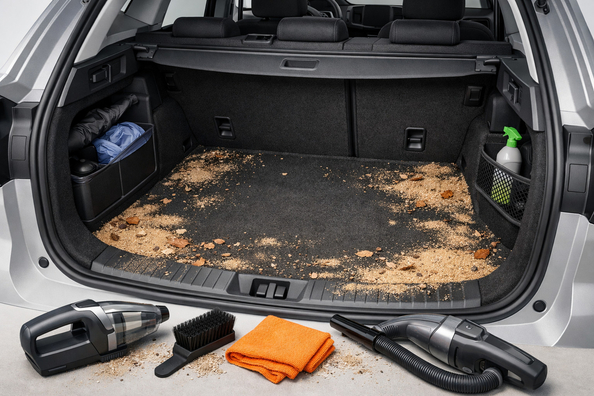
If you clean out the trunk and after a few trips there’s sand and fine dirt in there again, the problem is almost never the mat itself. Either dust gets in through the tailgate area, or it has built up inside the tailgate and drains and keeps falling down, or it’s being carried in by the items you haul every day.
The right sequence here is: first find the path the dirt is taking, then restore the seal or clean the problem area, and only after that protect the trunk with something that holds the sand on itself rather than on the factory carpeting.
On dusty roads, the rear of the car acts like a zone where fine dirt settles. If the tailgate seal is compressed less in one spot, the latch pulls the tailgate unevenly, or there’s a micro-gap in a seam, dust gradually makes its way inside. This is most noticeable on vehicles with a large tailgate and with daily driving on dry, dusty asphalt, dirt roads, or gravel roads.
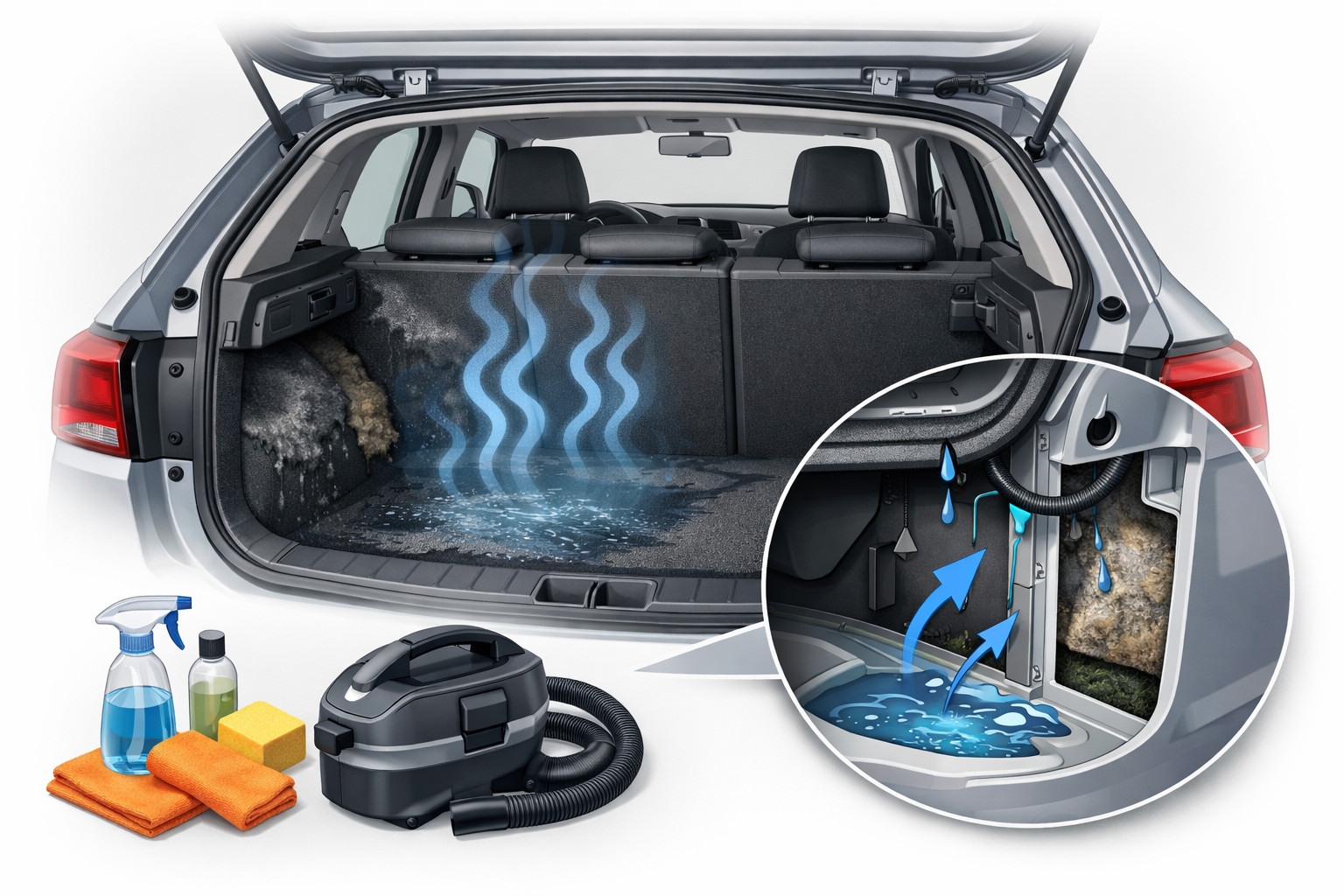
There’s a second common scenario: the trunk seems sealed, but dust has accumulated in the tailgate cavities, down by the drains, or near the taillights. When you open or close it, it spills onto the floor, so it looks like the dirt is appearing on its own.
Start checking only with a clean, dry trunk. Before a test drive, close all windows, and turn the climate system off or switch it to recirculation — it’s easier to rule out unrelated airflow.
DD Tuning expert comment: Most often, owners immediately install a new liner and then wonder why sand still shows up along the edges. A liner protects the floor, but it doesn’t eliminate the path dust takes through the tailgate or seam. The second mistake is heavily treating the seal with a care product without checking latch compression and the condition of the drains.
| Symptom | Likely cause | What to do |
|---|---|---|
| Dust stripe along the lower edge of the trunk opening | Weak or uneven seal compression | Check compression around the entire perimeter, adjust the latch or hinges, replace the seal if needed |
| Dirt appears after opening the tailgate | Sand in the tailgate cavities, clogged drains | Clean the drains, blow out and rinse the cavities with low pressure |
| Localized sand near one corner or a taillight | Micro-hole, seam defect, leak near a mounting point | Find the exact point and seal it locally; don’t smear the entire tailgate continuously |
| Sand evenly in the center of the floor with no perimeter traces | Dirt is brought in by items, shoes, or tools | Install a tight-fitting liner, separate dirty items, shake them off before loading |
| Water or wet streaks along with dust | Seam, seal, taillight area, or tailgate misalignment | Check body seams and tailgate fitment; don’t stop at simple cleaning |
What works best isn’t cleaning — it’s the sequence. First you find where the dust is getting in, then restore proper tailgate contact or remove dirt from the cavities, and only then install protection for everyday use.
If weak compression is visible, adjusting the latch, hinges, or replacing a worn seal helps. If dust enters locally near a seam or taillight, only targeted repair of that specific spot works. If dirt spills out after opening, you don’t need to wash the floor — you need to clean the tailgate cavities and drains.
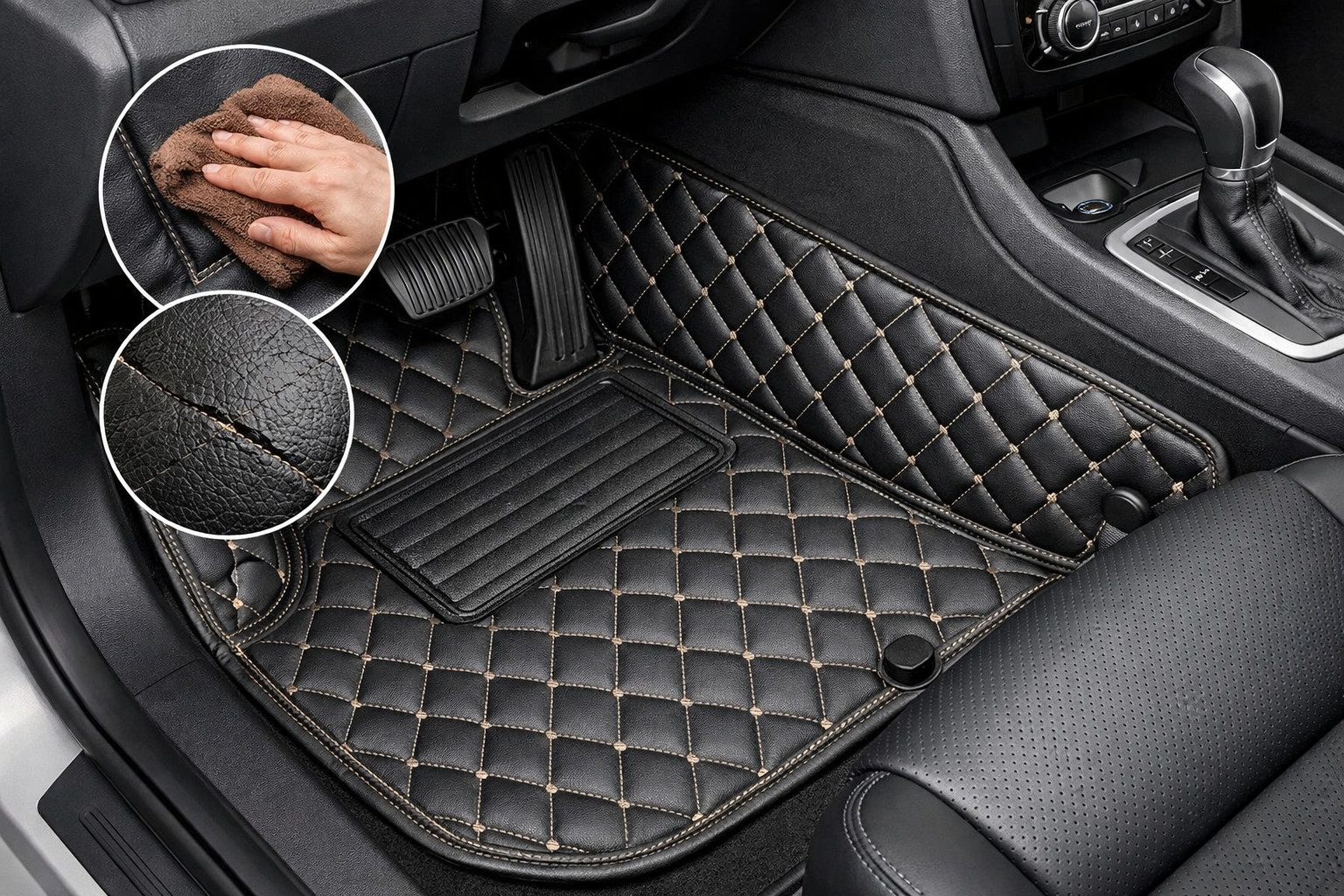
For daily floor protection, the best effect comes from a tight liner with a high lip: it doesn’t cure a leak, but it keeps sand, water, and small debris in one zone. If the liner arrives rolled up in cold weather, give it a day in a warm room and a few days to settle into its final shape; if an edge gap of about a centimeter or more remains, protection will work worse.
If the dust path has already been found or you simply don’t want to clean the trunk every week, the most useful accessory is a rubber trunk mat with a high lip. It collects sand on itself and prevents it from embedding into the factory carpeting.
When dirt isn’t only on the floor but also rubs against the side panels or the sill during loading, trunk plastic makes sense. This isn’t about sealing — it’s about faster cleaning and less wear from everyday items.
If the seal has lost its shape, is cracked, or the paper test shows weak contact, then it’s logical to look at seals. But if dust is spilling from inside the tailgate or the issue is in a seam, replacing rubber alone won’t pay off.
| Solution | When it works | When it’s not worth spending money |
|---|---|---|
| Adjusting the latch and hinges | There’s uneven seal compression, the tailgate closes misaligned | When the issue is clogged drains or a micro-hole in a seam |
| Replacing the seal | The rubber is hard, torn, sagged, or can’t maintain compression | When the old seal is intact but dust comes through a seam or from tailgate cavities |
| Cleaning drains and tailgate cavities | Dirt spills out after opening; there’s buildup at the bottom of the tailgate | When you already see a clear dust entry track around the opening perimeter |
| Localized sealing of a seam or hole | There’s a specific point where dust or water is being sucked in | When the leak point hasn’t been found and sealer is applied at random |
| High-lip liner | You need to protect the floor from daily sand, moisture, groceries, tools | When you expect it to eliminate a tailgate sealing issue |
| Additional protection of the trunk area with plastic | You often carry dirty items, crates, a stroller, garden tools | When the main problem is dust entering through the tailgate |
From a customer’s experience: At first, the person was only looking for a new mat because fine sand kept collecting in the trunk after trips around the city and to a country house. During inspection, it turned out the main dust track ran along the lower right corner of the tailgate, and dirt had already accumulated inside the tailgate itself. After cleaning the drains, restoring compression, and installing a tight liner, the trunk stopped filling with sand, and cleaning is reduced to quickly shaking out the liner itself.
Constant sand in the trunk isn’t a minor annoyance — it’s a symptom of a specific cause. In most cases, a three-step approach works: find the dust entry path, restore proper contact or clean the tailgate and drains, and then install protection that actually holds dirt. If there’s moisture along with the dust or a localized issue near a seam or taillight, don’t waste money on random fixes. This material is based on real selection experience, hands-on practice, and real usage scenarios — not generic advice without diagnostics.
| ✔ | Before changing anything, you can identify the source of the dirt: the article provides a simple check procedure for the seal, latch, drains, and seams. This helps avoid spending money on random fixes. |
| ✔ | Adjusting the latch, hinges, or replacing a worn seal really works if the issue is uneven tailgate pressure. In other words, there are practical steps for a mechanical cause, not just cleaning up the consequences. |
| ✔ | Cleaning the drains and tailgate cavities solves the situation when sand spills out after opening the trunk. This is especially useful in cases where dirt builds up inside rather than coming from the floor. |
| ✔ | A dense liner with a high lip is well suited for daily use because it keeps sand, water, and small debris in one area. It is convenient to simply shake it out instead of doing a full trunk cleanup. |
| ✔ | Local sealing of a seam or the area near the taillight makes sense when there is a specific leak point. This is a targeted solution, not an attempt to smear the entire body without diagnosis. |
| ✘ | The factory mat by itself does not solve the problem: you can shake it out, but after a few drives the sand appears again. If the source is not removed, cleaning will only be temporary. |
| ✘ | Generous lubrication of the seal does not eliminate a misaligned cover or weak clamping. Because of this, the product may remove only squeaking or sticking, but not the actual cause of the dust. |
| ✘ | Coating the entire cover with sealant looks unnecessary and does not guarantee a result. The article emphasizes that only the found micro-holes or seam defects should be sealed. |
| ✘ | The liner does not fix trunk leaks; it only protects the floor. If you expect it to eliminate dust entering through the cover, the result will be disappointing. |
Shipping to EU
Wholesale and retail
Own warehouse
Опис продукту
Подарунки не надаються при оформленні покупки у кредит під 0,01% або при покупці частинами.