03.07.2026
202
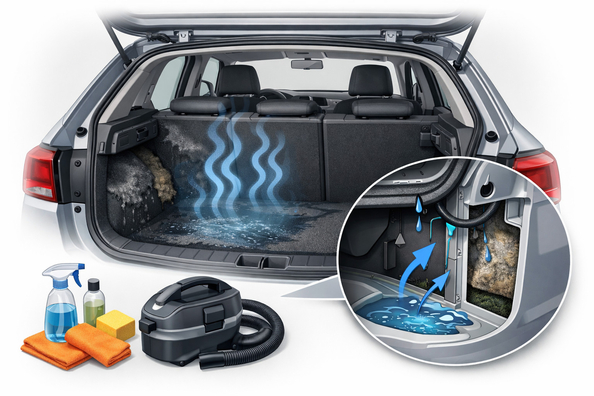
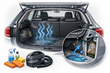
After rain, a musty smell in the cabin almost always means not “poor ventilation,” but water that has entered the rear of the body and is sitting in the carpet, foam, or trunk sound insulation. Until the moisture source is found, air fresheners, cleaning foam, and quick drying only provide a short-term effect.
Most often, water gets in through the trunk lid seal, rear lights, seams around the rear window, sunroof drains, body plugs, or rear ventilation. If the smell comes specifically from the air vents on startup after the car has been parked, the cause may no longer be in the trunk, but in the ventilation and air-conditioning system.
The smell doesn’t come from the droplets themselves, but from moisture sitting for a long time in porous materials. The top of the carpet may seem dry, while underneath—in the spare-wheel well, behind side trim, or in the sound insulation—water has already accumulated. When the cabin warms up, the airflow pulls this odor forward.
The problem is made worse by the fact that the rear compartment dries unevenly. The plastic on top is dry, but wet foam remains underneath. If such materials aren’t dried quickly, the risk of mold rises sharply, and even after fixing the leak the smell can linger for some time.
DD Tuning expert comment: The most common mistake is changing the cabin filter without opening up the trunk from the inside. The second typical mistake is drying only the top of the carpet, while most of the water is in the foam underneath or in the side pocket by the light. If the smell returns after rain, you often won’t find the cause without removing trim.
| Symptom | Likely cause | What to do |
|---|---|---|
| Wet spare-wheel well or water under the trunk floor | Trunk lid seal, body plugs, rear ventilation | Remove the floor, pinpoint the runoff, do a water test, repair the seal or the water entry point |
| Moisture in side pockets near the lights | Rear light gaskets, misalignment or incorrect installation of the light | Remove the light, check the gasket and the mating surface, then repeat the water test after reassembly |
| Wet rear pillars, headliner edge, or marks above trunk level | Rear sunroof drains or seams near the rear window | Check that water exits the drains freely, inspect hose routing and upper seams |
| Smell comes from the vents right after startup, trunk is dry | Cabin filter, evaporator drain, dirty evaporator | Diagnose the A/C system, check the drain and clean the evaporator |
| Fogging inside the light without obvious water in the trunk | Normal condensation or the start of a sealing issue | Let the light dry in dry weather; if moisture doesn’t go away or the well is wet, check the sealing |
What works is a sequence, not a single “magic” product. First locate the leak, then repair the specific water entry point, then dry everything completely—and only then deal with the odor.
In practice this means: fix the leak at the seal, light, seam, or drain; remove wet trunk components; dry the carpet, foam, and sound insulation. If the material has been wet for a long time and won’t dry properly, it’s better to replace it—otherwise the smell will return.
When the smell comes from the vents, a different set of steps helps: check the cabin filter, the evaporator drain, and clean the evaporator itself. This matters because a trunk leak and an odor from the A/C system are two different faults that are often confused.
After the repair, it’s worth repeating the water test. If everything is dry but a faint smell remains, the reason usually isn’t a new leak, but that hidden porous materials haven’t fully dried yet.
Air fresheners, fragrances, and strong deodorizers don’t remove water. They only mask the smell for a few days, and then the dampness returns.
“Drying from the top” is also ineffective—when only the mat or the visible part of the floor is dried. If wet foam remains underneath, the cabin will smell musty again after the first warm-up.
Replacing only the cabin filter doesn’t work either if water is actually entering the rear of the body. Likewise, it’s a questionable idea to just tighten everything without diagnosis: in the light area, overtightening sometimes doesn’t fix the problem but deforms the gasket.
Accessories make sense after the leak is fixed or in parallel with the repair, but not instead of it. Their job is to prevent water from wet items from soaking back into the carpet and to simplify monitoring the trunk’s condition.
As for replacing parts, it’s straightforward: the trunk lid seal is replaced when it has hardened, cracked, or no longer holds its shape; light gaskets—when they’re flattened, torn, or the leak remains after reinstalling; wet sound insulation—when it won’t dry out and keeps smelling.
| Solution | When it works | When it’s not worth spending money |
|---|---|---|
| Replacing the trunk lid seal | There’s a clear water trace along the opening, the rubber is hard or damaged | When water enters through the light, glass seam, or ventilation |
| Repairing or replacing rear light gaskets | Wet pockets near the lights, runoff starts from this area | When the trunk is dry and the smell comes only from the vents |
| Cleaning and restoring sunroof drains | Wet rear pillars, headliner edge, or water comes from top to bottom | On cars without a sunroof or when the issue is clearly localized low near the light |
| Drying or replacing foam, carpet, sound insulation | The leak is already fixed, but the smell won’t go away due to saturated materials | While the water source hasn’t been eliminated yet |
| Rubber trunk mat | After the repair, to avoid soaking the carpet and to make cleanliness easier to control | As a way to “cure” a hidden leak under trim |
| Evaporator cleaning and cabin filter replacement | The smell appears from the vents on startup and the trunk is dry | When water has already been found in the rear compartment |
From a customer’s experience: After two heavy rains, the owner first suspected the A/C, but after removing the trunk floor he found water in the spare-wheel well and wet foam by the left rear light. After repairing the light seal and fully drying, the smell didn’t disappear the same day—it went away once the hidden layer under the carpet dried out. To keep an eye on the trunk condition, he kept a rubber mat so he could immediately see if water appeared again.
If after rain the cabin smells damp from the trunk, you shouldn’t be looking for an “odor remover,” but for the water entry point. There’s one working approach: localize the area, fix the leak, dry or replace saturated materials, and only then deal with residual odor and choose accessories. This material is based on real selection experience, hands-on practice, and real-world use cases, so the main advice is simple: cause first, cosmetics second.
| ✔ | The article explains the damp smell through a specific cause — moisture gets trapped in the foam, carpeting, and trunk sound insulation, rather than just poor ventilation. This helps avoid wasting time on ineffective odor masking. |
| ✔ | The article clearly lists the typical entry points for water: the tailgate seal, rear lights, rear window seams, sunroof drains, and ventilation flaps. This makes the initial inspection easier without randomly dismantling the entire cabin. |
| ✔ | It provides a practical diagnostic algorithm: remove the floor and trim panels, look for hidden moisture, perform a water test by zones, and avoid using high pressure. This reduces the risk of misidentifying the leak source or damaging seals. |
| ✔ | The article distinguishes between two different issues — a trunk leak and a smell from the ventilation/air conditioning system. This is useful because it indicates when to inspect the trunk and when to check the cabin filter, evaporator drain, and the evaporator itself. |
| ✔ | It honestly lists what really works after fixing the leak: complete drying, replacing wet materials, and repeating the water test. This makes it possible not to limit yourself to surface cleaning if moisture has already soaked into porous elements. |
| ✘ | Without removing the floor and part of the trim, the cause is often hard to find, because the main water may be under the carpeting or in a side compartment. In other words, a simple visual inspection is usually not enough. |
| ✘ | Drying only the top layer gives weak results if the foam or sound insulation underneath is still wet. Because of this, the smell can return after the first time the cabin heats up. |
| ✘ | Air fresheners, deodorizers, and other odor-removal products do not solve the problem if water keeps entering the body. They only temporarily cover up the damp smell, after which the odor appears again. |
| ✘ | Even after the leak is repaired, the smell may persist for some time until the hidden porous materials dry out. This means you should not expect a quick effect on the same day. |
Shipping to EU
Wholesale and retail
Own warehouse
Опис продукту
Подарунки не надаються при оформленні покупки у кредит під 0,01% або при покупці частинами.