
19.09.2026
93
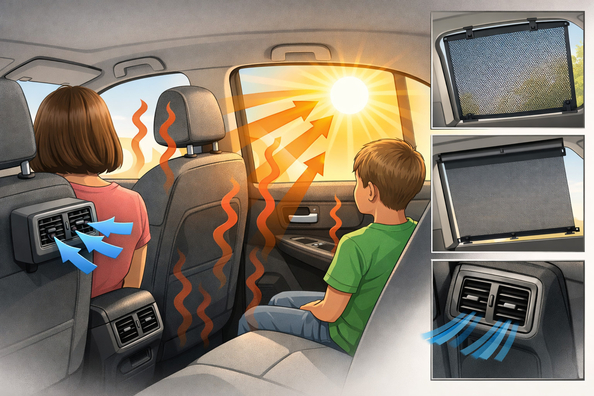
When rear passengers are baking in the sun, the problem is almost never just a weak A/C. Usually two things are happening at once: the cabin is gaining heat through the glass and roof, while cool air reaches the second row late or in too small a volume.
That’s why a single dark shade rarely changes the situation dramatically. The best results come from a combination: reduce solar load through the glass, quickly vent overheated air after parking, and check whether the rear zone is actually getting proper airflow.
Most of the sun’s heat enters the cabin through the glass, and in a parked car the temperature can easily be 20–30 °C higher than outside. Rear passengers feel it the most: they sit next to large side windows, the rear window, sometimes a panoramic roof, and they get fewer direct streams of cool air than the front.
If the car is parked with the rear or side facing the sun, the rear seats, door panels, and seat belts heat up faster. Even when the front is already tolerable, the person in the back feels not only the air temperature, but also radiant heat from hot surfaces and glass.
DD Tuning expert comment: The most common mistake is trying to solve overheating with only a dark shade when the rear row barely gets any airflow. If it’s cold in the front and hot in the back, first check airflow, cabin filter condition, and rear blend-door operation—then pick accessories. The second typical mistake is judging a shade’s effect without using a parking sunshade: in a heat-soaked cabin it simply can’t carry the entire load on its own.
| Symptom | Likely cause | What to do |
|---|---|---|
| After parking, the rear glass, seats, and belts are very hot | Solar heat enters through the glass and roof | Use a reflective sunshade while parked, close the panoramic shade, consider heat-reflective glass protection or dense model-specific shades |
| The front is already cool, but after 10 minutes it’s still stuffy in the back | Insufficient flow of cool air to the rear | Check rear vents, airflow mode, cabin filter, and distribution flaps/doors |
| Worst at noon and on the sunny side of the car | Direct sun hitting the rear side windows | Cover the area with shades or film with a heat-reflective effect, change parking orientation |
| After brief ventilation at the start, it becomes noticeably easier | Overheated air accumulates in the cabin after parking | Vent the heat out first, then turn on recirculation for stable cooling |
| Weak or slightly warm airflow from rear vents | The issue isn’t the sun—it’s the HVAC system | Don’t spend money only on shades; start with diagnosing the A/C and air ducts |
If rear passengers suffer most in direct sun, and it gets much better after moving into shade or in the evening, it makes sense to start with accessories. In this scenario, sun shades are appropriate, and before buying it helps to understand which shades truly work against the sun and which only darken the cabin.
If the car is often parked in the sun and you need to leave a small gap to release heat, window deflectors can help. But this is only a supporting tool: they don’t replace either glass protection or proper A/C performance.
Replacing components is needed when the problem doesn’t go away even without direct sun: weak airflow to the rear, different temperatures by zones, unusual noises from the flaps/doors, rapid fogging, or a dirty cabin filter. In that case it’s more sensible to invest not in another shade, but in a filter, A/C service, or repair of the airflow distribution components.
| Solution | When it works | When not to spend money |
|---|---|---|
| Heat-reflective protection for rear and side glass | When the main discomfort comes from direct sun and hot surfaces | When there’s almost no cool airflow to the rear |
| Model-specific shades for rear windows | When you need to quickly reduce direct sun for passengers without drastic changes | When you expect a complete fix for overheating after long parking |
| A reflective parking sunshade and short ventilation before driving | When the car sits in the sun for a long time and the cabin heat-soaks heavily | When the car overheats while driving due to a faulty HVAC system |
| Window deflectors for micro-venting | When you need to slightly crack windows while parked or dump heat faster | When you need primary protection from solar heat |
| Service for the A/C, filter, and flaps/doors | When front and rear have different airflow or temperature, or airflow is weak | When the issue happens only due to direct sun on rear passengers and the system blows normally |
From a customer’s experience: On a family crossover with a large rear window, they first tried cheap suction-cup mesh shades, but the kids in the second row still had their faces baking after parking at the mall. After installing denser shades, getting into the habit of airing out the cabin before driving, and replacing a clogged cabin filter, the rear row stopped being the hottest place in the car. The customer was satisfied not because they found one magic accessory, but because they eliminated two causes at once.
If the sun is baking rear passengers, first separate two stories: overheating through the glass and weak airflow to the rear zone. In the first case, heat-reflective protection, shades, and a parking sunshade help; in the second, diagnose the filter, flaps/doors, and the A/C itself. This material is based on real selection experience, hands-on practice, and real-world use cases, so the main advice is simple: don’t look for one magic item—remove the specific cause of overheating in your car.
| ✔ | It clearly explains how to tell overheating caused by the sun from problems with the climate control system. This helps avoid wasting money on shades if the real issue is weak airflow to the rear area. |
| ✔ | There are simple self-check tests: touch hot surfaces after parking, compare the effect in shade and in the sun, and assess the airflow from the rear vents. These steps let you quickly understand the source of the problem without a service visit. |
| ✔ | The article suggests not just one solution, but a combination: a parking screen, brief ventilation, heat-reflective glass protection, and checking the filter and flaps. This is more practical than relying only on dark tinting or a single shade. |
| ✔ | It clearly states when accessories are truly appropriate and when it is better to diagnose the air conditioner right away. This separation saves time and reduces the risk of buying something unnecessary. |
| ✘ | The article gives almost no specifics about choosing shades or heat-reflective materials: it does not explain which signs distinguish a better option from a worse one. Because of this, after reading it you still need to separately figure out compatibility and quality. |
| ✘ | The solutions depend heavily on the cause of overheating, but not all drivers will be able to distinguish weak airflow from the effects of direct sunlight on their own. If the diagnosis is wrong, you may choose the wrong method and get no result. |
| ✘ | Some tips work only while parked or before starting, and do not solve the problem during the trip itself. If the car already has weak airflow to the rear row, such measures will help only partially. |
Shipping to EU
Wholesale and retail
Own warehouse
Опис продукту
Подарунки не надаються при оформленні покупки у кредит під 0,01% або при покупці частинами.