05.09.2026
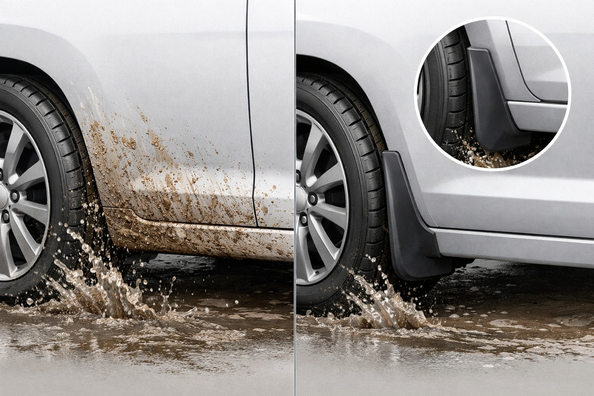
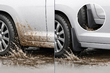
If the lower part of the doors keeps getting dirty even in the city, the cause is usually not the doors themselves, but how the front wheels throw water, salt, sand, and fine gravel onto the rocker panel and the front edge of the doors. Most often, the problem is solved not by just any mud flaps, but by a kit that matches the tire width, wheel offset, and arch shape.
There’s a second important point, too: sometimes mud flaps aren’t enough. If dirt also packs into the door opening, you need to look at the seals, drains, and how the airflow moves around the rocker. So the right approach here is simple: first find the source of the spray, then choose the solution.
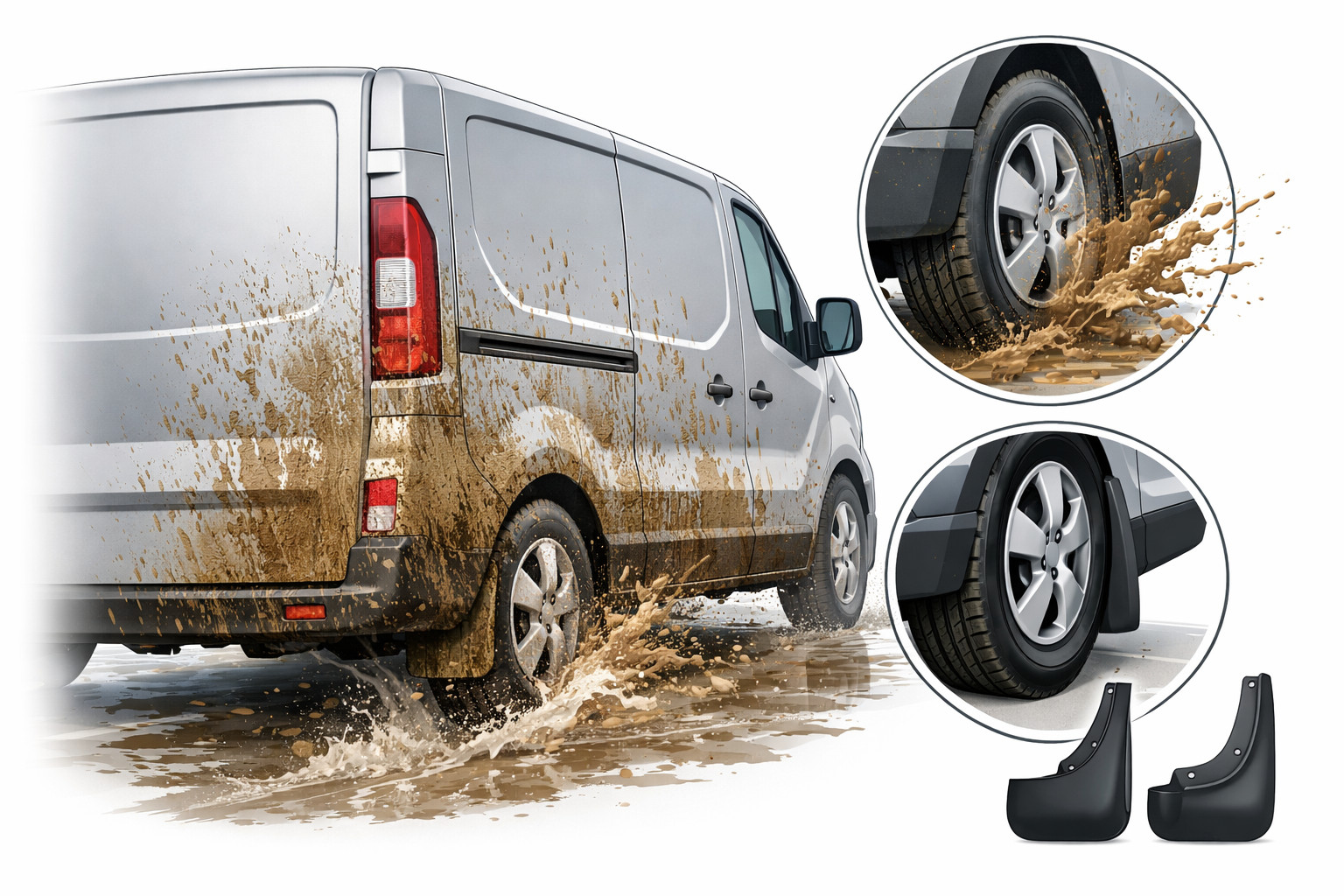
In the city, the lower part of the doors is most often dirtied by the spray trail from the front wheels. On wet asphalt it’s made of water and dust, in winter—of salty slush, and on broken inner yards it also includes abrasive grit. When the wheel sticks out slightly or the mud flap is too narrow, this stream travels along the rocker and settles exactly where you see the dark stripe.
The issue gets worse on cars with wider tires, changed wheel offset, side steps, rocker covers, or fender flares. In these setups, dirt flies not downward but to the side and a bit upward. If, after opening the door, you also see dirt on the inner lower edge, you should check not only the mud flaps but also the sealing.
Wash the lower body, drive 5–10 km on a wet city road, and look where the first trace appears. If dirt starts from the front edge of the door and stretches rearward along the rocker, the front wheel is almost certainly to blame. If it’s dirtiest inside after opening the door, check the seal and the drain holes.
Next, look at the car from the front or from above along the arch: if the tread clearly sticks out outward, a standard narrow mud flap is often already too small. Also assess ground clearance. If the lower edge of the future mud flap will be too close to the ground, it will catch on curbs, snow, and speed bumps, and the benefit will be smaller.
DD Tuning expert comment: the most common mistake is buying the first kit that matches the shape, without looking at tire width and wheel offset. The second typical mistake is installing only rear mud flaps when the front doors are getting dirty. If the wheel is already pushed outward, you should immediately look for a wider or longer option, otherwise the effect will be weak.
| Symptom | Likely cause | What to do |
|---|---|---|
| Dirty front edge of the door and top of the rocker | The front wheel throws a spray trail; there is no front mud flap or it’s too small | Start with a front set matched to the arch and tire width |
| After switching to wider tires, it got worse | The wheel sticks out beyond the factory protection | Look for a wider or longer mud flap; sometimes an offset mounting point is needed |
| In winter the doors get much dirtier than in rain | A short or stiff mud flap doesn’t hold back salty slush | Install a more flexible and slightly longer option without excessive lowering |
| Dirt is present not only outside but also in the lower door opening | Insufficient front protection, worn seal, or clogged drains | Clean the drains, check the seals, and if needed add a small front mud flap |
| The mud flap quickly rubs on snow or a curb | Too little distance to the ground | Reduce the length or change the mounting point; don’t install an extremely low kit |
| After installation there’s less dirt, but sand still chips the paint on the rocker | The stream is reduced, but abrasive is still in the rocker zone | After correctly selecting mud flaps, additionally protect the rocker with covers |
In the city, the best result is usually provided by a front set of mud flaps, not a rear one. It’s the front wheels that most often dirty the lower part of the doors. For a stock vehicle with factory wheels, it makes sense to start with a vehicle-specific kit for the factory mounting points.
If the tire is wider, the wheel is pushed outward, or side steps are installed, you need not just any mud flap but a wider and, if necessary, longer option. In cold climates, flexible material works better: it’s less affected by frost, doesn’t stiffen, and handles contact with snow more easily. Also pay attention to ground clearance: when the lower edge drops to roughly below 15 cm, the risk of snagging increases sharply.
If dirt and ice already accumulate near the inner lower edge of the door, mud flaps alone may not be enough. In that case, you should check the seals and drains at the same time, because some of the dirt gets there not only from the direct spray trail but also due to improper water drainage.
Such solutions either provide a weak effect or create new problems: rubbing, snow buildup, mounting vibration, and even paint scuffing if the part is installed crooked.
Accessories make sense when you already understand the cause. If the car is stock and the problem is on the outside of the rocker and doors, start with proper selection of mud flaps. If you want a factory-style fit in the stock locations without extra trimming, look at original mud flaps.
When the paintwork on the rocker is already dull from sand, after fixing the main cause you can add rocker covers. They don’t remove the dirt spray trail, but they reduce wear in the area that suffers the fastest.
Replacing seals or cleaning drains is justified when dirt clearly gets into the door opening. A universal kit is worth choosing only when there is no vehicle-specific solution for your car and you understand how to install it correctly.
| Solution | When it works | When it’s not worth spending money |
|---|---|---|
| Front vehicle-specific mud flaps | Stock wheels, stock arch, the outside lower part of the doors gets dirty | If the tire is already much wider or the wheel is pushed outward |
| Wider or longer mud flap | After changing wheels, wider tires, lifting the suspension | If due to low ground clearance it will constantly snag |
| Flexible material | Winter, uneven yards, lots of snow and salt | If the issue isn’t the material but insufficient width or the wrong mounting position |
| Rear mud flaps only | When you need to reduce dirt on the rear doors or bumper | When the main problem is the lower part of the front doors |
| Replacing seals and cleaning drains | Dirt packs into the door opening; there’s moisture inside the lower edge | If the dirt is only outside and the cause is clearly the wheel |
| Rocker covers | When you need to protect the rocker edge after removing the main spray trail | If you expect them to remove dirt from the doors by themselves |
From a customer’s experience: a person reached out after switching to wider winter tires, because the lower part of the front doors started getting packed with salty slush almost daily. After checking, it turned out the factory mud flap had become too narrow, so we chose a wider front set and also cleaned the drains separately. The dirt didn’t disappear completely, but it became noticeably less, and the inner lower edge of the doors stopped packing up so quickly.
If, in city driving, the lower part of the doors keeps getting dirty, in most cases you shouldn’t guess the accessory—you should check three things: where the dirt is coming from, whether the mud flap has enough width and length, and whether the wheel geometry has changed. For a stock car, a front vehicle-specific set usually works; for wider tires or changed offset—a wider or longer option; and if there’s dirt in the door opening, you’ll also need to look at the seals and drains.
It’s also important to understand the limits of the effect: even properly selected mud flaps won’t eliminate the wet spray trail 100%, but they can significantly reduce dirt and abrasive hitting the doors and rockers. This material is based on real selection experience, hands-on practice, and real use scenarios—not on the theory that “any mud flap will fit.”
Shipping to EU
Wholesale and retail
Own warehouse
Опис продукту
Подарунки не надаються при оформленні покупки у кредит під 0,01% або при покупці частинами.