02.05.2026
352
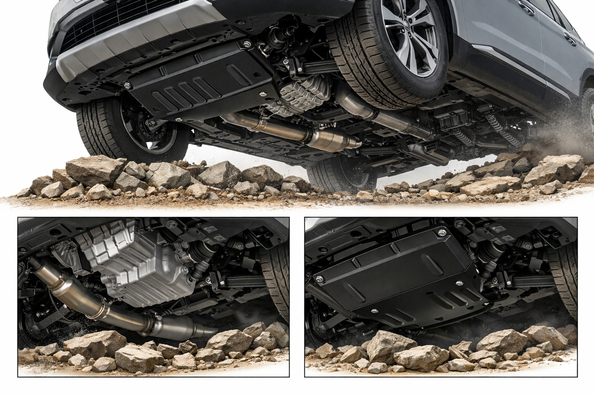
If you regularly drive over potholes, ruts, packed winter tracks, or rocky dirt roads, a gearbox guard is usually needed. The transmission, its mounts, and nearby underbody components don’t like pinpoint impacts: at first it may be just a scratch or a dent, and then rattles, vibration, leaks, or water-related issues can appear.
But not every metal sheet under the car is actually useful. Only a properly selected guard for your specific vehicle design works: with proper mounting points, cooling clearances, service access, and without a tendency to trap dirt in “pockets.”
On a bad road, an underbody hit often lands not only in the engine area, but farther back—into the gearbox zone. The risk increases when the car is loaded, has low real clearance under the central part of the body, or takes an obstacle too fast. On rough dirt roads, vehicles with more ground clearance usually scrape less, but there’s no universal threshold: rut depth, approach angle, wheelbase length, and driving style also matter.
A separate issue is that after an impact, damage isn’t always visible right away. Mud and snow cover fresh scratches, and water can worsen automatic transmission operation after the trip—when the owner thinks everything passed without consequences.
That’s why the answer isn’t a simple “yes” or “no.” If underbody hits are regular for you, you need protection. If it’s a one-off trip on a broken road once a season, sometimes a careful inspection and adjusting your driving is enough.
DD Tuning expert comment: The most common mistake is looking only at sheet thickness and not at the shape, mounting points, and ease of cleaning. The second typical mistake is installing a guard but not checking whether it’s packing dirt or whether the bolts have loosened after a few harsh trips. If your route is the same all the time, impact marks quickly show which component should be protected first.
| Symptom | Likely cause | What to do |
|---|---|---|
| Fresh scratches or dents under the gearbox | Regular impacts with stones, ruts, or ice | Assess how often the contacts repeat and install a vehicle-specific gearbox guard if it’s not a one-time case |
| Metallic ringing after driving through mud or snow | Mud packed between the guard, the gearbox, or the exhaust | Clean the underside, check clearances and fasteners |
| Worse shifting after water exposure | Water getting onto gearbox components or related parts | Don’t limit it to a guard—do transmission diagnostics and an underbody inspection |
| Constant scraping on the same obstacles | Not enough clearance or the car takes the obstacle too fast | Reduce speed; otherwise the guard will only take the hit without solving the root cause |
| A guard is already installed, but it rattles or vibrates | Bent edges, loose mounts, or a poor design | Reinstall, straighten, or replace the panel with a stiffer, better-fitted one |
If the car often scrapes the central part of the underbody, the guard alone is only half the solution. The other half is a realistic assessment of clearance, load, and route.
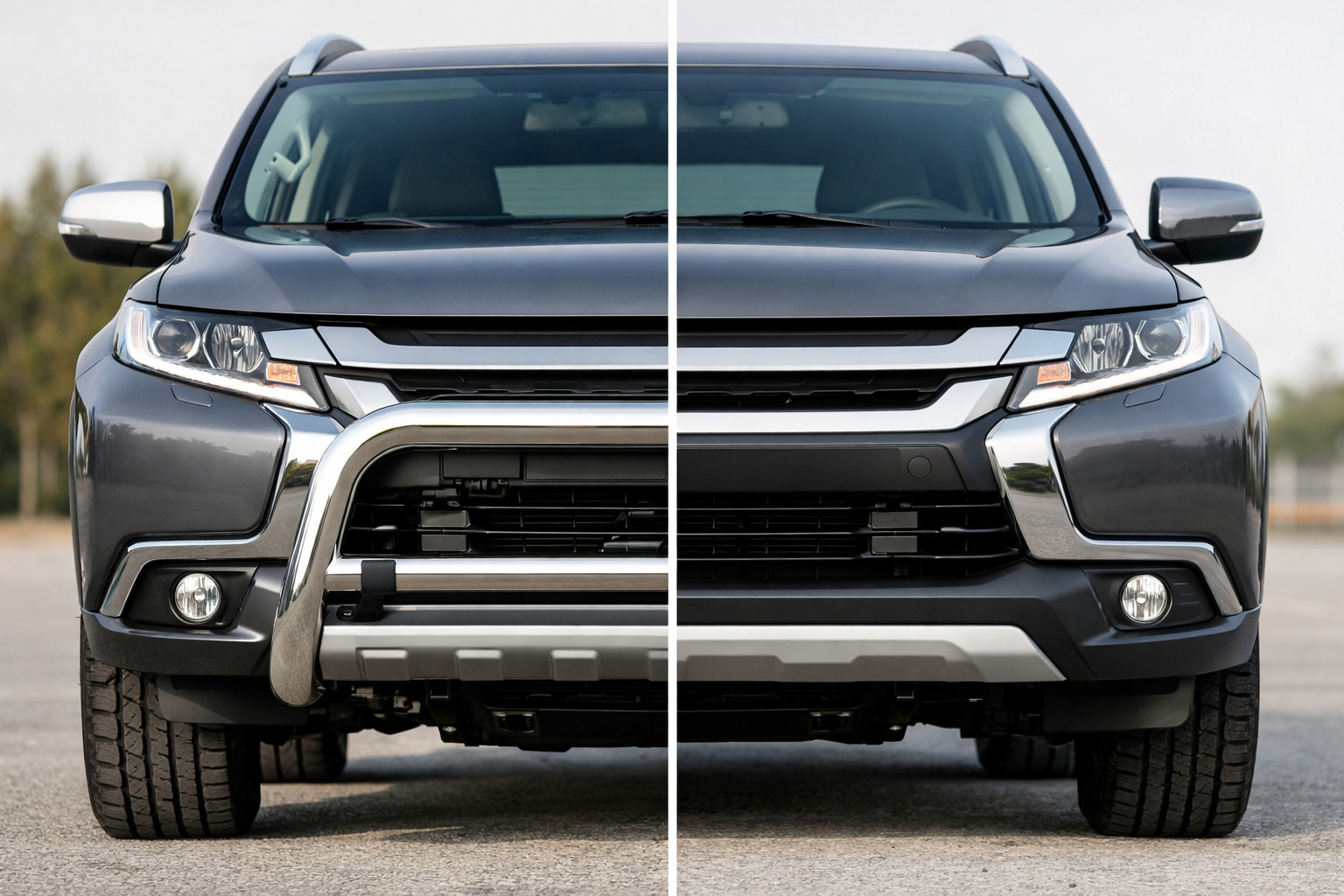
An equally questionable solution is removing the factory lower panel and not replacing it with anything. If the element served an aerodynamic or protective function, an empty space doesn’t solve the problem.
If impact marks repeat, the factory lower panel is already bent, or you constantly drive broken routes, it makes sense to use vehicle-specific solutions for the component—not an abstract “underbody reinforcement.” In practice, people usually look at three things:
Replacing a thin factory element with a sturdier one is justified when the standard panel no longer holds up to your conditions. But if underbody contacts are rare and light, the cost of a heavy комплект may not pay off.
| Solution | When it works | When it’s not worth spending money |
|---|---|---|
| Vehicle-specific gearbox protection | When there are repeated hits specifically in the transmission area | When the car hardly ever leaves normal asphalt and there are no contact marks |
| Front underbody protection kit | When several components suffer at once: oil pan, gearbox, subframe | When the issue is only in one local spot and the rest of the underbody doesn’t scrape |
| Replacing a thin factory panel with an impact shield | When the factory element bends, cracks, or won’t hold its shape | When the factory protection is enough and there’s no damage even after your route |
| Changing driving style and controlling load | Works almost always, especially in ruts and potholes | Don’t expect buying protection to let you keep taking obstacles mindlessly |
| Working on clearance and tires | When the underbody scrapes constantly, even without hard impacts | When the problem is occasional and solved by simply driving more carefully |
From a customer’s experience: someone was looking for protection after several winter hits on rutted tracks on the road to their country house. During inspection it turned out the issue wasn’t only the transmission: the factory lower panel had already bent and started collecting snow and mud. In the end, they chose a stiffer vehicle-specific guard and adopted the rule of inspecting the underside after every trip on a bad road—the extra noise disappeared, and there were noticeably fewer new contact marks.
If you often drive on bad roads, gearbox protection usually makes sense. But it works only as part of the right approach: reasonable speed, regular underbody inspection, cleaning off dirt, and choosing the exact design that fits your vehicle—not just a “thicker sheet.” This material is based on real selection experience, practice, and real-world use cases—not on the myth that one plate solves all problems under a car.
| ✔ | Needed on roads with potholes, ruts, rocky dirt tracks, and winter-packed snow: in such conditions, the gearbox and nearby components really take point impacts. |
| ✔ | Helps reduce the risk of hidden damage, when after an удар the failures do not appear immediately, but later — vibrations, rattling, or leaks. |
| ✔ | A vehicle-specific guard with the right mounts and clearances can cover the exact risk area without affecting cooling or access for servicing. |
| ✔ | After hard drives, inspecting the guard and underbody makes it possible to spot dirt, деformations, and loose fasteners earlier, before the problem turns into a repair. |
| ✔ | If impacts keep happening in the same area, such a guard works as a practical solution, not just a decorative plate under the car. |
| ✘ | A thin universal panel without proper mounting points hardly solves the problem and can even collect dirt and create extraneous noises. |
| ✘ | The protection does not make up for too low ground clearance and fast obstacle crossing: if you drive just as aggressively, it will only take the hits itself. |
| ✘ | A poorly fitted or already bent shield may rattle, vibrate, and start hitting adjacent parts. |
| ✘ | If the gearbox started shifting worse after water exposure, protection alone is not enough — diagnostics are needed, because the problem may already be in the transmission itself or its components. |
Shipping to EU
Wholesale and retail
Own warehouse
Опис продукту
Подарунки не надаються при оформленні покупки у кредит під 0,01% або при покупці частинами.