07.08.2026
106
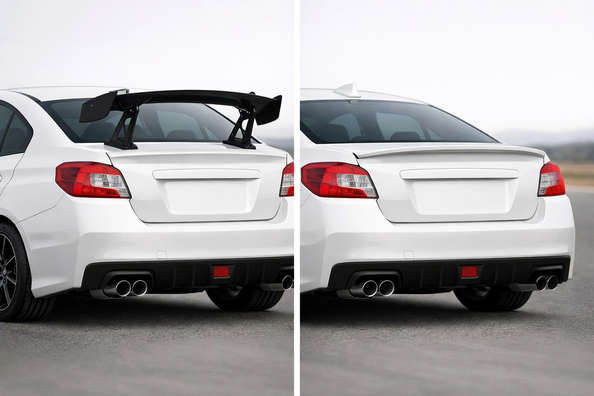
For a daily driver, in most cases it’s smarter to choose a spoiler rather than a rear wing. A low element on the trunk lid is easier to install, it’s less likely to add unwanted noise, and it usually adds less drag, whereas a rear wing makes sense when the car actually drives fast, is loaded in corners, and is used for more than just city driving.
The choice here isn’t about a “more aggressive look” but about compromise. A spoiler mainly corrects airflow behind the body, while a rear wing creates more noticeable downforce—but it asks more in return: stronger mounting, the correct angle, balance with the front of the car, and a willingness to live with more noise and a higher price.
A spoiler usually sits close to the plane of the trunk lid and intervenes more gently in aerodynamics. For a road car, this is often the healthiest format: you can calm the rear end a bit at speed without a big penalty to comfort and everyday practicality.
A rear wing sits higher, has a gap under the profile, and works as a separate aerodynamic element. Its advantage is a stronger effect at high speed. Its downside is that in normal city driving this effect is often too small, while the drag, noise, and installation demands stay with you every day.
| Option | Strengths | Weaknesses | Who it suits |
|---|---|---|---|
| Low spoiler | Easier installation, less noise, better compatibility with daily driving | Small effect at low speeds, doesn’t provide high downforce | City, highway, family car, mild tuning |
| Pronounced spoiler | More noticeable impact on stability, still without the extremes of a wing | May add drag and noise, more demanding about shape and angle | Powerful road cars, fast trips without regular track days |
| Rear wing | Stronger downforce at high speed, better performance in loaded corners | More complex installation, higher noise, more load on the trunk lid, higher drag | Prepared cars, frequent high-speed use, track days |
DD Tuning expert comment: the most common mistake is buying a rear wing from photos without checking trunk lid stiffness and the real driving scenario. In the end, people get noise, extra drag, and almost zero benefit in the city. For a daily car, it’s safer to start with a moderate spoiler and only then think about more serious aerodynamics.
For a daily car, the most balanced option is a low lip spoiler or a spoiler close to the factory style. If the geometry is moderate, it can reduce rear-end lift without a sharp increase in drag. That’s why for everyday use this format is usually more выгодний: fewer noise risks, less chance of overloading the trunk lid, and easier to live with day to day.
The weak spot of a spoiler is sensitivity to shape. If the element is too large or set at an aggressive angle, it easily turns from a useful part into a source of whistling and extra fuel consumption. For road use, moderate solutions usually work better than maximum size or showy geometry.
A rear wing is justified when you truly use speed: a powerful car, frequent high-speed sections, active driving with corner loading, or regular track sessions. In those conditions it can noticeably load the rear axle and make the car’s behavior more stable.
But for normal use, a wing often turns out to be too demanding. It loads mounting points more, sometimes requires reinforcing the trunk lid, and almost always needs balance with the front of the car. If you install it on its own, without a thought-out approach, it’s easy to get more style than real benefit.
If the car drives around the city every day, parks near stores, carries the family, and only occasionally goes on the highway, a spoiler looks like the most sensible choice. It’s less annoying in daily life, creates noise less often, and doesn’t force you to modify the body for an effect that still won’t really reveal itself in the city.
If it’s a powerful coupe or sedan that often drives fast on out-of-town routes, you can look at a more pronounced spoiler. It gives a better compromise between stability and daily usability. A rear wing is also possible here, but only if you clearly understand why you need it.
For a car that regularly goes to the track, a rear wing already makes sense. But then it should be viewed not as a standalone decoration, but as part of the entire aero package—otherwise the car’s balance can get worse rather than better.
| Scenario | Best choice | Why |
|---|---|---|
| Daily city driving | Low spoiler | Less noise, easier installation, minimal everyday inconvenience |
| Long highway trips | Low or moderately pronounced spoiler | Better compromise between stability and drag |
| Powerful car without track days | Moderate spoiler | Usually sufficient for road use without extra load on the body |
| Regular track days | Rear wing | Real downforce at high speed and in corners actually matters |
| Only the visual effect is needed | Spoiler | Simpler, cheaper, and less likely to regret it in daily use |
A more expensive solution makes sense not when you want “something more serious,” but when the car can already use that potential. If there are frequent high-speed runs, active cornering loads, a prepared chassis, and a clear demand for stability, then an adjustable rear element, pricier materials, and more complex installation can be justified.
In that case, you should look not at a single part but at the whole configuration: which spoilers fit a road scenario, what a front splitter actually does, and how the daily and high-speed approach differs in the comparison of a rear wing and a spoiler. If the car lives in the city, then a more expensive solution often just means a more expensive visual effect without proportional benefit.
From a customer’s experience: the owner of a daily sedan initially wanted a big rear wing because he was looking for a bolder look and “better stability.” After choosing based on the driving scenario, he settled on a moderate spoiler without radical вмешання to the trunk lid. As a result, he got a cleaner look, didn’t add highway noise, and didn’t overload the body with extra mounts.
For a daily car, a spoiler is usually the better buy—especially a low or near-factory format. It’s easier to install, more practical in everyday life, and less likely to bring unpleasant side effects like noise, extra drag, or mounting issues. A rear wing is worth considering when there is real high speed, regular corner loading, and a readiness to build balanced aerodynamics rather than just adding a part at the back.
This material is based on real selection experience, practice, and real use cases: for the city and everyday highway driving, a restrained solution works better, and expensive aerodynamics are justified only where the car can truly make use of them.
| ✔ | A spoiler is usually easier to install and often does not require major bodywork modifications. For a daily driver, this reduces installation risks and makes further use simpler. |
| ✔ | A low-profile spoiler is less likely to add noise and extra drag than a wing. This matters for city driving and everyday trips, where comfort and quiet are felt every day. |
| ✔ | At normal speeds, a spoiler offers a more balanced compromise between stability and practicality. The text directly notes that for road use, a moderate solution is usually better. |
| ✔ | A spoiler puts less load on the trunk lid and is less likely to create everyday inconveniences. It is easier to wash, interferes less with car care, and is better suited to calm daily driving. |
| ✔ | For a car that drives in the city and only occasionally goes on the highway, a spoiler delivers a more practical result. In such a scenario, a wing often does not have time to reveal its effect, while the drawbacks remain. |
| ✘ | A wing is more difficult to install: drilling is often required, as well as checking the trunk lid stiffness. This increases installation requirements and can make it harder to choose the right fit for a specific car. |
| ✘ | At city speeds, the effect of a wing is often too small to justify installing it. At the same time, drag, noise, and mounting requirements remain every day. |
| ✘ | A wing places more load on the mounting points and sometimes requires reinforcing the trunk lid. For an ordinary car, this means extra costs and a potential risk to the body. |
| ✘ | Such a solution requires balance with the front end of the car, and without it may not improve handling. If a wing is installed on its own, there is a risk of getting more visual effect than real benefit. |
Shipping to EU
Wholesale and retail
Own warehouse
Опис продукту
Подарунки не надаються при оформленні покупки у кредит під 0,01% або при покупці частинами.