29.04.2026
268
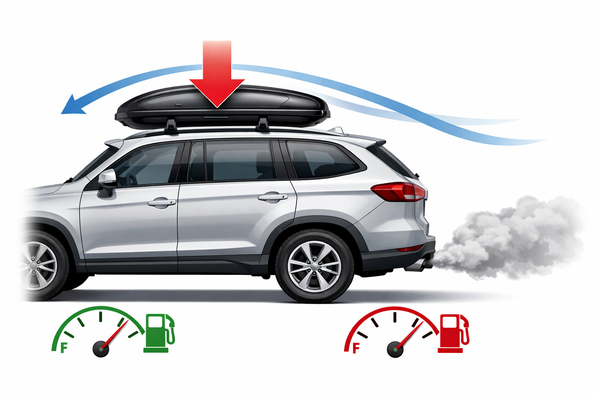
A roof box almost always increases fuel consumption, and that doesn’t mean something is broken. It’s normal to see about 2–8% extra in the city, 6–17% on highways, and up to 10–25% on motorways at 105–121 km/h. If the increase is noticeably higher, it’s usually not just the box—speed, installation, crossbars, cargo weight, tire pressure, or winter conditions are often to blame.
The biggest mistake is comparing two different trips and blaming everything on the roof. The same box on a sedan vs a crossover, in winter, with wind vs without, will produce different results. That’s why it’s important to separate the normal aerodynamic penalty from incorrect installation or an unfavorable usage scenario first.
At speed, fuel use is driven less by weight and more by air resistance. A roof box sits in the worst possible place: on the roof it increases frontal area, disrupts airflow over the windshield, and creates turbulence behind it.
That’s why the increase is often moderate in the city, but rises sharply on the open road. Sedans usually suffer more than crossovers, and even empty crossbars can create a noticeable penalty without any cargo.
One short drive isn’t representative. It’s best to track either full-tank-to-full-tank over the same distance, or a stable average after a longer trip—not after 10–15 km.
| Symptom | Likely cause | What to do |
|---|---|---|
| Almost no change in the city, but a sharp jump on the road | Normal aerodynamic penalty plus high speed | Reduce cruising speed and compare again |
| High consumption even with an empty box | Box shape or a large gap above the roof | Remove the box between trips, check the fit |
| Worse even without the box—crossbars only | Drag from the crossbars themselves | Don’t keep them on permanently unless needed |
| Much worse in winter, especially on short trips | Cold weather, denser air, lower tire pressure | Check tire pressure and assess consumption over a longer route |
| Whistling or slight instability at speed | Poor installation or box position | Reinstall per the instructions, check fasteners |
| After loading heavy items on top, the car feels more sluggish | Too much mass on the roof | Move heavy items into the cabin or trunk; put light bulky items in the box |
A new low-profile roof box makes sense if your current one is tall, you often drive at 110–130 km/h, and the biggest penalty shows up on the highway. Here, shape matters more than a difference of a few kilograms.
If you only need a box a few times a year, replacing it for fuel savings often won’t pay back. It’s smarter to remove it between trips, and choose roof boxes when you truly need lower height, better crossbar compatibility, or more usable volume without overloading the roof.
| Solution | When it works | When it’s not worth spending money |
|---|---|---|
| Reduce speed by 10–20 km/h | Mainly highway and motorway driving | If the issue is noticeable only on short winter trips |
| Remove the box and crossbars after the trip | When the box is used seasonally or occasionally | If you need roof volume every day |
| Check tire pressure | Before a long trip, after a cold snap, with a full load | If pressure is already correct and consumption rises only at high speed |
| Move heavy items down | When the box carries dense, heavy cargo | If the box already contains only light bulky items |
| Replace a tall box with a lower one | With frequent highway trips and a clear aerodynamic penalty | If you use it rarely and mostly in the city |
| Switch to a rear platform or rear box | When the car has the right mounting and you do many highway trips | If there’s no suitable mounting or your main route is urban |
A roof box isn’t supposed to be “free” in terms of fuel consumption. But the increase shouldn’t automatically scare you either: within a few percent in the city and roughly up to 10–20% on the road is typical, and on high-speed motorways the penalty can be even higher. If your numbers clearly exceed these ranges on the same route, check speed, installation, crossbars, roof load, tire pressure, and seasonal conditions. In most cases, that’s where the issue is solved—not by randomly buying a new box.
| ✔ | Provides clear benchmarks for what level of fuel consumption increase is considered normal: in the city, on the highway, and on the motorway. This helps avoid confusing a regular aerodynamic penalty with a malfunction. |
| ✔ | Explains how to check whether the problem is actually the roof box: it suggests comparing the same route, with and without the crossbars, and at the same speed. This approach helps rule out external factors. |
| ✔ | Offers practical ways to reduce fuel consumption: lower your speed, remove the box and crossbars when they are not needed, and move heavy items lower down. This can be done at no extra cost. |
| ✔ | Separately takes seasonal conditions, tire pressure, and installation into account, showing where extra fuel consumption most often appears. This is useful for finding the cause without replacing the box at random. |
| ✘ | Even a working roof box almost always increases fuel consumption, especially on the highway and motorway. In other words, you have to pay for comfort and extra space with fuel. |
| ✘ | Empty crossbars also create noticeable drag, so leaving them on the roof all the time is not practical. This adds extra consumption even without cargo. |
| ✘ | A tall or poorly installed box can make the situation much worse, and on sedans the effect is often more noticeable than on crossovers. Because of this, the result depends heavily on the specific car and installation. |
| ✘ | It is hard to draw conclusions after a single short drive, because wind, cold, route, and speed all affect the figures. This makes it difficult to assess real-world fuel efficiency in everyday use. |
Shipping to EU
Wholesale and retail
Own warehouse
Опис продукту
Подарунки не надаються при оформленні покупки у кредит під 0,01% або при покупці частинами.