11.04.2026
300
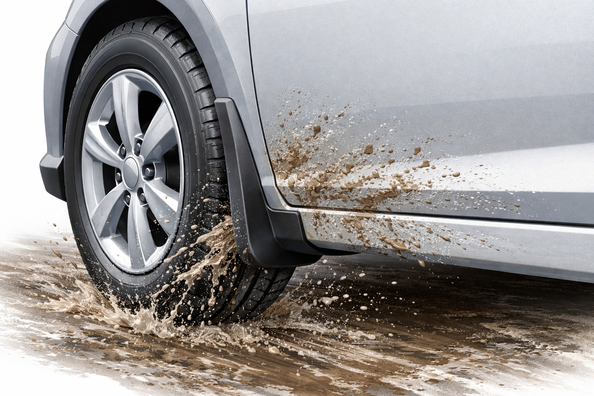
If spray still hits the sills, lower doors, and side panels even after installing mud flaps, the problem is usually not that the part itself is “low quality.” Most often it simply doesn’t cover the real trajectory of water and dirt from your specific wheel: you changed tires, offset, added wheel spacers, the car became taller, or the mud flap is mounted in the wrong place or the wrong way.
The key here is not to guess, but to check the geometry. The same kit can work fine on a stock vehicle and noticeably worse after wider tires, a lift, or in winter when slush builds up on the arches and on the mud flap itself.
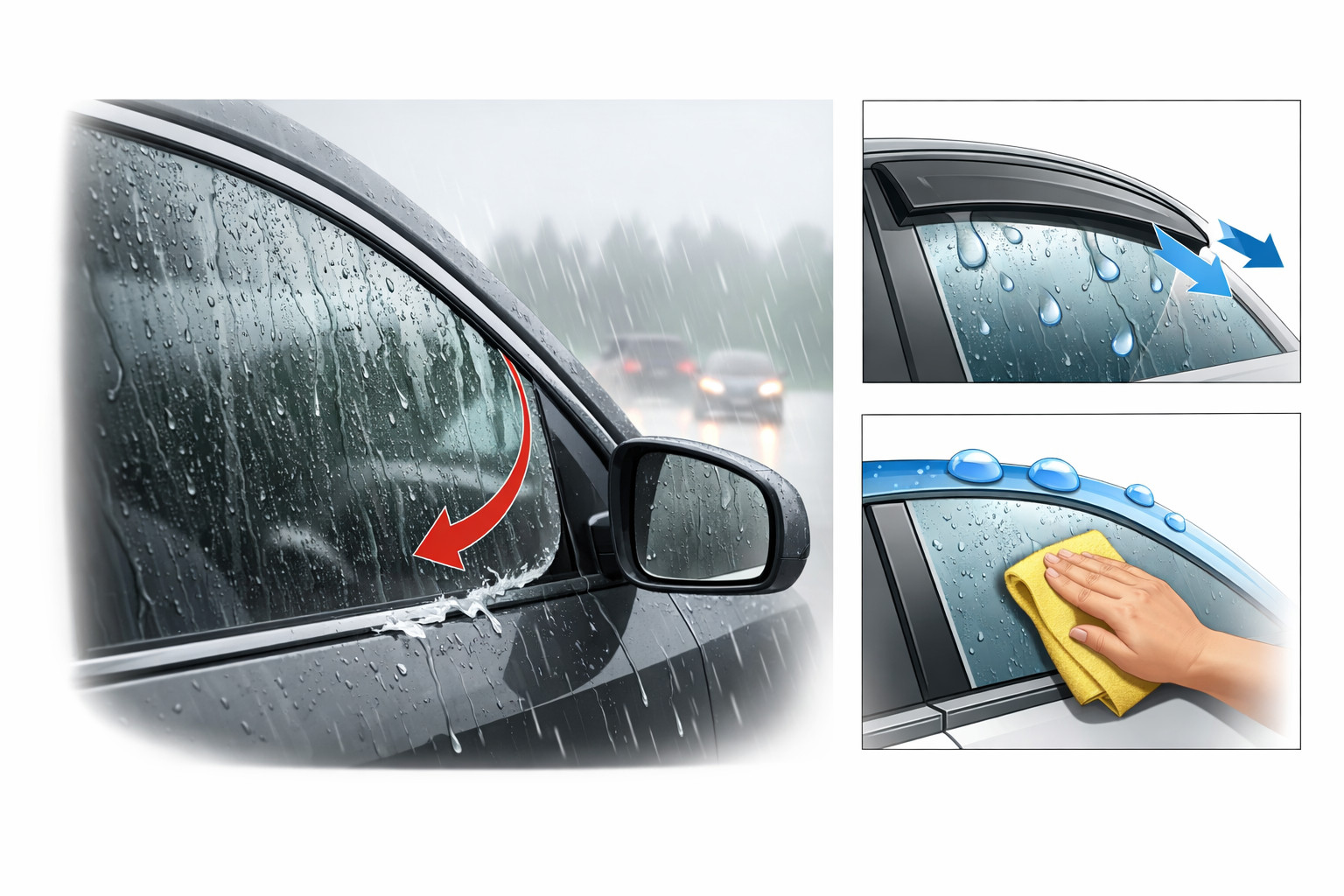
Spray doesn’t fall straight down. Part of the flow runs off the outer edge of the tread and travels in an arc toward the sills, doors, and the lower part of the fender. If the mud flap doesn’t cover the full tread width or isn’t positioned close enough behind the wheel, water passes around it.
OEM mud flaps are usually designed for the factory setup. As soon as the wheel moves outward, the tire gets wider, or the suspension is raised, the factory design no longer matches the real spray trajectory. In winter the effect is stronger, because heavy slush with sand and salt sticks more than plain water.
Start with the dirt pattern. If the dirtiest areas are the sills, the lower part of the doors, and the rear edge of the front doors, the flow is coming off the wheel’s outer edge. If the mirrors and side windows also get heavily sprayed, the wheel is often already sticking out past the arch line, and OEM mud flaps alone aren’t enough.
Next, check three things. First: does the mud flap cover the full tread width, not just the tire sidewall. Second: how close it sits behind the wheel. Third: the height of the lower edge— a practical guideline is not to raise it much higher than about 15 cm from the road, otherwise protection drops.
Also watch what happens at speed. If the mud flap clearly “lays down” backward, the issue isn’t the concept of a mud flap, but the softness of the material or weak mounting. If it’s tolerable in summer but gets much worse in winter, check for ice and dirt buildup in the wheel arch.
DD Tuning expert comment: the most common mistake is choosing a mud flap by vehicle name, but not looking at the actual tread width and wheel offset. The second typical mistake is installing a soft piece on weak mounting and expecting stable performance on the highway. If the car already has wider tires, spacers, or a lift, you should base the choice not on the stock mud flap size, but on the real wheel geometry.
| Symptom | Likely cause | What to do |
|---|---|---|
| Dirt hits the sills and lower doors | The mud flap doesn’t cover the tread’s outer edge | Check the actual tire width and fit a wider piece that covers the full tread |
| It got worse after changing wheels or adding spacers | The wheel is pushed beyond the stock arch line | Assess offset, tire width, and how far the wheel protrudes; sometimes you won’t get results without a wider mud flap or arch extensions |
| Protection drops sharply on the highway | Soft material or weak mounting; the mud flap bends backward | You need stiffer material and multi-point mounting |
| After a lift or bigger tires the body gets dirtier | The tire is more exposed to side throw | Select a longer and wider mud flap for the new ride height and wheel size |
| In winter the mud flap gets coated with ice | The shape traps slush; buildup increases in the arch | Clean the arch and the mud flap regularly; if needed, change the shape or material |
| Dirt passes by the mud flap even though it’s wide enough | The piece is mounted too high or too far from the tire | Check mounting position and height; move it closer to the wheel within a safe clearance |
An important expectation limit: even a correctly chosen kit won’t eliminate spray completely. It should significantly reduce side throw, not make the body perfectly dry in heavy rain or slush.
If the car remains in stock geometry, it’s worth looking first at original mud flaps: they usually fit the arch well and don’t require modifications. But if you already have wider tires, a different offset, or spacers, it’s more logical to look at mud flaps with greater real coverage rather than just an OEM-like appearance.
When the issue is not only the sills but also constant heavy slush buildup in the arches, it makes sense to also check fender liners. They don’t replace a mud flap, but they help keep the arch cleaner and reduce repeated dirt throw outward.
Universal solutions make sense only when they can be set correctly for height and width and mounted rigidly. If the wheel protrudes far beyond the body, sometimes the fix has to be comprehensive rather than just swapping one accessory.
| Solution | When it works | When it’s not worth spending money |
|---|---|---|
| Original OEM-size mud flap | Vehicle without spacers, without a lift, on stock wheels | If tires are wider, offset is changed, or the wheel already sticks out past the arch |
| Wider and longer mud flap | When you need to cover the real tread width and catch the outer edge of the flow | If the problem is that at speed the piece simply bends backward |
| Adjusting height and position | When the mud flap is mounted too high or too far from the wheel | If the piece itself is already physically too narrow for your tire |
| Stiffer material and multi-point mounting | When on the highway the mud flap loses shape and “flows” backward | If the wheel protrudes so far outward that the flow goes past even a rigid mud flap |
| Regular winter cleaning of arches and mud flaps | When the main issue is amplified by ice and slush buildup | If the cause is incorrect geometry, not just seasonal buildup |
| Fender liners as an add-on | When you need to reduce dirt accumulation in the arch | If the expectation is to completely eliminate side spray with this alone |
From a customer’s experience: after installing spacers and wider tires, the owner kept the stock mud flaps and ended up with constantly dirty sills, even though the parts were intact. After switching to a wider kit with stiffer mounting and checking the install height, side dirt decreased noticeably, but in heavy winter slush he still cleans the arches periodically. That’s what a normal real-world result looks like: not a total absence of spray, but controlled and significantly reduced buildup.
If spray hits the sides even with mud flaps installed, look not for a “broken accessory,” but for a mismatch between wheel geometry and what the mud flap actually covers. Most often the culprits are tread width, changed offset, spacers, a lift, mounting too high, or a mud flap that bends back at speed.
The best approach is simple: look at the dirt pattern, check coverage width, distance to the wheel, height off the road, and behavior at speed. If you then choose a solution without myths, you spend money more accurately. This material is based on real fitting experience, practical know-how, and real use scenarios—not abstract promises.
| ✔ | Mud flaps really help if you choose them based on the actual tread width, not just the car model. This reduces the sideways spray of dirt onto the sills and lower doors. |
| ✔ | A wider and longer mud flap can make a noticeable difference after spacers, a lift, or switching to larger wheels. The article directly notes that the stock size in such cases is often already too small. |
| ✔ | A firmer mounting and material make the protection more stable at speed. This matters because soft covers can bend back and lose effectiveness. |
| ✔ | Regular cleaning in winter really restores some of the effectiveness when the mud flaps and wheel arches build up ice and slush. In other words, the problem can be partially controlled without replacing the whole set. |
| ✔ | Wheel arch liners can be a useful addition if dirt keeps accumulating in the arches. They do not replace mud flaps, but they help keep the arch cleaner. |
| ✘ | Factory mud flaps often stop working after the wheel geometry changes. If the tires are wider, there are spacers, or the offset has changed, they no longer cover the actual spray path. |
| ✘ | Mounting them too high or too far from the wheel reduces the effect even with a wide mud flap. From the outside everything may look normal, but the water simply goes past. |
| ✘ | Soft universal covers without proper mounting work poorly on the highway. At speed, they bend back, so the protection becomes unstable. |
| ✘ | In heavy winter slush, even a properly chosen set does not eliminate spray completely. It only reduces the amount, but does not make the body completely dry. |
Shipping to EU
Wholesale and retail
Own warehouse
Опис продукту
Подарунки не надаються при оформленні покупки у кредит під 0,01% або при покупці частинами.