01.06.2026
241
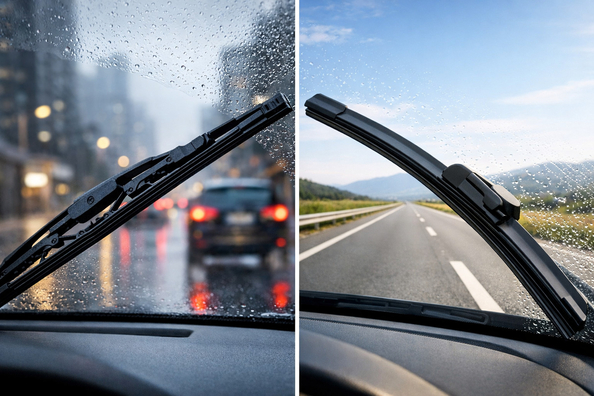
If you drive mostly in the city, in rain without hard frost, and don’t want to overpay, conventional frame wiper blades often do the job just fine. But if you spend time on the highway, deal with winter, have a curved windshield, or have higher demands for quiet operation, quality beam (frameless) blades usually win on consistency.
The main mistake here is simple: choosing not for real driving conditions, but only by price or the word “frameless.” In reality, what matters isn’t the design name by itself, but mount compatibility, rubber compound quality, the condition of the frame or adapter, your typical speed, and how often the wipers work through dirt, road salt, and ice.
A frame wiper blade has a metal frame with joints that presses the rubber at several points. It’s a simple, affordable design that still works well on many cars, especially in calm city driving.
A beam (frameless) blade has no external joints, and pressure is distributed along the length via an internal spring strip. In practice, this more often means more even contact on curved glass, less noise at speed, and fewer icing issues in winter. But cheap beam models can disappoint easily: with weak rubber or a poorly designed adapter, they may work worse than good frame blades.
Separately, it’s worth assessing your windshield geometry. On an almost flat windshield, a good frame wiper can clean nearly as convincingly as an average beam blade. On a more strongly curved windshield, the difference is usually more noticeable.
| Option | Strengths | Weaknesses | Who it’s for |
|---|---|---|---|
| Frame | Lower price, easier to match for many older cars, sometimes effective enough in normal city rain | Joints can freeze, more noise at speed, pressure isn’t always even on curved glass | Drivers who mostly commute in the city, in a mild climate, and want a decent result without extra cost |
| Beam (frameless) | More even pressure, better behavior on the highway, less noise, less ice buildup | Higher price, sensitive to exact mount selection and adapter quality, cheap models are often overrated | Drivers who often travel on highways, face winter conditions, want quieter operation and more consistent wiping |
DD Tuning expert comment: Most often, buyers look only at blade length and overlook the mount, which is why even a good beam model becomes a source of play, noise, or incomplete pressure. The second common mistake is replacing only the rubber insert on an old frame where the joints are already worn out. If the wiper works in jerks or leaves streaks at the edges, the cause is often in the base, not the rubber strip itself.
The strong side of a frame design is simplicity. It’s cheaper, often easier to find for older cars, and in normal rain it can work perfectly well. If the car is used calmly, without frequent highway runs, the difference versus a beam blade may not be dramatic.
The weak point is the joints and bridges. That’s where dirt, snow, and ice build up, causing the blade to lose flexibility and follow the windshield shape worse. Add wind at speed, and a frame wiper more often starts to make noise, chatter, or leave streaks along the upper edge.
The idea “I’ll buy a cheap frame blade and just replace the rubber” doesn’t always work. If the frame is already loose or fatigued, a new strip won’t restore proper pressure. In the end, the savings are only on paper.
A beam blade is better suited for modern windshields with more complex curvature. It presses more evenly along its length, catches less air at speed, and usually runs quieter. That’s why on the highway the difference is often felt not because of ads, but literally in the first rain.
In winter conditions, this design is more practical because it has fewer exposed parts where ice can form. That doesn’t mean beam blades don’t need cleaning in winter, but they lose their shape less often due to ice crust in joints.
The downside is that beam blades are more demanding when it comes to selection. The wrong adapter, looseness in the fit, or simply a budget model with weak rubber can ruin the entire point of paying extra. In other words, you’re not paying for the name—you’re paying for quality execution.
For a typical city with no harsh winter, frame blades remain a rational choice. If speeds are moderate, the glass isn’t too curved, and you replace wipers on time, they can deliver perfectly acceptable wiping without overpaying.
For highway driving, frequent intercity trips, winter mornings, and wet snow, beam blades have the edge. Here it’s not only about streaks on the glass, but also predictable performance at speed: when the blade doesn’t lift in the airflow and doesn’t start humming, the driver gets less fatigued.
If you have an older car and rarely drive in bad weather, frame blades are also logical. But if you want to choose a set properly once and get quiet operation, stability, and less winter hassle, beam blades usually justify the price difference.
| Scenario | What to choose | Why |
|---|---|---|
| City, mild climate, moderate budget | Frame | No point overpaying if the wipers mostly work in rain without ice and high speeds |
| Frequent highway trips | Beam (frameless) | More stable pressure, less noise and vibration at speed |
| Winter, wet snow, frequent freezing temps | Beam (frameless) | Fewer exposed parts where snow and ice accumulate |
| Older car with a simple mount | Frame | Usually easier to match and cheaper to maintain |
| Requirement for quiet operation | Beam (frameless) | On average, lower chance of whistling and chattering in the airflow |
| Minimal budget, but a decent result is needed | Good frame blades instead of the cheapest beam blades | A quality basic frame model is often smarter than a weak “check-the-box” beam option |
Paying extra for beam blades—or simply for a higher-quality product line—makes sense when wipers actually work in tough conditions: highway driving, winter, frequent night trips, heavy rain, curved glass, or high sensitivity to noise. In these scenarios, a more expensive blade often delivers not “a bit better,” but a more consistent day-to-day result.
If you’re choosing a new set, start with the wiper catalog. If you’re unsure about length and mount compatibility, it’s useful to check the guide how to choose wipers. And when the blades are already performing worse but it’s unclear whether it’s wear, it’s worth separately checking when it’s time to replace them.
There’s no point overpaying if the car almost never goes out in bad weather and most trips are short and urban. But if you’re annoyed by streaks in your field of view, whistling at speed, and winter icing, saving on wipers quickly stops being a good deal.
From a customer’s experience: A driver chose new blades after regular frame wipers started making noise on the highway and freezing quickly during morning frosts. Instead of another budget replacement, he switched to quality beam blades, matched precisely to the mount and length. As a result, he got quieter operation, fewer edge streaks, and fewer winter stops for manual cleaning.
For city driving in a mild climate, frame wipers often remain a very sensible choice: cheaper, simpler, with no unnecessary expectations. For highway driving, winter, curved windshields, and quieter operation, in most cases it’s better to look at quality beam blades.
The most important thing is not to confuse the design type with a guaranteed result. You need to look at the mount, the quality of the specific blade, the condition of the wiper arm, and your real driving conditions. This material is based on real selection experience, practical know-how, and real-world use cases—not on an abstract superiority of one type over another.
| ✔ | Frame wipers in the city usually deliver a sufficient result without unnecessary costs. For calm driving in the rain and on cars with a simple mount, this is a practical option. |
| ✔ | Beam wipers hold better on curved glass and press more evenly along the length. This helps provide more stable cleaning, especially on the highway. |
| ✔ | Beam wipers are usually quieter at speed and are less affected by the airflow. In real driving, this reduces noise and vibrations. |
| ✔ | In winter conditions, beam wipers are less prone to getting clogged with ice and snow in the joints, because they have fewer exposed parts. That is why they keep working better in frost and wet snow. |
| ✔ | Frame wipers are cheaper upfront and often easier to match for older cars. This offers a normal compromise for those who do not want to overpay. |
| ✘ | Cheap beam models can clean worse than quality frame ones. If the rubber is weak or the adapter is poor, the advantage of the design simply disappears. |
| ✘ | Frame joints are more often clogged with dirt, snow, and ice. Because of this, the wiper loses mobility and starts following the glass shape less effectively. |
| ✘ | At speed, frame wipers are more likely to make noise, bounce, or leave streaks. This is especially noticeable on the highway and in strong wind. |
| ✘ | Beam wipers are demanding when it comes to precise mount selection and adapter quality. A fit error or play can nullify the entire extra cost. |
Shipping to EU
Wholesale and retail
Own warehouse
Опис продукту
Подарунки не надаються при оформленні покупки у кредит під 0,01% або при покупці частинами.