15.05.2026
492
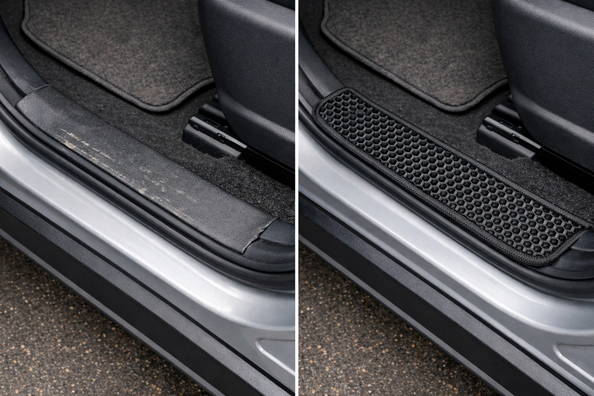
EVA mats for door sills don’t make sense for everyone. If meltwater, sand, and dirt regularly get into the car specifically over the edge near the doors, an extra section or extended side wall really does reduce the mess. But if the car is driven mostly around a dry city, and the sill is low and easy to wipe separately, it’s often just paying extra for a more complex shape.
In this choice, it’s not the loud product names that matter, but three practical things: an exact pattern for your specific model, reliable fixation, and full compatibility with the pedals. These are what determine whether the mat is convenient every day or starts to annoy you after the first winter.
The term “EVA mats for door sills” can mean different designs: a taller side wall, a 3D shape, a separate insert near the door opening, or simply a mat with a pronounced wrap up the side. Because of this, there can’t be one universal answer: sometimes it’s useful protection, and sometimes it’s an extra element that makes cleaning harder.
There’s practical value when dirt actually climbs over the standard mat edge: in winter, in slush, on dirt roads, in a family car with kids, or in a vehicle that stops often and keeps opening the doors. If that’s not your case, a standard EVA set often delivers the same result without overpaying.
Safety deserves separate attention: the driver’s mat must be fixed in place as intended and must not sit tight against the pedals. After winter and after hard suspension impacts, it’s a good idea to check the fasteners again.
| Option | Strengths | Weaknesses | Who it’s for |
|---|---|---|---|
| Standard EVA without a sill section | Holds water and sand well in the cells, dries quickly, easier to clean | Doesn’t cover the edge by the door if dirt gets in specifically there | Most city drivers who want practicality without extra elements |
| EVA with a side wall or wrap onto the sill | Catches dirt better along the side edge, useful in winter and wet conditions | More expensive, harder to wash, sometimes brings little benefit in cars with low sills | Those who often drive in slush, on dirt roads, with kids, or in a work-use routine |
| Rubber mats with a high lip | Easiest to wash after mud, handles rough use well | Less tidy look in the cabin, water can feel like a puddle on the surface | Taxis, delivery, rural driving, construction sites, very dirty conditions |
| Carpet mats | The most familiar cabin look, pleasant in dry use | Handle moisture worse, dry longer, harder to care for in winter | Dry city driving, highways, careful use without constant wet dirt |
DD Tuning expert comment: The most common mistake is buying the tallest lip and extra sections without checking the pattern. If the edge by the sill is held only by Velcro or sits under tension, it starts to peel away after washes and морозів. For the driver’s area, you first look at fixation and clearance to the pedals, and only then at the lip height.
This is the basic and often sufficient option. The cellular structure localizes water, snow, sand, and fine dirt well, and the mat itself is easy to shake out or rinse. If the car isn’t living in constant mud, a standard set is usually enough.
There’s one advantage here, but it’s specific: the area by the door is better covered, where dirt gets in from the side rather than from above. This is useful in crossovers, family cars, winter operation, and whenever people often get in with wet shoes. The downside is that the benefit depends heavily on the floor shape: in a car with a low sill, a 1–2 cm side wall may change almost nothing.
This is the choice for a rough-use scenario. They’re easier to quickly hose off after soil, cement dust, or thick mud, so work vehicles often do best with rubber. If the main priority is cleaning speed rather than a neat cabin look, rubber is a more honest choice than EVA for sills.
They remain a logical option for a dry city and highways, when the cabin is rarely wet. If the factory look and a softer feel underfoot matter to you, carpet is nicer. But moisture, salt, and sand quickly show its limits.
For a typical city car without constant slush, standard EVA is most often enough. You get the main benefit of the material—water and dirt don’t smear around the cabin—and you don’t add extra complexity when washing.
If the car sees wet snow, sand, kids’ boots, a dog after a walk, or frequent in-and-out every day, the version that wraps onto the sill already looks justified. But only if the mat is made precisely for the vehicle and isn’t held on by compromise Velcro.
For delivery, taxi use, rural driving, and construction routes, practicality often beats a tidy look, so high-lip rubber is often the smarter choice. And carpet is best left to those who almost never carry wet dirt and don’t want a utilitarian accessory in the cabin.
| Scenario | Best choice | Why |
|---|---|---|
| Dry city, office trips, highway | Standard EVA or carpet | Extra sill protection usually doesn’t pay off, and the factory look matters more |
| Winter, slush, lots of meltwater | EVA with a wrap onto the sill | Dirt more often ends up on the side edge, and the extended shape actually works |
| Family, kids, frequent snacks in the car | Standard EVA or EVA for the sill | Depends on whether the area by the door gets dirty; for the floor overall, EVA is very practical |
| Taxi, delivery, work vehicle | Rubber mats | Least time spent washing and least regret over rough use |
| Rural roads, dirt roads, mud | Rubber or EVA for the sill | If the dirt is heavy and sticky, rubber is easier; if it’s more water and sand, EVA is more convenient |
| Factory cabin look is important | Carpet or standard EVA | Sill add-ons are often unnecessary both visually and practically |
Paying extra is justified when you clearly see the problem you need to solve. If dirt consistently hits the edge by the door, it makes sense to look at EVA mats for door sills. If you need the cellular structure itself without extra geometry, standard EVA cabin mats are enough. And when the car works in the dirtiest mode and cleaning speed matters, it’s more practical to switch to rubber mats.
The simple rule is this: the more expensive option must remove a specific drawback of the base one, not just look “more protected.” If there’s no such problem, the standard set is almost always the smarter choice.
From a customer’s experience: the owner of a city hatchback initially wanted EVA with maximum wrap onto the sill because he feared winter dirt. After an inspection it became clear that his sill was low, and the main dirt stayed in the central floor area, so he chose a standard EVA set. In the end he got the same tidy cabin, but without extra cost and without the hassle of washing the side section.
EVA mats for door sills aren’t a must-have purchase—they’re a narrow solution for a specific use pattern. They’re genuinely useful where water and dirt systematically get onto the edge by the door: winter, shoulder seasons, dirt roads, family or work vehicles. In a calm city scenario, a standard EVA set usually gives almost the same result, and sometimes is even easier to maintain.
So the choice should be based not on flashy descriptions, but on the floor shape, pattern accuracy, fixation, and your real driving scenario. This material is based on real selection experience, practice, and real use cases—not on the promise that a more expensive shape is automatically better.
| ✔ | They cover the area by the doors better, where dirt and meltwater often come in from the side rather than from above. This is especially noticeable in winter, in slush, and in cars with frequent getting in and out. |
| ✔ | They can be useful for family cars, crossovers, and work vehicles where the floor regularly gets a lot of wet dirt. In such cases, the extra section really helps reduce mess near the sill. |
| ✔ | If the mat is made exactly for the model and properly secured, it does not create extra problems in daily use. With the right pattern, it fits without waves and does not interfere with the pedals. |
| ✔ | Compared with more complex protections, this is still EVA with its basic advantages: the cells hold water and fine dirt, and the mat dries quickly. So you get extra protection without switching to a rougher material. |
| ✘ | In dry city use, their benefit is often minimal, especially if the sill is low and easy to wipe separately. In that case, the extra cost for the extended shape may not bring any noticeable benefit. |
| ✘ | The additional side elements are more difficult to wash and care for. If they are not rinsed carefully, they lose their neat look faster. |
| ✘ | There is a risk of overpaying not for real protection, but for a more complex shape. If dirt does not build up specifically by the sill, a standard EVA set looks more practical. |
| ✘ | For the driver's seat, what matters more is not the side height, but secure fixing and clearance to the pedals. If the fit is done poorly, the edge may lift or create inconvenience. |
Shipping to EU
Wholesale and retail
Own warehouse
Опис продукту
Подарунки не надаються при оформленні покупки у кредит під 0,01% або при покупці частинами.