03.07.2026
1093
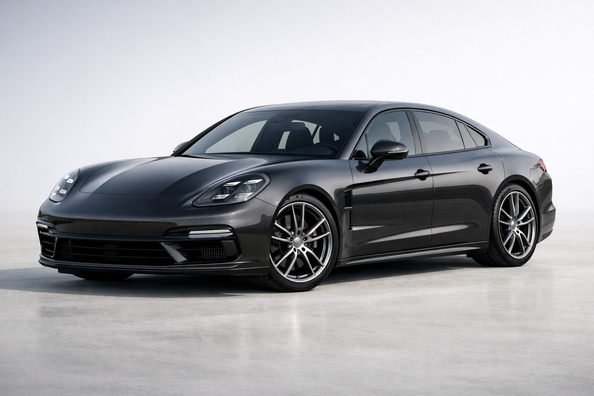
Panamera is a large Porsche that makes sense not only as a status item. The current lineup includes seven versions with outputs from 348 to 771 hp, all with an 8-speed PDK, standard adaptive air suspension, and a large rear hatch—so the car genuinely works as a fast daily driver rather than a weekend toy.
Panamera suits best someone who wants to combine long-distance trips, daily city use, and a steering feel closer to a sports car than to a soft executive sedan. What it’s not made for: bad roads, high curbs, a desire for an ultra-soft ride, and indifference to the cost of tires, brakes, and servicing.
Panamera sits in the part of the market where the buyer is no longer choosing just a “big premium car.” Here it matters that the car is fast, precise in corners, usable every day, and still not cramped. That’s why it’s often compared with the BMW 8 Gran Coupe, Mercedes-AMG GT 4-Door, and Audi A7/S7—but in character, the Porsche usually feels noticeably more driver-focused.
The model’s main strength is balance. It’s larger and more practical than the brand’s classic sports cars, yet it doesn’t turn into a “ship” that’s only interesting for carrying passengers. If you need a big car for highway and city—not for off-road—Panamera often looks more logical than many similarly priced crossovers.
| Competitive factor | Porsche Panamera | What it means in real life |
|---|---|---|
| Body format | Five-door grand tourer | Easier access to the trunk than a classic sedan |
| Character | Driver-focused, with an emphasis on handling | Less “pillowy” comfort, more composure |
| Positioning | Premium + sport | More emotion, but higher ownership costs |
| Everyday usability | High | Can work as the only family car if the size doesn’t intimidate you |
The model appeared in 2009 as Porsche’s attempt to enter the segment of large, fast five-door cars. The idea worked: Panamera quickly became the car for those who find the 911 not practical enough but don’t want to move to a purely comfort-oriented sedan. With each generation it became more tech-heavy, and the role of hybrid versions grew more important.
| Generation | Years | What matters |
|---|---|---|
| First | 2009–2016 | The model’s launch: a big five-door Porsche focused on powerful gasoline versions and the grand-tourer format. |
| Second | 2016–2023 | A major step forward in chassis, digital cabin, and ride quality; hybrids became a much more important part of the range. |
| Third | from 2023 | The current generation: deeper electronics updates, a broad hybrid lineup, refined suspension, and the practicality of the large hatch retained. |
In the current generation everything is fairly straightforward: base versions get a 2.9-liter twin-turbo V6, the GTS gets a 4.0-liter twin-turbo V8, and the quickest variants combine a V6 or V8 with an electric motor. All versions use an 8-speed PDK dual-clutch gearbox; rear-wheel drive remains only on the base Panamera, while the rest are all-wheel drive.
In practice, that means this: the regular Panamera or Panamera 4 is the choice for those who want a balance of price, weight, and simplicity. Hybrids are interesting if you can charge regularly and do a lot of city driving. GTS and Turbo versions are about maximum performance, with matching running costs.
| Version | Powertrain | Power and torque | Drivetrain and performance |
|---|---|---|---|
| Panamera | 2.9 L twin-turbo V6 | 348 hp, 499 N·m | Rear-wheel drive, 0–100 km/h about 5.0 s |
| Panamera 4 | 2.9 L twin-turbo V6 | 348 hp, 499 N·m | All-wheel drive, 0–100 km/h about 4.7 s |
| Panamera 4 E-Hybrid | 2.9 L twin-turbo V6 + electric motor | 463 hp, 650 N·m | All-wheel drive, 0–100 km/h 3.9 s |
| Panamera 4S E-Hybrid | Hybrid powertrain | 536 hp, 750 N·m | All-wheel drive, 0–100 km/h 3.5 s |
| Panamera GTS | 4.0 L twin-turbo V8 | 493 hp, 659 N·m | All-wheel drive, 0–100 km/h 3.6 s |
| Panamera Turbo E-Hybrid | 4.0 L twin-turbo V8 + electric motor | 670 hp, 929 N·m | All-wheel drive, 0–100 km/h 3.0 s |
| Panamera Turbo S E-Hybrid | 4.0 L twin-turbo V8 + electric motor | 771 hp, 999 N·m | All-wheel drive, 0–100 km/h 2.8 s |
Acceleration figures can vary slightly by market and specification, but the overall picture doesn’t change: even the “entry” versions are very quick, and the top ones are already in exotic territory—while the car still remains usable every day.
Panamera is big: length 5052 mm, wheelbase 2950 mm, width 1937 mm without mirrors and 2165 mm with mirrors. That’s why it feels stable and grown-up on the highway, but in tight parking garages you need to get used to its size. The five-door format is very appropriate here: trunk access is better than in a classic sedan.
Chassis-wise, the key point is this: adaptive PASM air suspension comes standard, and hybrids can be equipped with the Active Ride system, which controls body roll and pitch even better. Ground clearance in public sources varies roughly from 124 to 131 mm depending on version and measurement method—so it’s definitely not a car for dirt roads or speed bumps taken without slowing down.
| Parameter | Value |
|---|---|
| Length | 5052 mm |
| Width without mirrors | 1937 mm |
| Width with mirrors | 2165 mm |
| Height | 1423 mm |
| Wheelbase | 2950 mm |
| Ground clearance | Approximately 124–131 mm depending on version |
| Trunk (gasoline versions) | About 493–498 L |
| Trunk (GTS) | About 479 L |
| Trunk (hybrids) | About 419–428 L |
| Maximum volume with the second row folded | About 1255–1328 L depending on version |
On higher trims, the brakes match the car’s character as well: for example, the Turbo E-Hybrid uses very large hardware, which is great for speed but bad for the consumables budget. It’s better to understand this before buying, not after your first disc and pad replacement.
Inside, Panamera is strong not only in driving position but also in everyday usability. It can be configured as a four- or five-seater, the second row is suitable for adults even on long trips, and the low seating position doesn’t mean it’s cramped. That’s one reason the model is often chosen as the only car in a family rather than a second “mood car.”
In terms of comfort, Panamera doesn’t disguise its character: it isn’t pillowy or detached, but composed. That’s why some owners rate the handling highly, while others complain that compared with large comfort sedans it rides more firmly. Useful in the city are the 360-degree camera, active parking, and systems that help you avoid scraping the front overhang on tricky ramps.
The weaker spots are also typical of a complex premium car: reviews sometimes mention complaints about navigation, minor electronic quirks, and not always perfect cabin quiet on rough surfaces. That doesn’t make the model problematic by definition, but it’s a reminder that Panamera likes attentive service and the right tire setup.
In daily life, Panamera pleasantly surprises by not forcing you to endure sports-car compromises every minute. The base rear-wheel-drive version in steady highway driving can show around 7.4 L/100 km at a stable speed, and the Panamera 4S E-Hybrid in a similar scenario is around 8.4 L/100 km. For a car of this size and pace, those are good numbers.
Plug-in hybrids make sense if the car is charged daily. In real driving, an electric range of about 45–48 km lets you cover short city routes with almost no gasoline. If there’s no charging and the routes are mostly highway, the simpler gasoline version often looks more rational: less weight, more trunk space, less complexity.
In everyday terms, three things matter most. First: the body width requires attention in courtyards and parking garages. Second: the low ground clearance doesn’t like broken pavement and high curbs. Third: large wheels, powerful brakes, and OE-spec tires cost accordingly for this class—so Panamera should be judged not only by the entry price, but also by the cost of ownership.
From an owner’s perspective, Panamera is strong where many big fast cars fall apart into compromises: it truly combines speed, handling, and practicality. But it only works when the buyer honestly understands their use case.
| Pros | Cons |
|---|---|
| A very wide range: from a relatively rational base to ultra-powerful hybrids | High starting price and extremely expensive top versions |
| One of the best driver-focused chassis in the class | Comfort is sporty rather than softly executive |
| Practical large hatch and a proper second row | Hybrids have a noticeably smaller trunk |
| Standard air suspension balances comfort and precision well | Ground clearance is too low for bad roads and curbs |
| Strong urban assistance for parking and maneuvering | Possible minor electronic and service nuances typical of complex premium tech |
Who it suits: anyone who wants one large car for every occasion but isn’t willing to put up with dull handling. Who it doesn’t suit: those who drive on broken roads, want the softest possible ride, or don’t want to spend on expensive wheels, tires, and brakes.
For Panamera, tuning makes sense when it emphasizes the model’s strengths rather than breaking its balance. The most practical approach is not to lower the car even more, but to work intelligently with wheels, exterior elements, and compatible parts. A convenient starting point is tuning for Porsche Panamera to immediately see solutions compatible with this model.
If you’re looking at exterior upgrades without losing daily convenience, it makes sense to move to R21 forged wheels: they add composure and visual completeness, but require careful tire selection and a check of real fender clearance. For those who want a more complete look, a body kit set can work—but only if it doesn’t compromise ground clearance or make the car inconvenient in the city.
Panamera really isn’t just about showing status. In the right version, it’s one of the most functional large fast cars: practical enough for the city and travel, sharp enough for the driver, and diverse enough in powertrains to match a specific use case. Base gasoline versions look the most rational, hybrids are the most interesting for a city with charging, and GTS and Turbo are for those who know exactly what they’re paying for.
This material is based on real selection experience, practice, and real-life usage scenarios—which is why the main takeaway is simple. Panamera is worth considering not because it’s a “big Porsche,” but because it can be a fast daily car without unnecessary pretense—if you honestly assess your roads, budget, and expectations from the car.
| ✔ | A wide range of versions lets you choose a Panamera for different scenarios: from a more sensible base model to very powerful hybrids. This is handy if you need not just a status car, but a specific set of features. |
| ✔ | The model combines speed and everyday practicality very well. The large rear hatch, proper second row, and spacious trunk make it suitable for both trips and city use. |
| ✔ | The Panamera has a distinctly driver-focused character and one of the best chassis in the class for the person behind the wheel. It is precise in corners and does not turn into a soft, indifferent sedan. |
| ✔ | The standard adaptive air suspension helps strike a balance between comfort and handling. This keeps the car composed without completely losing everyday convenience. |
| ✔ | In the city, the Panamera has useful assistants for parking and maneuvering. For a large and wide car, this makes daily use much easier. |
| ✘ | The car is not cheap to buy, and the higher trims cost significantly more. On top of that, you should immediately factor in the cost of wheels, tires, brakes, and service. |
| ✘ | Comfort in the Panamera is sporty rather than softly executive. For those expecting a smooth, floaty suspension, its character may seem a bit stiff. |
| ✘ | In hybrid versions, the trunk is noticeably smaller than in the gasoline ones. If maximum practicality for cargo is needed, this is an important compromise. |
| ✘ | Low ground clearance and large dimensions make the car inconvenient on bad roads, high curbs, and in tight courtyards. It is not the best choice for rough surfaces. |
Shipping to EU
Wholesale and retail
Own warehouse
Опис продукту
Подарунки не надаються при оформленні покупки у кредит під 0,01% або при покупці частинами.