28.05.2026
345
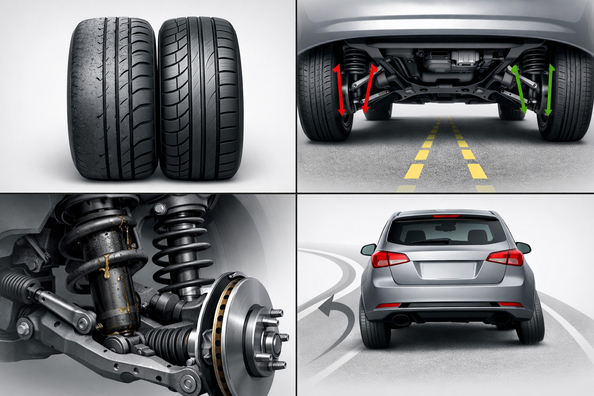
If your car pulls left or right on a straight road, the cause usually isn’t a single “bad alignment.” Most often the culprit is tire pressure, the tire itself, uneven wear, the brakes, or play in the suspension. That’s why mistake number one is going straight for a wheel alignment without checking the wheels first.
Proper diagnostics go from simple to expensive: cold tire pressure, a short test on a flat road, swapping the front tires, checking the brakes, and only then the alignment rack and a suspension inspection. This way you can quickly separate a tire issue from a suspension issue and avoid paying twice for something that doesn’t help.
A car drifts to one side when the left and right wheels generate different lateral force. Even a small pressure difference can cause it, as can a tire carcass defect, uneven wear, a sticking brake, or shifted angles after a pothole or curb hit.
There’s also an important nuance: not every slight drift is a malfunction. On a road with cross slope, the car may pull slightly toward the drainage side. That’s why you should test on the flattest, straightest section possible, without actively forcing the car to stay in the lane. If over about 100 m the car noticeably moves to one side, that’s a reason to look for the cause—not to get used to it.
DD Tuning expert comment: the most common mistake is doing two or three alignments in a row without checking the pressure and the tires themselves. The second typical story is relying on the TPMS warning light: it triggers late and won’t catch a small but already noticeable difference between tires. If after swapping the front tires the car starts pulling the other way, you should be looking not at the steering rack or subframe, but at the tire.
| Symptom | Likely cause | What to do |
|---|---|---|
| Car pulls constantly on a straight road | Unequal pressure, tire conicity, uneven wear | Equalize pressure, inspect wear, swap front tires to confirm |
| Pulls only during braking | Sticking caliper, hose issue, uneven pad operation | Check wheel temperatures after driving, diagnose the brake system |
| After a pothole the steering wheel is off-center and the car pulls | Alignment knocked out, bent wheel, damaged control arm or tie rod | Inspect suspension and wheels, then adjust alignment angles |
| After swapping front tires the car pulls the other way | Problem tire | Replace the tire or move it to another axle; don’t “fix” it with alignment |
| Wear only on the inner or outer shoulder | Incorrect camber, suspension play, toe issues | Check suspension, eliminate play, then do an alignment |
| On one road it pulls, on another it almost doesn’t | Road cross slope | Repeat the test on another flat section; don’t repair the car without confirming the issue |
What works is what removes the root cause. If it’s a pressure difference, setting the correct values on cold tires is enough. If a tire is at fault, swapping to confirm the diagnosis and replacing the problem wheel helps—not another trip to the alignment rack.
After a pothole hit, what really helps is a full check: wheel, play, control arms, tie-rod ends, and only then alignment. If the car pulls only during braking, repairing the brake assembly is what makes sense. One more thing that often pays off long-term is regular tire rotation: it doesn’t cure a defect, but it prevents wear from turning into a new cause of pulling.
Wheel balancing. It’s needed for vibration, runout, and steering wheel shake, but it doesn’t fix a steady pull to one side.
Alignment “by guesswork.” If the issue is a tire or suspension play, you can only push angles to extremes and accelerate tire wear.
Relying only on the tire pressure warning light. It may not show a small but already noticeable deviation.
Trying to “get used to it.” If the car pulls after an impact, uneven tire wear often follows, and the repair gets more expensive.
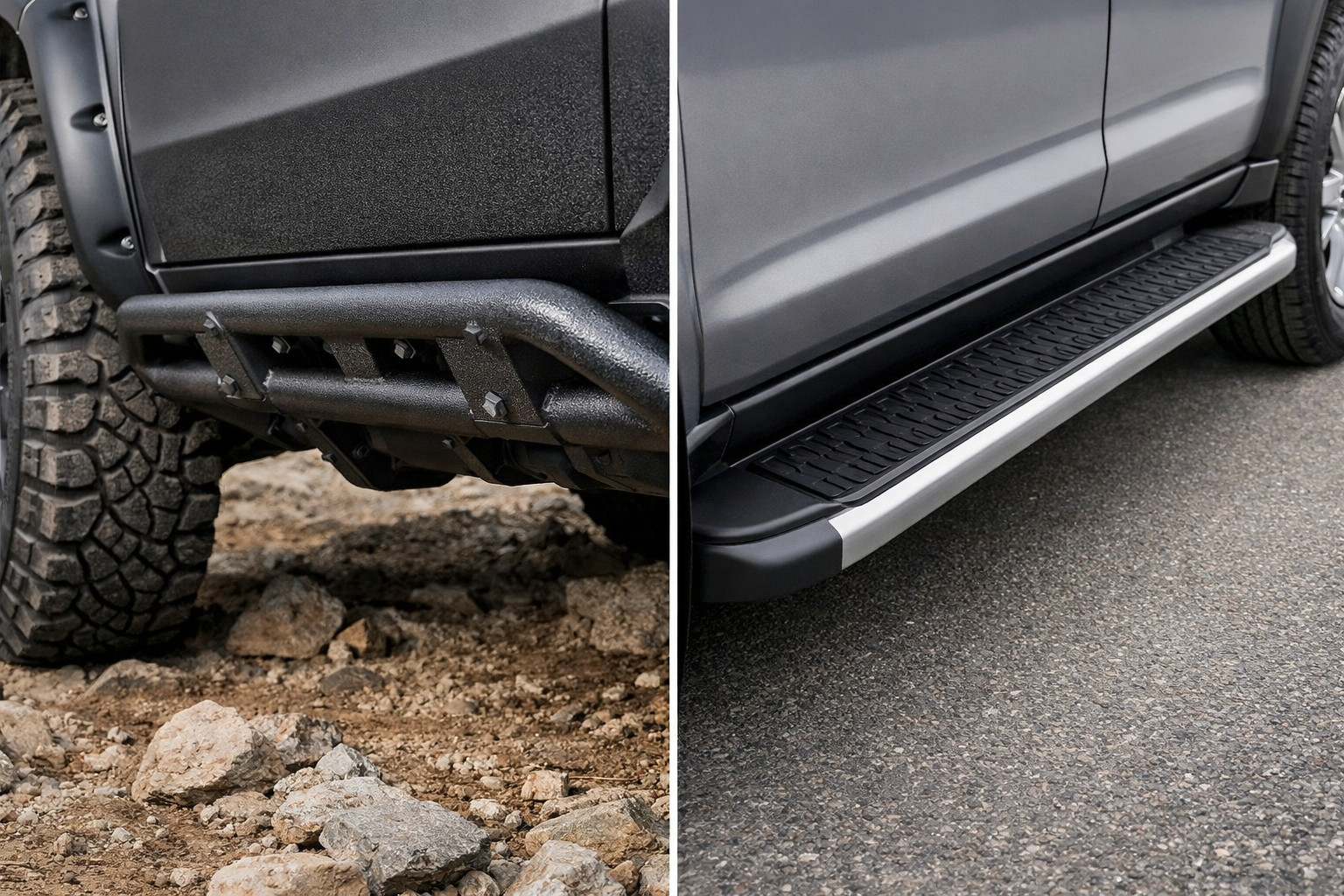
Accessories don’t cure the pulling itself. They make sense either as prevention against repeated impacts or when diagnostics have already identified a specifically damaged component. After driving on rough roads, engine skid plates and underbody protection are appropriate: they don’t correct alignment, but they reduce the chance of hitting components from below again.
If a pothole has bent a wheel, the money should go not to another alignment attempt, but to repairing or replacing the wheel. In that scenario it makes sense to look at categories like car wheels. Spacers, decorative parts, or any “handling upgrades,” however, won’t fix a tire defect or a bent suspension.
| Solution | When it works | When it’s not worth spending money |
|---|---|---|
| Correcting tire pressure | There’s a difference between tires or a seasonal pressure drop | Pressure is equal but the car still pulls |
| Swapping front tires for diagnosis | Tires are non-directional and you need to check suspected conicity | Directional tread or a staggered wheel setup |
| Replacing the problem tire | The pull direction changes after swapping; there’s a defect or uneven wear | The real cause is in the brakes or suspension |
| Wheel alignment | After an impact, suspension repair, new tire installation, with confirmed angle shift | There’s play in the suspension or the tire itself pulls the car |
| Brake system repair | The car pulls mostly during braking | Without braking, the problem is the same |
| Replacing suspension or steering components | There’s play, deformation, impact damage, or alignment won’t hold | Suspension is fine and only the tire or pressure is to blame |
From a customer’s experience: after two alignments, the crossover still pulled to the right even though the rack numbers were within spec. On a flat road the behavior didn’t change, but after swapping the front tires the car started pulling to the left. In the end they replaced one front tire, did one контрольный alignment check, and the problem disappeared without unnecessary suspension work.
When a car pulls to one side, most often the culprit isn’t “mystical angles,” but basic things: pressure, the tire, wear, brakes, or the aftermath of an impact to the suspension. The right order is simple: cold pressure, a test on a flat road, tire checks, brakes separately, then suspension and the alignment rack. This helps you avoid confusing pulling with road crown, avoid expecting miracles from balancing, and avoid paying for unnecessary adjustments. This material is based on real selection experience, hands-on practice, and real usage scenarios—not theory without road verification.
Shipping to EU
Wholesale and retail
Own warehouse
Опис продукту
Подарунки не надаються при оформленні покупки у кредит під 0,01% або при покупці частинами.