07.06.2026
5256
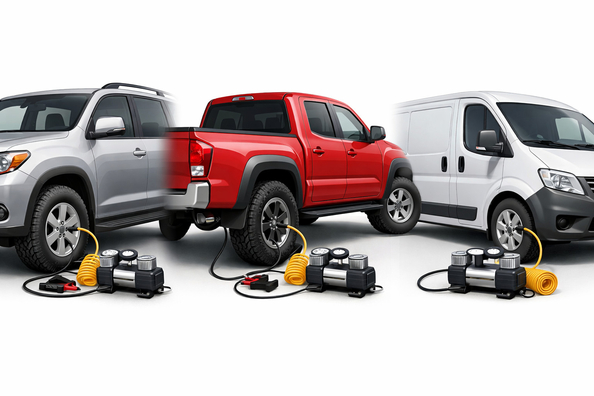
For an SUV, pickup, or van, the problem is usually not that the compressor is “bad”, but that its class doesn’t match the tire volume and the power supply method. On large wheels, a weak 12V model that plugs into the cigarette lighter runs for a long time, heats up, causes voltage drop, and often can’t handle inflating several wheels in a row.
A practical rule of thumb is simple: for tires up to 33 inches, a compressor around 20–32 A and 42–87 l/min is usually enough; for 33–35 inches, it’s better to look at 23–30 A and 51–65 l/min; and for big wheels, a long-wheelbase van, or dual rear wheels, you need a noticeably higher class. What matters is not only the pressure numbers on the box, but first and foremost airflow, duty cycle, and direct power from the battery.
On a crossover, pickup, or van, a wheel has a larger internal volume than on a passenger car. That means the compressor must not just “be able to pump to 8–10 bar”, but actually deliver enough air volume without overheating. That’s why a compact model that still works tolerably on a small tire suddenly becomes slow and exhausting on a 32–35-inch tire.
The second reason is power supply. Many cabin sockets are limited to about 15 A or 180 W. For a large tire, this is often not enough, so the compressor either can’t reach normal output, or it heats the plug, or it blows the fuse. On a van this is felt even more because there are more wheels, and it’s harder to reach all points with the short included hose.
DD Tuning expert comment: the most common mistake is choosing a compressor by maximum pressure rather than by airflow and current draw. The second typical story is plugging a powerful model into the cigarette lighter, after which the owner thinks the compressor is faulty. For large wheels, first check power from the battery, the real inflation time for one tire, and only then draw conclusions.
| Symptom | Likely cause | What to do |
|---|---|---|
| The compressor takes a very long time to inflate a large wheel | Too little airflow for an SUV, pickup, or van | Move to a higher-output class instead of looking for a model with higher “maximum pressure” |
| After 1–2 wheels the housing is hot, then it inflates even slower | Duty cycle exceeded, overheating | Let the compressor cool down and next time choose a model with a 50–100% duty cycle for back-to-back inflation |
| Blows a fuse or the plug heats up | Powering through a socket with a current limit | Connect directly to the battery or via a dedicated power connector; run it with the engine running |
| The compressor is loud but the flow is weak | Voltage drop due to a thin cable, poor contacts, or a weak battery | Shorten the power line; check clamps, wire, fuse, and battery condition |
| Pressure keeps dropping even though the compressor seems fine | Leak via the valve, puncture, bead seating, or seasonal cold | Soapy water test, valve check, and measuring pressure when cold |
| The tire “always needs to be inflated to the maximum” | Using the wrong pressure value as a reference | Use the recommended pressure on the vehicle placard, not the maximum on the sidewall |
What works best is choosing a compressor not “just in case”, but for your wheel size and scenario. If it’s a crossover or pickup on wheels up to 33 inches, a good 12V compressor powered from the battery is usually enough. If it’s 33–35 inches, regular off-road trips, or a heavy van, you already need a performance margin and a proper duty cycle.
The second thing that really helps is powering it with the engine running. This gives the compressor more stable voltage and puts less load on the battery. For a van or long-wheelbase vehicle, a long hose is more practical than a long thin power cable: it’s safer for the electrical system and more stable for performance.
If you often deflate and reinflate tires, a hard-mounted compressor or a powerful portable model with a high duty cycle pays for itself very quickly. If you only need inflations rarely, a quality portable model is enough—but not the weakest class.
If you just need a reliable portable option for the road, it makes sense to start with the category of tire inflators. If you’re unsure what class to choose for your wheels and usage pattern, it’s useful to first go through the material how to choose an автомобильний компресор.
Replacing the hose, chuck, clamps, or power wire makes sense when the compressor itself is still fine, but there’s a leak at a connection, contacts are heating up, or a power drop is visible. But if the model is too weak for your wheels from the start, a small repair won’t change the device class—then it’s more rational to move to a more productive level, for example a 85 l/min compressor or an equivalent in capability.
For a van, commercial transport, or a vehicle with dual rear wheels, it’s also worth evaluating hose length and access to all wheels. Sometimes the problem isn’t the pump itself, but that the kit is physically inconvenient to use.
| Solution | When it works | When it’s not worth spending money |
|---|---|---|
| Portable 20–32 A compressor powered from the battery | For a crossover or pickup with wheels up to 33 inches and infrequent inflation | If you have very large wheels, many wheels in a row, or regular intensive use |
| More powerful portable class 23–30 A with a good hose | For 33–35 inches, a long-wheelbase vehicle, a van, frequent trips | If the only issue is a valve leak or incorrect pressure measurement |
| High-duty-cycle model or onboard compressor | When you need to inflate several wheels back-to-back after every trip | If you inflate tires a few times per season and value versatility for different vehicles |
| Replacing wire, clamps, fuse at the OEM rating, hose | When the compressor is the right class, but loses performance due to power supply or leaks | If the pump is too weak from the start and can’t handle your tire size |
| Checking pressure on cold tires and searching for leaks | When it seems the “compressor can’t cope”, but in reality pressure drops due to cold or leakage | If there is already obvious overheating, blown fuses, and weak airflow even on a sound tire |
From a customer’s experience: a van owner first looked for a compact cigarette-lighter compressor because he didn’t inflate often. In practice, the rear wheels took a long time, the plug heated up, and after two wheels he had to take a break. After switching to a model powered from the battery and a longer hose, inflating all wheels became predictable, and the fuse problem disappeared.
For an SUV, pickup, or van, the right compressor is chosen not by the “maximum pressure” label, but by airflow, current draw, duty cycle, and power type. If you have large wheels, several tires in a row, or a long wheelbase, a cigarette-lighter compressor will almost always be a compromise that quickly becomes annoying.
The rational approach is: first check pressure on cold tires, rule out leaks, evaluate the power supply, and only then decide whether connection repairs are enough or whether you need a higher-class compressor. This material is based on real selection experience, practice, and real-world usage scenarios—not abstract numbers from the box.
| ✔ | For an SUV, pickup, or van, you can choose a compressor for a specific wheel size instead of taking a “universal” one at random. The article gives clear guidelines on current, output, and power supply for tires up to 33, 33-35 inches, and larger wheels. |
| ✔ | Direct connection to the battery provides a more stable power supply for more powerful models. This reduces the risk of voltage drop, plug overheating, and blown fuses. |
| ✔ | For frequent top-ups or several wheels in a row, models with a high duty cycle work better. This is more practical than a compact compressor that overheats quickly after 1-2 wheels. |
| ✔ | The article also helps distinguish a compressor problem from a tire leak or incorrect pressure measurement. This saves time and reduces the chance of buying a new pump instead of fixing the cause. |
| ✔ | For vans and long-wheelbase vehicles, it is useful to choose a longer hose rather than a long thin power cable. This approach is safer for the electrical system and more convenient when working at all wheels. |
| ✘ | A weak cigarette-lighter compressor for large wheels works slowly and often overheats. As a result, inflating several wheels in a row becomes inconvenient and takes longer. |
| ✘ | The cabin socket is often current-limited, so it may not be enough for powerful models. Because of this, the plug heats up, performance drops, or the fuse blows. |
| ✘ | If the model is initially chosen for the wrong tire size, a small repair will not solve the device class problem. In that case, you will still have to switch to a more powerful compressor. |
| ✘ | For regular work with large wheels or a van, a simple portable option can quickly become a compromise. This is especially noticeable if many wheels need inflating or if there is a long wheelbase and difficult access. |
Shipping to EU
Wholesale and retail
Own warehouse
Опис продукту
Подарунки не надаються при оформленні покупки у кредит під 0,01% або при покупці частинами.