
29.07.2026
194
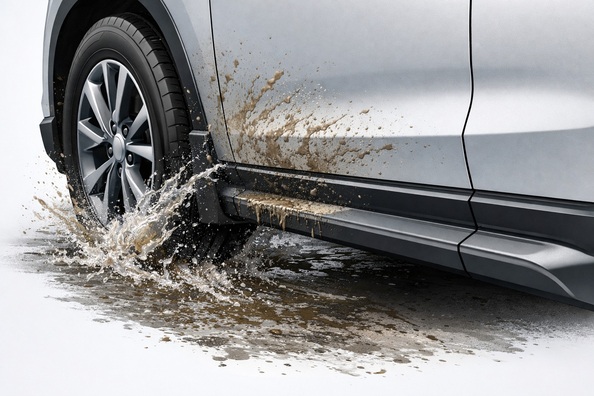
If after rain a dirty streak appears on the doors and sills, stretching from the front wheel arch backward, the source is usually not outside dirt, but your own wheels. The tire picks up water and fine grime from wet asphalt, and the airflow in the wheel well carries it along the side of the body.
This doesn’t require big puddles or highway speeds. In the city, a thin film of water, patches, ruts, joints, and damp asphalt near the curb are enough. That’s why the issue often shows up even at low speed—especially on cars without proper front splash protection or with poorly matched wheels.
The mechanics are quite simple: the tread collects water from the road, forms a side wave, and throws droplets outward and backward. After that, everything depends on the shape of the wheel well, the wheel’s position relative to the fender, and the airflow along the body. If the pressure drop near the front arch favors carrying droplets out, they fly not downward, but onto the sill and the lower part of the doors.
A typical trace of this issue: the dirt starts immediately behind the front wheel and runs along the sill. If, instead, the rear bumper, tailgate, or license plate gets dirtier, the source is more often the rear wheels and the rear wake.
In the city the effect isn’t weaker just because speeds are lower. On uneven wet pavement, the wheel constantly moves from water to a drier section, and each transition creates a new burst of droplets. That’s why even a short neighborhood trip can leave the doors dirty.
The simplest check is to wash the side of the car, drive 5–10 km on your typical wet city route, and see where the first trace appears. If the dirt starts right behind the front arch, you should look at the front wheels, tires, and splash protection—not the rear of the car.
Next, compare the left and right sides. If one side is noticeably dirtier, the cause may be different pressure, different tire wear, driving closer to the curb where there’s more water, or how that specific wheel works over uneven surfaces. If both sides get equally dirty, the culprit is more often the flow geometry itself and insufficient front protection.
Separately check three things: actual cold tire pressure, tread condition across the full width, and the wheel’s position relative to the fender. If the tire is close to the limit, worn on the edges, or the wheel protrudes more than stock, the cause becomes clear. If after a speed bump the car makes an extra nod or bounces, the suspension should also be ruled out not just by words, but by inspection.
DD Tuning expert comment: The most common mistake is looking only at the car brand and ignoring the actual tire width and wheel position. If the wheel has a different offset or the tire is wider than stock, a small mud flap may still be in place but no longer intercepts the main stream. Before buying, it’s worth assessing where the dirty streak really starts and whether the wheel protrudes past the fender line.
| Symptom | Likely cause | What to do |
|---|---|---|
| A dirty streak starts at the front arch and runs along the sill | The front wheel throws water onto the side; protection is too small | Check front mud flaps, wheel position, tire size |
| Both sides get dirty even after light drizzle | Thin water film plus arch design and weak splash protection | Start with front mud flaps and control speed before wet sections |
| One side is consistently dirtier than the other | Different pressure, different tire wear, or driving through water closer to the curb | Check pressure, inspect tread, compare behavior on a different route |
| The problem got worse after different wheels or wider tires | The wheel moved outward; factory protection no longer blocks the spray | Choose enlarged splash protection to match the actual wheel geometry |
| The rear bumper and license plate get the dirtiest | The main contribution comes from the rear wheels and the rear wake | Don’t expect an effect from front-only solutions; look at the rear |
| On wet joints and waves in the asphalt there’s suddenly much more spray | Local water buildup and extra suspension movement | Reduce speed before uneven surfaces; check shock absorbers |
| Together with dirt, small chips appear on the lower doors | Not only water but also abrasive from the road is hitting | Combine splash protection with additional paint protection |
If the car has no front protection or the factory pieces are too small, it’s logical to start with mud flaps. They make the most sense when the dirty streak starts right behind the front wheel and the lower doors are constantly wet and abrasive.
If the doors and sills are already sandblasted, and in winter a mix of water and road chemicals constantly hits the body, it’s worth adding protective film for the sills. It doesn’t reduce the spray itself, but it takes the wear and small chips.
When the problem is not only dirt but also constant rubbing on the edge, passenger entry, or loading, door sill plates are appropriate. This is mechanical protection of a vulnerable area, not a remedy for the water plume.
Replacing components is necessary when you can see a cause that an accessory won’t cover: the tread is near the limit, the tire wears unevenly, or the car oscillates too much over wet uneven surfaces. A new mud flap won’t compensate for bad tires or a tired shock absorber.
| Solution | When it works | When it’s not worth spending money |
|---|---|---|
| Front vehicle-specific mud flaps | The dirt streak starts at the front arch; wheels are close to stock geometry | If the wheel protrudes far outward and the part is very small |
| Enlarged non-stock mud flaps | Wider tires, different wheel offset, changed ride height | If every centimeter of ground clearance is critical for you, or the issue comes from the rear of the car |
| Rear mud flaps | The rear bumper, plate, and tailgate get dirty the most | When the main trace runs along the doors from the front wheel |
| Pressure correction and replacing worn tires | Tread is worn, water evacuation is worse, wet-road behavior is unstable | If the tires are fine and the root cause is wheel geometry and weak protection |
| Checking and replacing shock absorbers | Spray increases sharply on waves; the car bounces and sways | If the suspension works normally and contamination is uniform on typical wet pavement |
| Protective film for lower areas | You need to protect paint from abrasion and small chips | If you expect the body to become cleaner by itself |
| Door sill plates | You need to protect the edge from mechanical scuffs | If the goal is to reduce the water plume from the wheel |
From a customer’s experience: the owner of a city crossover complained that after any rain the lower part of the front doors immediately turns gray, while the rear bumper stayed relatively clean. After inspection it turned out the car had wider winter tires and the factory front protection was very short. As a result, a combination of enlarged front splash protection and sill protection from abrasive worked: the body didn’t become perfectly clean, but the dirty streak became much lower and the doors wash off without new sandblasting marks.
Spray on doors and sills in the city is mostly the result of self-contamination from your own wheels, not some strange washing quirk or just bad weather. Most often, the culprit is a combination of wet pavement, tire condition, wheel geometry, and insufficient front splash protection. That’s why the right order of actions is: first understand where the dirty streak starts, then check tires, pressure, and suspension, and only after that choose accessories.
The best result usually comes not from one magic part, but from a set of the right solutions: front protection matched to the actual wheel, good tires, and, if needed, additional paint protection. This material is based on real fitting experience, practice, and real use scenarios, so the main advice is simple: don’t treat the symptom with a random part—remove the exact cause that exists on your car.
| ✔ | Explains why the splashes come from your own wheels, not from “bad weather” or washing the car. This helps avoid looking for the problem in the wrong place. |
| ✔ | Provides a practical diagnostic method: wash the side of the car, drive a typical wet route, and see where the dirty streak starts. This approach helps determine whether the front wheels, rear wheels, or suspension are to blame. |
| ✔ | Breaks the causes down by specific factors: tire pressure, tread wear, tire width, wheel offset, ride height, and shock absorber condition. This makes inspection easier without unnecessary guesses. |
| ✔ | Clearly separates solutions that really work from those that give only a weak or short-term effect. For example, it shows when front mud flaps are needed and when it is already worth thinking about sill protection or tire replacement. |
| ✔ | Explains that the problem is also real in the city because of wet asphalt, joints, and ruts, so it is not tied only to highways or large puddles. This is useful for everyday use. |
| ✘ | The material returns many times to the same idea about splashes from the front wheels, so some blocks partially repeat one another. Because of this, the text reads less compactly. |
| ✘ | There are plenty of mentions of mud flaps, film, and overlays, but no exact recommendations on choosing the size, shape, or installation method. For practical selection, this may be not enough. |
| ✘ | The solutions are presented mainly as general principles rather than a step-by-step guide for a specific car. If the cause is mixed, the text does not always make it clear where to start first. |
| ✘ | The article almost does not provide boundaries for when the problem should no longer be solved with accessories and when it is necessary to go for a full suspension or alignment diagnostic. Because of this, some cases will have to be determined on your own. |
Shipping to EU
Wholesale and retail
Own warehouse
Опис продукту
Подарунки не надаються при оформленні покупки у кредит під 0,01% або при покупці частинами.