21.06.2026
580
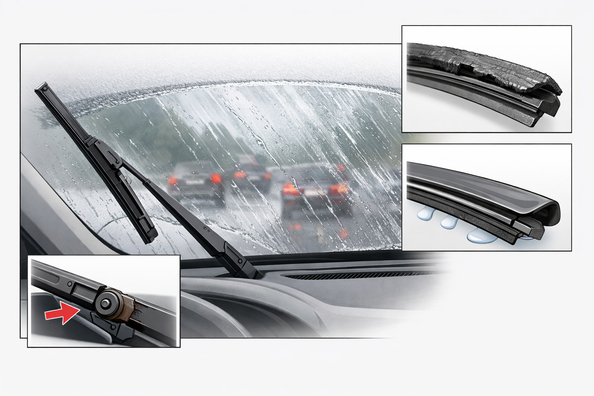
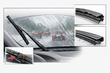
If your wipers have stopped removing water and instead drag it across the glass as a greasy haze or streaks, the problem isn’t always the blades themselves. Most often, the culprit is a film on the windshield, a dirty or hardened rubber edge, weak arm pressure, or winter conditions when ice forms in the joints and on the wiping edge.
The right order is simple: first separate dirt/film from wear, then check pressure and angle, and only after that buy new blades. Otherwise, it’s easy to spend money twice and get the same result.
A wiper works properly only under three conditions: the rubber edge is straight and elastic, the glass is clean with no greasy film, and the arm presses the blade evenly along its entire length. If even one point is missing, water isn’t cut into a thin layer — it gets smeared.
In practice it often looks like this: after a wash with wax or after highway driving, an invisible residue appears on the glass, and even a new blade starts smearing. On curved windshields, after glass replacement, or at high speed, the issue can get worse due to the wrong contact angle or weak pressure.
Start with checking, not buying. If after properly washing the glass and wiping the edge with a damp wipe the blade “comes back to life” for a few passes, the source is most likely dirt or film. If a streak stays in the exact same place, look for a local defect on the edge or a spot of contamination on the glass.
If the blade wipes clean in one direction but smears on the return stroke, that’s a typical sign of incorrect geometry or a hardened edge. If one wiper works fine and the other constantly streaks, the suspicion falls not on the fluid but on that specific blade, its size, adapter, or arm.
In winter, the check is even simpler: after warming the glass and thawing the joints, the performance noticeably improves — meaning the problem wasn’t wear, but icing. If quality drops sharply at speed, it’s worth checking the blade type, spoiler, and pressure.
DD Tuning expert comment: The most common mistake is immediately replacing a set of blades without cleaning the windshield itself from wax, road film, and old washer fluid. The second typical story is installing the wrong size or adapter, so the blade works at the wrong angle. In winter, many people blame it on “bad rubber,” although after thawing the joints and changing the fluid, the problem disappears.
| Symptom | Likely cause | What to do |
|---|---|---|
| Greasy haze across the entire wiped area | Film on the glass or poorly chosen washer fluid | Deep-clean the glass, drain or replace the fluid, flush the nozzles |
| One or two постоянні streaks | Chip/tear in the edge, localized dirt | Inspect the rubber, clean it, and if there’s damage replace the blade |
| Clean in one direction, smears on the return stroke | Incorrect arm angle or hardened edge | Check geometry and pressure; if needed replace the blade or the arm |
| Problem only in мороз or wet snow | Ice in the joints, summer fluid, hard rubber | Thaw it, fill with winter fluid, consider winter blades |
| Missed spots appear at high speed | Weak pressure, unsuitable blade type, damaged spoiler | Check the arm, blade type, and correct installation |
| New blades smear the same as old ones | The issue isn’t the rubber, but the glass or mechanics | Don’t replace the set again — check the glass, angle, and arm spring |
What works best isn’t one magic product, but the right sequence. First, wash the windshield thoroughly to remove ordinary dirt and greasy film, especially the lower resting zone where the blades park. Then clean the blades themselves gently, without aggressive solvents, and check whether a black or dirty mark remains on the wipe.
Next, assess the blade itself: if the edge is wavy, frayed, or the rubber has gone hard, cleaning won’t save it. Check the washer system separately: the wrong or old fluid can create a dirty film on its own, especially in the shoulder seasons. If the problem repeats only on one side or after windshield replacement, the issue is often not the rubber but the arm’s angle and clamping force.
Simply installing new blades on dirty or waxed glass is almost guaranteed to be a temporary fix. It may improve for the first few days, but then the smearing comes back.
A bad idea is rubbing the edge with gasoline, harsh solvents, or ripping off frozen blades by force. That quickly destroys the rubber. Likewise, don’t expect any additive, rain repellent, or “magic” spray to correct a bent arm angle or a torn edge.
If the rubber has already hardened, there are tears, or you need a different type for your specific vehicle, it makes sense to choose new wiper blades. When symptoms get worse in мороз, the right washer fluid is just as important: a weak or season-inappropriate mix often creates film and icing by itself. And if the car is often used on the highway or the windshield has a complex curve, it’s worth separately understanding when frameless wipers really help.
Replacing the arm or adjusting it makes sense when the blade smears only on the return stroke, chatters, doesn’t press down at the edge, or the issue doesn’t go away after cleaning the glass and installing new blades. But buying a more expensive set without checking the glass and mechanics usually doesn’t make sense.
| Solution | When it works | When it’s not worth spending money |
|---|---|---|
| Deep cleaning the glass | There’s film, wax, insect marks, road residue | If the edge is already damaged or the arm is bent |
| Cleaning the blades | The rubber is still good but dirty | If it’s cracked, hard, or frayed |
| A new set of blades | There’s wear, hardening, the wrong size or type | If the glass is still dirty or the cause is pressure |
| Winter washer fluid | The problem appears in мороз, there’s icing and a dirty trace after spraying | If in warm weather the streaks come from a damaged blade |
| Frameless or winter blades | There’s icing, uneven pressure on curved glass, ухудшення at speed | If the cause is localized film on the glass or a misaligned arm |
| Adjusting or replacing the arm | The blade works only one way, chatters, one edge doesn’t press down | If the problem disappeared after proper glass cleaning |
| Rain repellent or third-party additives | Only as an extra effect on clean glass, not as a repair | If you want to use them to mask blade wear or a mechanical defect |
From a customer’s experience: first, the person replaced the blades twice because they started smearing almost immediately after installation. In the end, the cause wasn’t the rubber, but a film after a wax wash and weak winter fluid that left a dirty trace in freezing temperatures. After proper glass cleaning, replacing the fluid, and switching to the right blade type, the problem disappeared without wasting money on a third set.
When wipers smear water, most often it’s not “bad blades” to blame, but dirty glass, film, a worn edge, or incorrect pressure. That’s why what works isn’t random part swapping, but step-by-step диагностика: glass, rubber, fluid, arm angle and spring — and only then new blades or other accessories.
This approach helps you distinguish a cheap fix from a mechanical issue and avoid spending money blindly. The material is based on real selection experience, hands-on practice, and real-world use cases, where the cause is almost always found after a proper check — not after the second or third random purchase.
Shipping to EU
Wholesale and retail
Own warehouse
Опис продукту
Подарунки не надаються при оформленні покупки у кредит під 0,01% або при покупці частинами.