28.05.2026
340
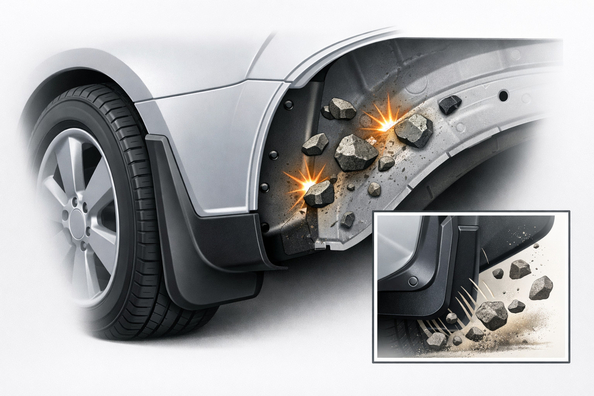

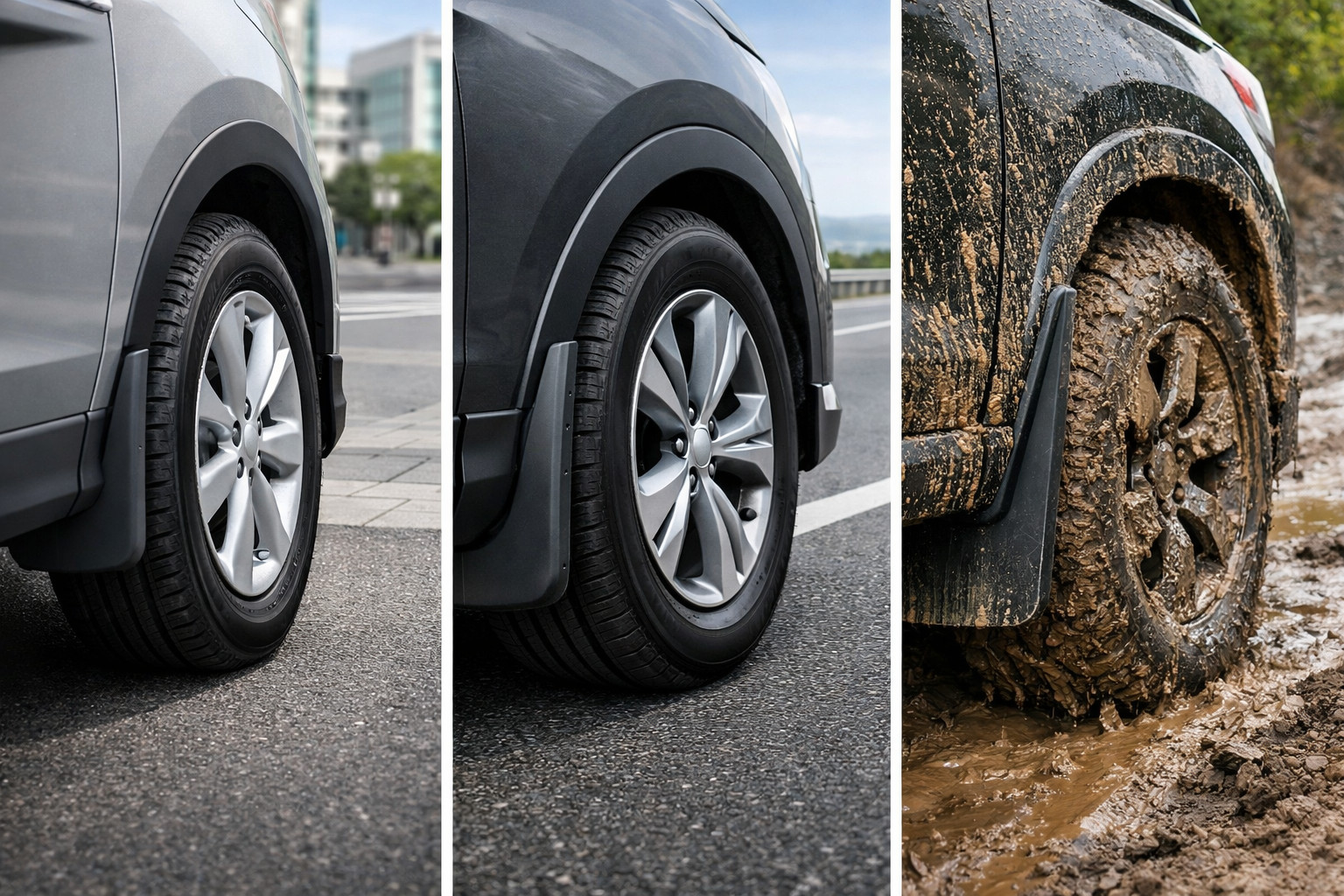
Yes, mud flaps usually reduce stone hits on the rear arches, but on their own they rarely solve the problem completely. They do a good job knocking down spray, dirt, slush, and some fine gravel, but on loose gravel, with wider tires, or on a body with an exposed side area, chips will still appear.
In short, it’s not one part that fixes it, but the right combination: a mud flap that actually blocks the stone’s trajectory, plus protection for the impact zone itself on the front edge of the rear arch. That’s where paint most often gets knocked off.
A stone doesn’t “just fly into the arch” — the tread picks it up at the tire’s contact patch and throws it in an arc toward the body. For the rear arch, the most vulnerable spot is its front edge: that’s where fine gravel flies if it wasn’t intercepted by the mud flap or a body element.
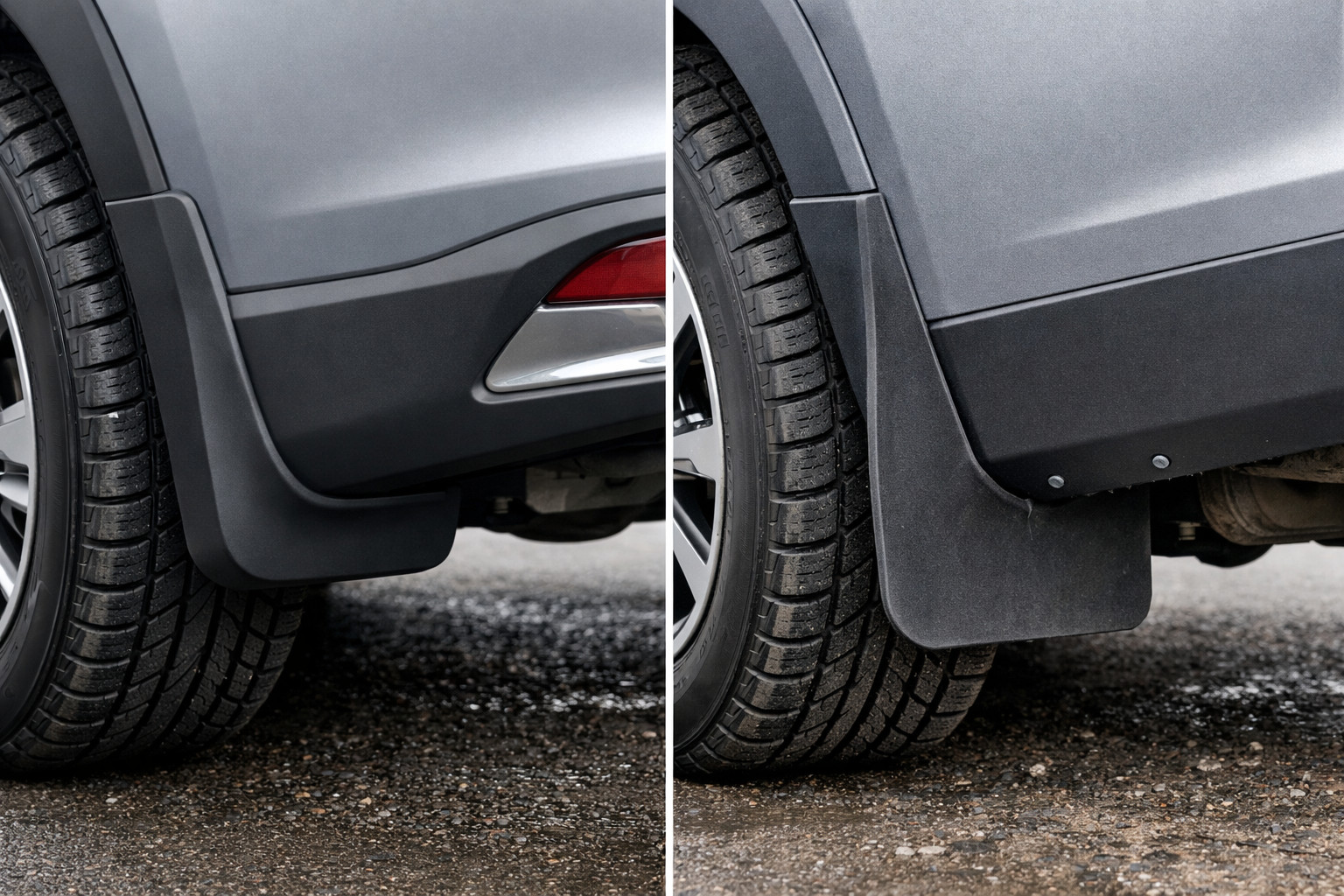
The rougher the surface, the higher the speed, and the wider the tire, the stronger the abrasive поток. If the mud flap’s lower edge sits too high or the mud flap is narrow, some stones pass by and hit the paintwork directly.
DD Tuning expert comment: the most common mistake is installing a short universal mud flap and expecting full arch protection. The second typical mistake is covering only the inner liner area while leaving the front edge of the rear arch unprotected — where the main impact happens. If the tire protrudes beyond the body, without protecting the chip zone itself, the result is almost always incomplete.
| Symptom | Likely cause | What to do |
|---|---|---|
| Chips concentrated on the front edge of the rear arch | Typical stone trajectory from the wheel; the mud flap doesn’t block the flow | Choose a longer vehicle-specific mud flap and cover the impact zone with anti-gravel film |
| The problem gets much worse after gravel roads | Coarse gravel and speed create a stronger impact | Reduce speed on loose surfaces; don’t rely on mud flaps alone |
| The body gets heavily splashed with dirt and water along the side | No mud flap, or it’s too short | Install properly sized mud flaps, especially for daily use |
| Chips appear even after installing mud flaps | Wide tires, increased track width, or the kit is mounted too high | Check wheel offset, tire width, and the mud flap’s real length; add film |
| The inner part of the arch and the lower liner area suffer | Insufficient protection of the inner wheel well | Add inner fender liners, but don’t confuse them with protection for the outer arch edge |
| In winter, mud flaps seem to help, but buildup appears | Snow and ice accumulate on the part | Clean regularly, check mounting, and avoid overly rigid long versions for harsh conditions |
The most consistent results come from a combination, not a single accessory. Level one is a mud flap that knocks down the main flow of dirt and small stones. Level two is anti-gravel film on the impact zone itself, because it takes what still gets through.
If the car is driven mostly in the city, on the highway, and through seasonal slush, the first logical step is mud flaps. They do reduce the amount of dirt and some impacts, but you should choose them not just “to fit,” but so the lower edge works along the stone trajectory.
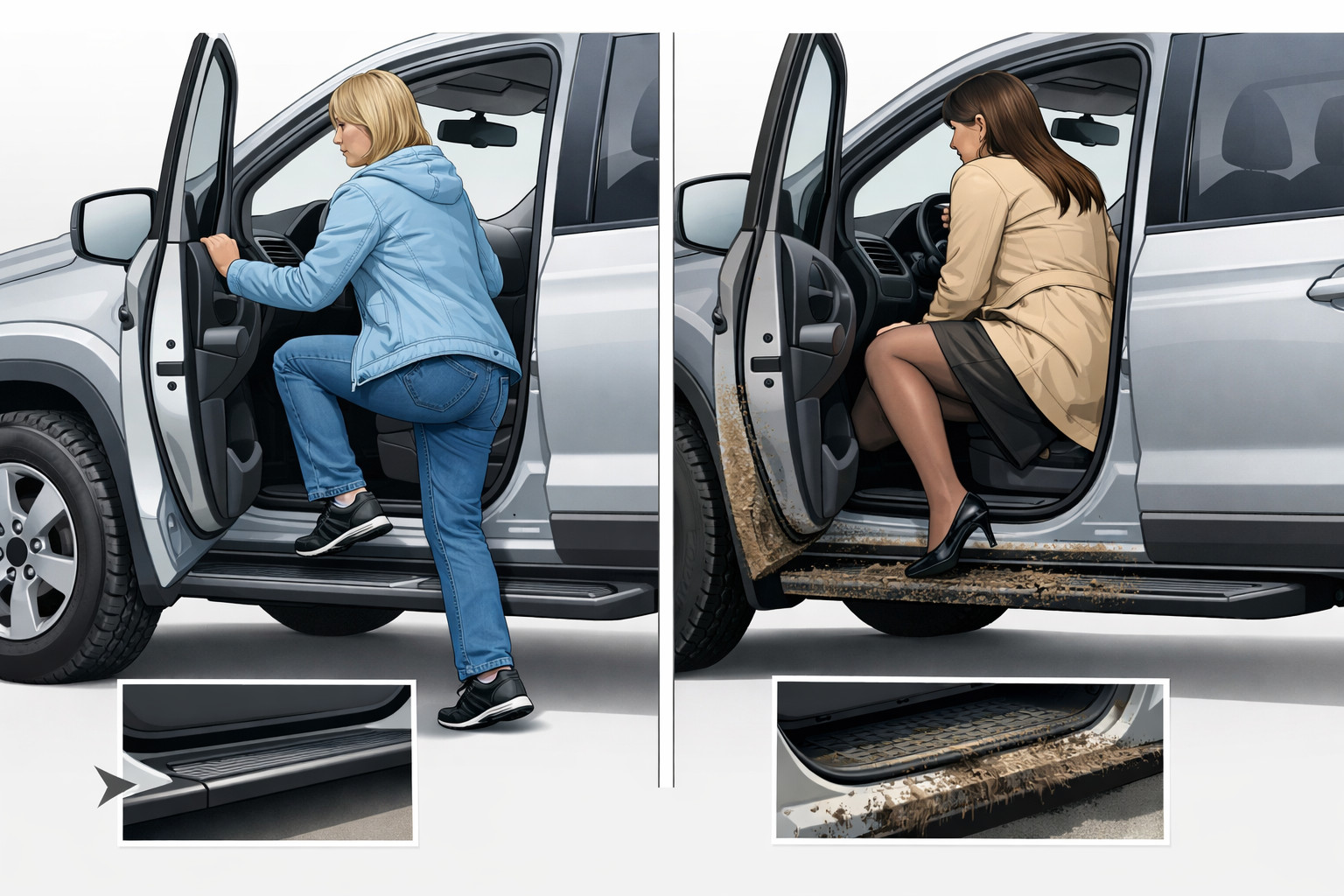
If the damage also affects the inner wheel well area, it makes sense to look at inner fender liners. And on taller crossovers, SUVs, and pickups where the flow travels along the side, side steps sometimes help as an additional screen. If an old mud flap is torn, hardened, or clearly too short, repairing it makes little sense — you need a replacement with proper geometry. Another important point: not all kits are compatible with each other, so they must be selected for the specific vehicle design.
| Solution | When it works | When it’s not worth spending money |
|---|---|---|
| Longer vehicle-specific mud flaps | Daily driving, wet roads, fine gravel, winter | When the tire protrudes far beyond the body or the vehicle often drives harsh off-road |
| Anti-gravel film on the impact zone | When chips hit the same spot every time | If the surface already needs body repair, not just protection |
| Mud flaps plus anti-gravel film | The best option for highway, gravel, and mixed use | If you expect impacts to disappear completely on wide wheels without other changes |
| Inner fender liners | When you need to protect the inner wheel well from dirt and sandblasting | If the goal is to save the outer arch edge without additional protection |
| Side steps | On taller vehicles where stones and dirt travel along the side | On passenger cars where the main impact is localized only on the arch edge |
| Rigid long mud flaps | For calm road use with no off-roading | When the vehicle regularly catches ruts, snow, or obstacles off asphalt |
From a customer’s experience: a crossover owner came in with chips right on the front edge of the rear arches and initially wanted to limit it to mud flaps only. After inspection, it was clear the tire protruded slightly outward, so we chose a longer set and additionally covered the impact zone with anti-gravel film. After that, new stone marks on daily routes practically stopped accumulating, although nobody promised zero chips on gravel.
Mud flaps don’t invent the problem and they don’t solve it magically: they really help, but most often they only reduce the number of stone impacts on the rear arches. If you want a proper result rather than a temporary effect, look at mud flap geometry, tire protrusion, and protecting the chip zone itself with anti-gravel film. This conclusion is based not on theory, but on real selection experience, practice, and real use scenarios where mud flaps alone don’t work well in every case.
| ✔ | Mud flaps do reduce the amount of spray, dirt, slush, and some of the small gravel flying toward the rear arch. This is especially noticeable in everyday driving on wet roads and in winter. |
| ✔ | Longer model-specific mud flaps can really reduce the load on the body if their lower edge blocks the path of the stones. For city driving, highways, and mixed use, this is a practical solution. |
| ✔ | Anti-gravel film on the front edge of the rear arch covers exactly the area where the paint most often gets chipped. Together with a mud flap, it gives a noticeably better result than either accessory on its own. |
| ✔ | On taller vehicles, where stones and dirt travel along the side, side steps can also help. They work as another shield and partially block the flow of abrasive debris. |
| ✘ | Short or universal mud flaps often end too high and do not cover the main path of the stones. In that case, chips on the rear arch still appear. |
| ✘ | If the tires are wider than stock or stick out beyond the body line, one mud flap is usually not enough. Then the impact on the arch remains even after installing protection. |
| ✘ | On gravel, coarse asphalt, and winter slush, mud flaps only reduce the problem, but do not eliminate it completely. At high speed, the flow of abrasive debris becomes so strong that some of the stones still reach the paint. |
| ✘ | Rigid long mud flaps are not universal: on vehicles that regularly go off-road, they can catch and tear off. This makes them an inconvenient option for harsh operating conditions. |
Shipping to EU
Wholesale and retail
Own warehouse
Опис продукту
Подарунки не надаються при оформленні покупки у кредит під 0,01% або при покупці частинами.