07.06.2026
614
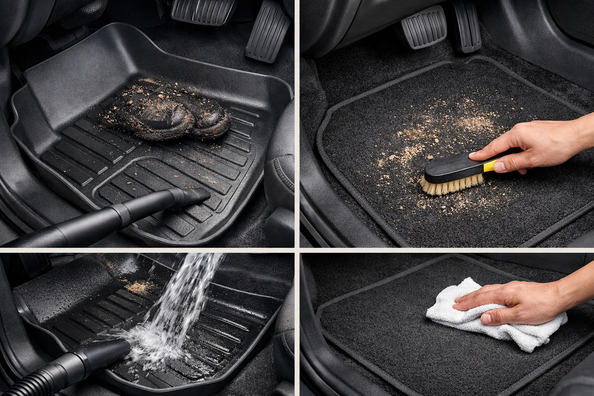
If you need a quick takeaway: for mud, snow, wet shoes, kids, and frequent trips, mats with raised edges are more convenient—they hold water better and are easier to wash. Flat mats win where the cabin is mostly dry and you want a softer feel underfoot, quieter driving, and easier day-to-day removal.
The biggest mistake with this topic is looking only at the material. In everyday use, the shape for your specific floor, OEM fastening points, edge height, stiffness, and whether the mat interferes with the pedals matter just as much.
The difference between these two options isn’t “looks” but how they behave every day. A mat with raised edges works like a tray: it traps water, salt, and sand and prevents it from quickly spreading into the cabin carpet. A flat mat doesn’t do that, but it’s often nicer in dry use.
So the logic is simple. If you regularly get into the car with wet shoes, drive in winter, carry kids or a dog, or often go outside the city, raised edges are more practical. If the car is mostly used in town, the interior stays clean, and footwell dirt is rare, a flat mat can be more convenient for everyday driving.
One more important point: the benefits of any type disappear if the mat is universal, slips around, or sits on top of another mat. Safety matters more here than material or price.
| Option | Strengths | Weaknesses | Best for |
|---|---|---|---|
| Mats with raised edges | Contain water, snow, sand, and salt better; faster to clean; protect the factory floor covering better | More expensive; sometimes stiffer; can be less convenient to install if the shape or fasteners aren’t great | Those who drive daily, in winter, with kids or pets, or often get in with dirty shoes |
| Flat mats | Softer to the touch; often quieter; usually cheaper; convenient for dry city use | Worse at holding liquid; textiles take longer to clean and dry; higher chance of soaking the factory carpet | Those who mostly drive in dry conditions and want more comfort than dirt protection |
DD Tuning expert comment: most often people don’t get it wrong between “edge or no edge,” but between “vehicle-specific or whatever fits.” If the mat leaves gaps near the dead pedal area, seat rails, or pedal box, you’ll get both dirt in the cabin and extra mat movement. For the driver’s footwell, always check the fasteners and don’t place a new mat on top of the factory one.
Mats with raised edges are a choice not about softness, but about controlling dirt. In rain and winter, they genuinely reduce the amount of moisture that reaches the factory floor covering. That’s why they’re easier to maintain: shake them out, rinse, dry—and you’re done.
But not all such mats are equally convenient. If the edge is low, it’s less useful. If the mat is too stiff or not precisely molded, it’s harder to install and the edge may not sit perfectly. In daily driving, that means either extra noise or awkward removal for washing.
Flat mats are usually nicer in a dry cabin. This is especially noticeable with textile models: they’re softer, don’t give that “rubbery” feel under the sole, and often suit a quiet city car better. For summer and clean asphalt, it’s genuinely a comfortable solution.
The weak point of the flat format is moisture. Water, snow, and salt have nowhere to collect, so they transfer to the floor faster or soak into the mat itself. That means longer drying, a higher risk of odor, and more time spent on care. If the car is driven daily in mixed conditions, this difference becomes noticeable after the first season.
Service life isn’t that straightforward either. A good flat mat can last a long time if the environment is dry. A good raised-edge mat withstands harsher conditions, but cheap stiff models sometimes become annoying in use faster than they actually wear out. That’s why design and precise fit matter more than the type name itself.
For a dry city, short trips, and careful use, a flat mat makes sense. It doesn’t overload the interior, feels nicer day to day, and doesn’t create a “bath tray” feeling under your feet.
For mixed climates, shoulder seasons, and cars that truly work every day, a raised-edge mat is more often the better value. Less time on maintenance, less moisture in the cabin, and fewer chances that the floor under the mat stays damp all the time.
For a family car, taxi, trips with kids, sports gear, fishing, or a dog, the choice almost always leans toward raised edges. What matters there isn’t softness, but keeping debris and water within the mat instead of spreading across the whole floor.
The flat format also makes sense as a seasonal solution—for example, for the warm season, when you want a neat interior and minimal dirt. But if you don’t want to swap sets twice a year, the more universal option is usually the raised-edge type.
| Scenario | Better choice | Why |
|---|---|---|
| Dry city use | Flat mats | More comfortable day to day, sufficient when there’s no constant moisture and dirt |
| Winter, snow, de-icers | Mats with raised edges | Better at keeping meltwater, salt, and wet snow contained within the mat |
| Kids or pets in the car | Mats with raised edges | Easier to clean up spilled water, sand, hair, and dirt after walks |
| Weekend car or rare trips | Flat mats | If the cabin is clean and the car rarely drives in bad weather, the extra cost isn’t necessary |
| Daily work vehicle | Mats with raised edges | Faster upkeep and better floor protection under constant load |
| Want one set for the whole year | Mats with raised edges | Fewer compromises in rain, mud, and shoulder seasons |
Paying extra is justified when you’re buying not just “a mat,” but fewer problems for the next 2–4 seasons. This applies to a new car, long-term ownership, daily driving, kids, pets, and regions with lots of rain, snow, and mud. In those conditions, a vehicle-specific set with a proper edge and correct fixation is usually a better value than a cheaper compromise.
If you want to compare practical options by type, check out rubber mats, EVA mats, and textile mats. The difference isn’t felt in the description but in how often you clean the interior, dry the floor, and whether you see a puddle under your feet after the first wet week.
From a customer’s experience: a driver was looking for a set “so I don’t have to fuss in winter” for a daily city car and initially wanted cheaper flat mats. After comparing, they chose vehicle-specific raised-edge mats because they carry a child and often park in a courtyard with muddy surfaces. In the end, they were happy not with the looks, but with the fact that the cabin stays drier and the mats are genuinely quick to put back in order.
For dry, careful use, flat mats really are nicer: they’re softer, quieter, and often cheaper. But if you look at everyday practicality, easy maintenance, and real-world cabin protection, raised-edge mats more often turn out to be the smarter choice.
The key to a good result isn’t simply “edge or no edge,” but a precise vehicle-specific shape, OEM fixation, and understanding your own usage scenario. This material is based on real selection experience, practical use, and real-life scenarios—not abstract promises from a catalog.
| ✔ | Raised-edge mats hold water, snow, sand, and salt better, so less dirt spreads across the cabin floor. In everyday use, they’re easier to rinse and quicker to put back in the car. |
| ✔ | Flat mats feel softer and are usually quieter underfoot. In dry city driving, this makes them more comfortable for daily trips. |
| ✔ | Model-specific mats with the right shape and factory-style mounting fit the cabin better and do not interfere with the pedals. This is important not only for convenience, but also for safety. |
| ✔ | For a family car, trips with children or pets, or winter use, the raised edge offers a practical advantage. It helps keep wet debris within the mat instead of across the entire cabin. |
| ✔ | Flat mats are usually cheaper, so they can be a sensible choice for a dry cabin and occasional use. For a weekend car or the warm season, that may be enough. |
| ✘ | Flat mats hold liquid less effectively: water, snow, and salt reach the factory carpet faster. As a result, the risk of moisture, odor, and longer drying time increases. |
| ✘ | Raised-edge mats can be stiffer and do not always feel as comfortable underfoot. If the shape or mounting is poorly matched, they can also be more inconvenient to install and remove. |
| ✘ | Universal models, regardless of type, often leave gaps near the pedals, the sill, or the seat rails. The article states directly that this negates part of the protection and creates safety risks. |
| ✘ | A flat textile version requires more care: it needs to be vacuumed, dried, and sometimes cleaned with chemicals. In winter, this is especially inconvenient because it quickly absorbs moisture. |
Shipping to EU
Wholesale and retail
Own warehouse
Опис продукту
Подарунки не надаються при оформленні покупки у кредит під 0,01% або при покупці частинами.