
05.04.2026
1960
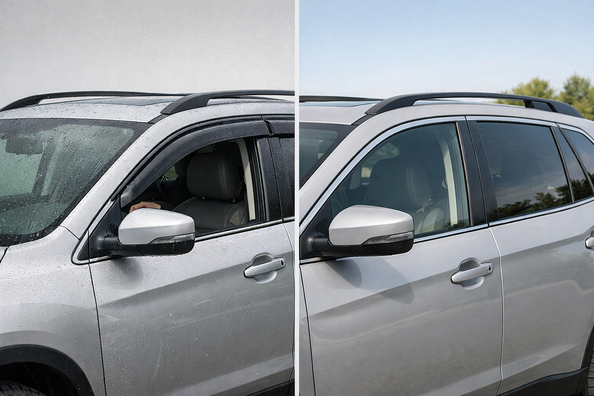
Window deflectors aren’t for everyone. They truly work when you regularly drive with the window slightly open in rain, damp weather, or heat, want to vent moisture from the cabin faster, or leave a bit of ventilation while parked. If your windows are almost always closed and your main priority is highway quietness, the accessory often turns into unnecessary plastic.
Most often, the choice comes down not to the brand, but to the design type: a precisely fitted vehicle-specific set or a cheap universal one. Fitment, mounting method, and material quality determine whether you get proper ventilation without hassle—or extra noise, misalignment, and peeling at the edges.
It’s simple: a deflector doesn’t make the car quieter by itself; it lets you open the window slightly without rain, snow, and a strong air stream blowing directly into the cabin. The most noticeable benefit is usually when the window is opened just a little—about 2–3 cm. In this mode, the cabin ventilates better and the windows fog up less.
So the right question isn’t “does it look good,” but “how often do I actually drive with the window cracked.” For city driving, humid weather, long trips, smokers, and those who dislike stale air, there’s real value. For a driver who runs the climate control and almost never opens the windows, the difference is minimal.
Also check how the window behaves after installation. On some cars, in-channel deflectors can interfere with sensitive anti-pinch protection, so after installation you may need to wait 24–48 hours and then calmly run another closing cycle.
| Option | Strengths | Weaknesses | Who it’s for |
|---|---|---|---|
| No deflectors | Zero risk of installation mistakes, no interference with the window channel, clean door look | No cracked-window ventilation in rain, doesn’t help with cabin humidity | Those who almost always drive with the windows closed |
| Vehicle-specific in-channel | Precise fit, lower risk to paintwork, closer-to-factory look | Requires settling time after installation, possible quirks with automatic window operation | Those who ventilate often and want a neat result |
| Vehicle-specific stick-on tape | Easier installation, doesn’t occupy the window channel, good practicality in rain and heat | Quality depends heavily on the tape and surface prep, removal can be tricky | Those who want a vehicle-specific set without interfering with the window guides |
| Universal stick-on | Lowest price, quick start without long selection | Inaccurate geometry, higher risk of noise, peeling, cracks, and poor fit | Only as a budget or temporary option |
DD Tuning expert comment: the most common mistake is buying a universal set just because it’s cheaper and expecting the same fit as a vehicle-specific one. The second typical issue is installing in-channel deflectors and immediately running the window in auto mode: if the car has sensitive anti-pinch protection, the set needs time to seat properly.
This is a perfectly reasonable choice, not “skipping a useful accessory.” If you rarely open the windows, don’t smoke in the cabin, have working climate control, and value calmness at speed, deflectors may add nothing important. In that scenario, the best solution is to install nothing.
The most practical option for those who actually use a cracked window. They hold in place thanks to their precise shape, require no drilling, and usually look cleaner. These sets most often feel like the accessory isn’t random, but matched to the door.
But installation matters: the channel must be clean, and after fitting the window often needs time to settle. On some cars, anti-pinch may trigger in the first days, so this isn’t an accessory that likes rushing.
A good compromise if you don’t want to touch the window channel or you’re unsure about automatic closing. With an accurate shape, they also deflect rain from the top edge of the glass and allow ventilation while driving and when parked.
The downside is that durability depends on surface prep and adhesive quality. If you apply it in the cold, on dirt, or without proper pressure, even a good set can start lifting at the edge earlier than it should.
Their main advantage is price. But this is also where problems most often begin: the geometry is approximate, the edges don’t follow the door frame, and the result depends heavily on how “almost fits” the set is for your car.
For daily use, this is the weakest option. If you need a deflector not for looks but for real ventilation in rain and heat, a universal set usually loses on lifespan, noise, and overall neatness.
For city driving, rain, and damp shoulder seasons, a vehicle-specific set works best. It lets you keep the window slightly open without sending water straight into the cabin and truly helps when windows fog up quickly.
For long trips in hot weather, deflectors are also useful—especially if there are passengers, kids, or pets in the cabin and you need a constant light air exchange. But if your main scenario is highway driving, high speed, and closed windows, the gain is minimal, and the demand for quietness is often higher than the potential benefit.
For those who smoke or use e-cigarettes, deflectors make more sense than for the average driver. They won’t solve everything, but they allow ventilation without a harsh side draft and without rain blowing straight in.
| Scenario | Best choice | Why |
|---|---|---|
| Frequent city driving in rain and humidity | Vehicle-specific in-channel | Provides ventilation with a small window opening and usually has the neatest fit |
| Need cabin ventilation but don’t want to interfere with the window channel | Vehicle-specific stick-on tape | Less chance of conflict with window mechanics if the set is precisely fitted |
| Main priority is highway quietness; windows are almost always closed | No deflectors | Benefit will be minimal, and any accessory on the frame may prove unnecessary |
| Smoking, vaping, regular short ventilation | Vehicle-specific in-channel or vehicle-specific stick-on | Works in everyday use when the window is often opened a small gap |
| Need the cheapest temporary option | Universal stick-on | You can save upfront, but for long-term use this is the weakest scenario |
A more expensive set is justified when the deflectors will be used constantly, not once a month. You’re paying not just for a name, but for precise geometry for a specific body, better material, cleaner edges, more stable installation, and longer service life. For a new car or a car you don’t want to spoil with bad tape or crooked fitment, this is the most sensible route.
If you want to choose a set without a lottery, start with the window deflector catalog, then separately compare the differences between vehicle-specific and universal and review installation nuances. At this stage, it usually becomes clear whether you need an expensive daily-use set—or whether it’s enough to go without deflectors altogether.
From a customer’s experience: the driver was looking for deflectors not “for looks,” but because they drove around the city daily in the rain and kept the window slightly open due to cabin humidity. At first they considered a cheaper universal set, but ended up buying a vehicle-specific set for the front doors and were satisfied specifically because of the proper fit, no misalignment, and real ventilation without water getting inside.
In short, window deflectors are needed when you actually use a slightly open window: in rain, heat, humidity, on long trips, or for quick ventilation. If your windows are almost always closed and what matters most to you is minimal noise and no extra details on the doors, it’s better to install nothing.
The safest choice in most cases is a precisely fitted vehicle-specific set, not a universal stick-on. This material is based on real selection experience, practice, and real use cases, so the main takeaway is simple: buy deflectors not “just in case,” but only for your driving style.
| ✔ | It makes it possible to slightly open the window in rain, damp weather, or heat without direct water ingress and strong airflow into the cabin. This is useful when short ventilation is needed while driving or parked. |
| ✔ | It helps remove moisture from the cabin faster and reduces window fogging, especially if the window is opened only 2–3 cm. For city driving, humid weather, and the off-season, this is noticeably practical. |
| ✔ | Model-specific in-channel deflectors usually have a more precise fit and look neater, closer to a factory solution. They are also less likely to damage the paintwork. |
| ✔ | Model-specific stick-on deflectors with tape are easier to install and do not take up the window channel. This is convenient if you do not want to interfere with the window mechanism. |
| ✔ | For smokers, drivers with passengers, children, or pets, deflectors are more useful because they allow a constant light exchange of air without a strong side draft. |
| ✘ | Deflectors do not make the car quieter on their own. At speed, they can only change the character of the noise, not eliminate it. |
| ✘ | Cheap universal kits often have inaccurate geometry and weak fitment. Because of this, the risk of misalignment, edge lifting, and cracking increases. |
| ✘ | Installing in-channel models requires a clean window channel and time for settling. On some cars, after installation, caution may also be needed due to the window anti-pinch system. |
| ✘ | Stick-on versions depend heavily on the quality of the adhesive base and surface preparation. If they are applied in cold conditions or on dirt, the kit may start to come loose quickly. |
Shipping to EU
Wholesale and retail
Own warehouse
Опис продукту
Подарунки не надаються при оформленні покупки у кредит під 0,01% або при покупці частинами.