08.05.2026
376
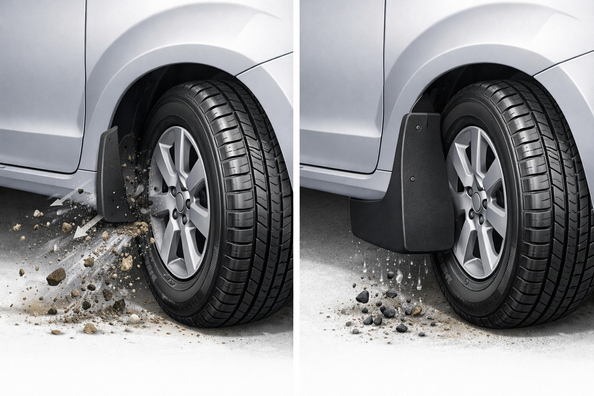
If after rain or winter slush the sills, lower door edges, rear doors, or the rear window are still dirty, the problem is usually not that mud flaps are useless. Most often they’re simply too short, too narrow, or positioned in a way that doesn’t cover the real spray path from the tire.
It’s important to distinguish two scenarios here. First: dirt flies off the wheel and hits the side of the body—then a different size, shape, or fitment of the mud flap helps. Second: the rear window and tailgate get dirty quickly, and then the tires’ spray is joined by the airflow wake behind the body, so replacing the factory part alone doesn’t always solve it.
A factory mud flap only works when it blocks the spray track from a specific wheel on a specific vehicle. If the tire got wider, the suspension was lifted, the wheel has a different offset, or the body itself creates a strong turbulent wake at the rear, the OEM part no longer hits the needed protection zone.
This is especially noticeable on crossovers, wagons, and hatchbacks with an almost vertical rear end. On them, dirt not only shoots out from under the wheels—it also gets pulled back by the airflow wake. So the owner thinks the mud flap is weak, while part of the issue is actually aerodynamic.
DD Tuning expert comment: the most common mistake is installing a rigid, long mud flap without checking wheel travel and the real tire poke/offset. The second typical mistake is changing the rear pair when the dirt actually starts at the front arch. If after installation the part sits skewed or pulls away from the bumper, the effect is almost always weaker than expected.
| Symptom | Likely cause | What to do |
|---|---|---|
| Sills and lower doors are dirty in a strip from the front arch rearward | Front mud flaps are short or narrow, wide tires | Check the front pair and wheel-width coverage and, if needed, install longer or wider front mud flaps |
| Rear window and tailgate get covered in dirt quickly | Strong airflow wake behind the body, vertical rear end, rear tires | Increase the effectiveness of the rear mud flaps and consider an aerodynamic add-on if the main issue is the glass |
| Sand and small stones hit the sill | Mud flap sits too high or doesn’t cover the outer tread edge | Adjust the fitment or switch to a wider option |
| After installing a new part, almost nothing changed | Same size and geometry, misalignment, large gap to the body | Check installation, angle, contact/pressure, and compare actual coverage of the spray track |
| Mud flap rubs the tire or bends back | Too low, too rigid, or over-tightened | Choose a more flexible type, correct the height, and don’t tighten the fasteners to the point of deformation |
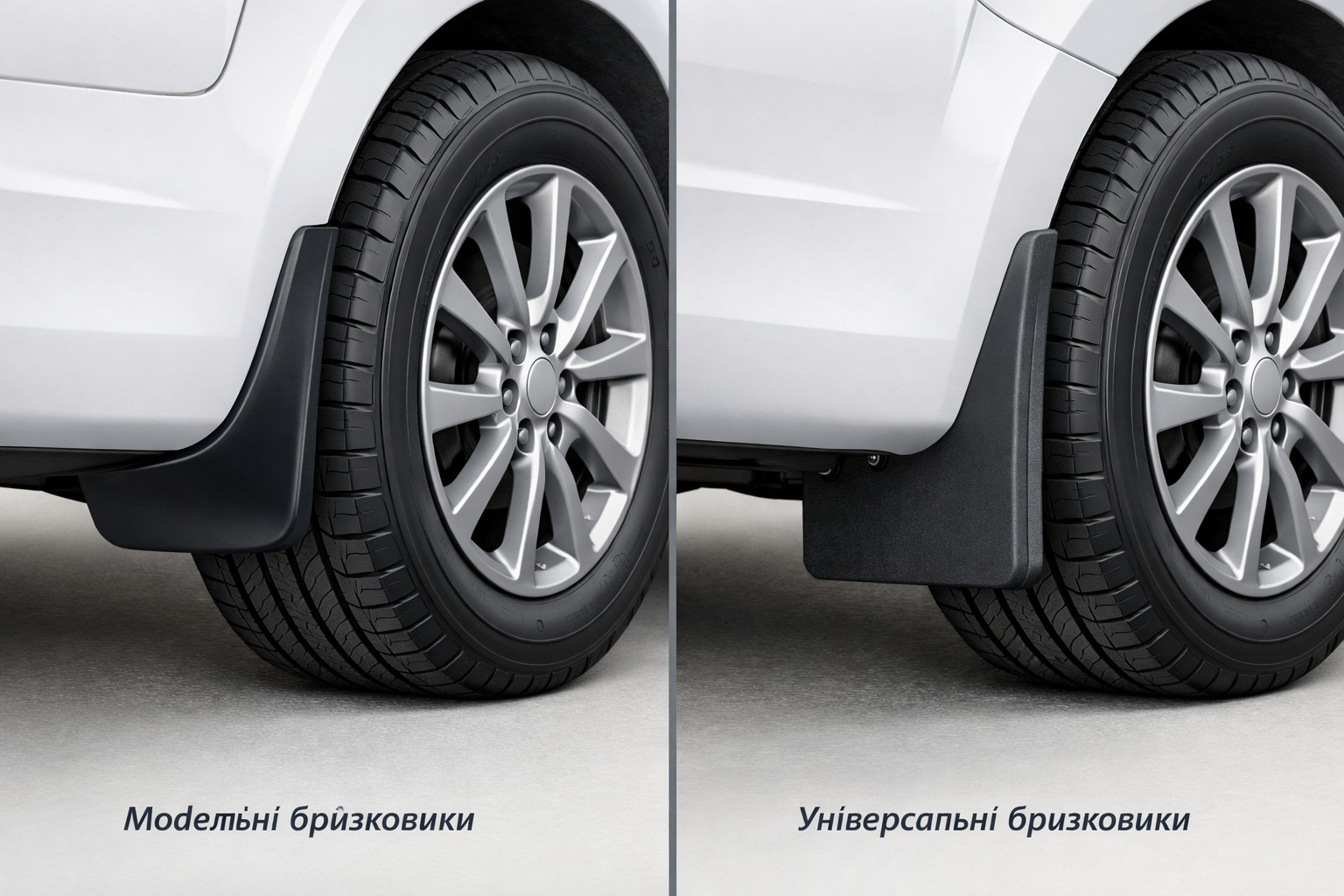
If the car is stock—no lift and no non-standard wheels—it makes sense to first look at original mud flaps: they usually follow the shape of the arch and bumper better and are less prone to mounting misalignment. But when the vehicle has already been changed in height or wheels, you more often need not an OEM copy but a different size and flexibility, so it’s logical to look toward universal mud flaps.
If the main complaint isn’t the sills but the rear window, then replacing the mud flap makes sense only as part of the solution. For hatchbacks, wagons, and some SUVs, it can sometimes be justified to also look at spoilers, because the problem often lies in the airflow behind the body, not only near the wheel.
| Solution | When it works | When it’s not worth spending money |
|---|---|---|
| Longer flexible mud flaps | OEM ones are short, the car is lifted, larger wheels are installed, lots of winter slush | When the main issue is only the rear window and the airflow wake behind the body |
| Wider mud flaps | Dirt comes from under the outer tread edge or the wheel has more offset/poke | When the width already covers the wheel and the contamination is driven mainly by aerodynamics |
| Reinstalling and precisely aligning the mounts | The part sits skewed, vibrates, there’s a gap to the body, the effect differs left vs right | When the mud flap is objectively too short or ends too high |
| Adding the front pair | Dirt stretches along the side from the front arch | When almost only the tailgate and rear window suffer |
| Spoiler or other aerodynamic add-on | At speed, the rear window of a hatchback, wagon, or SUV gets dirty quickly | When the problem is limited to sills, arches, and the lower part of the doors |
| Washing, wax, hydrophobic coating | As temporary care between trips | When you expect a noticeable reduction in spray and stone impacts |
From a customer’s experience: after lifting the suspension on a crossover, the factory mud flaps stayed in place, but in winter the sills started getting splashed much more. After checking, it turned out the lower edge was now too high from the road, and the wheel stuck out more than the OEM profile covered. Switching to a longer and wider flexible option noticeably reduced dirt on the sills, but the rear window still remained a zone where, without aerodynamics, miracles didn’t happen.
Factory mud flaps don’t become weak on their own—they become weak when their geometry no longer matches the real spray trajectory. If the dirt comes from the wheel, length, width, flexibility, and proper fitment are what matter. If the rear window gets dirty, you need to look wider and consider the body shape and the airflow wake.
The material is based on real selection experience, installation practice, and real usage scenarios. So the main rule is simple: first determine where the dirt is actually coming from, and only then spend money on a different type of mud flap or related accessories.
| ✔ | Longer or wider mud flaps can really remove some dirt from the sills, lower doors and wheel arches if the stock set does not cover the wheel spray path. This is especially relevant after lifting the suspension, installing larger wheels or wider tires. |
| ✔ | Proper installation gives a noticeable effect even without replacing the part, if the problem was misalignment, a gap to the body, or the wrong angle. Often it is the fit, not the product itself, that eats up most of the benefit. |
| ✔ | More flexible models are better suited for winter slush, joints and curbs, because they are less likely to deform or tear off. Rigid low-profile options perform worse in such conditions. |
| ✔ | If dirt is being thrown specifically from the front wheel arch, checking or replacing the front pair may be more beneficial than working only with the rear mud flaps. This helps avoid spending money on an element that does not solve the source of the problem. |
| ✔ | In the case of the rear window and trunk lid, replacing the mud flap can work as part of the solution rather than as the only remedy. This helps honestly assess when an aerodynamic element is needed as well. |
| ✘ | If the problem is mainly in the aerodynamic wake behind the body, a single mud flap will not completely remove dirt from the rear window. In such cases, additional solutions are needed, and simply increasing the size of the part only has a partial effect. |
| ✘ | Replacing the stock mud flap with one that is almost the same size usually changes little. Without a different length, width or fit, the effect remains almost the same. |
| ✘ | Too rigid or too low-mounted models can catch on snow, joints and curbs more quickly. As a result, they deform or tear off rather than simply protect the body better. |
| ✘ | Hydrophobic sprays and frequent washing do not solve the cause of the dirt buildup itself, they only temporarily improve the appearance. They do not change the spray trajectory and do not replace a properly selected mud flap. |
Shipping to EU
Wholesale and retail
Own warehouse
Опис продукту
Подарунки не надаються при оформленні покупки у кредит під 0,01% або при покупці частинами.