12.05.2026
543
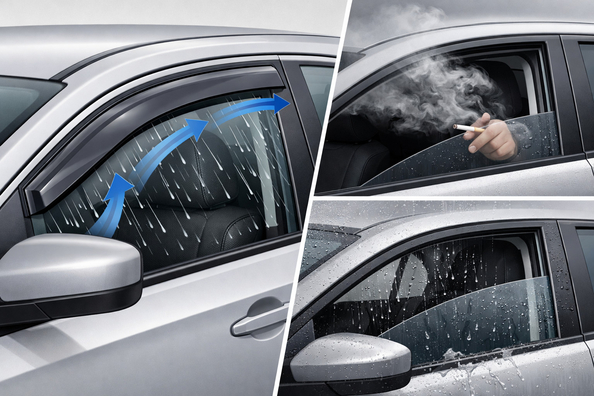
Window deflectors are often bought with inflated expectations: as if they will simultaneously keep out rain, eliminate whistling, stop the low-frequency “buffeting” with an open window, and even fix door issues. In reality, it’s a comfort accessory. It works well when you need to leave the glass slightly open in the rain, ventilate the cabin faster, or soften the airflow a bit, but it does not replace seal repairs, door alignment, or correct glass fitment.
The main mistake is confusing different symptoms. If unpleasant pressure and a rumble appear only with one window open, that’s usually air resonance in the cabin. If the noise is present even with the windows fully closed, you should look not at the deflector but at the seals, door geometry, or the fitment of the accessory itself.
Problems with deflectors don’t start with plastic—they start with expectations. The driver wants one simple solution for several different tasks: drive with a slightly open window without rain, reduce aerodynamic noise, and get rid of high-speed discomfort. But these tasks have different causes, so one accessory can’t cover everything equally well.
When only one window is open, a low-frequency resonance can occur in the cabin. A deflector sometimes reduces it because it slightly changes the airflow direction near the top edge of the glass, but it won’t remove it completely. And if the noise is there with the windows closed, the cause is no longer the air over the opening, but a loss of sealing, a misaligned door, or insufficient pressure of the weatherstrip.
DD Tuning expert comment: most often people make two mistakes—buy a non-vehicle-specific deflector and install it however, or try to “cure” seal noise with it. If after installation the problem appears even with the glass closed, don’t immediately blame the accessory itself: first check the fitment, cleanliness of the mounting area, door closing pressure, and how the glass behaves at the top stop.
| Symptom | Likely cause | What to do |
|---|---|---|
| Low-frequency “buffeting” with one window open | Cabin resonance | Crack the second window, reduce the gap of the first, don’t expect a deflector to eliminate it completely |
| Rain gets into the cabin with the window slightly open | No deflector installed, or the shape is too narrow/unsuitable | Install a vehicle-specific deflector that covers the top edge of the glass without misalignment |
| Whistling appeared after installing the deflector | Poor fitment, play, incorrect installation | Check installation geometry, adhesive layer or fit in the window channel; reinstall if needed |
| Noise is present even with the windows fully closed | Seal issue, weak door pressure, misaligned glass | Diagnose the doors and sealing, rather than buying another set of deflectors |
| The window won’t close after installation | The deflector hasn’t seated in the window channel yet or was installed incorrectly | Check fitment, allow time to stabilize, don’t strain the window regulator unnecessarily |
| Rear windows are noisier than the front | Rear door and airflow geometry specifics | Don’t judge only by the front doors; test front and rear separately |
If what you need is normal ventilation without rain getting into the cabin, it makes sense to start with vehicle-specific window deflectors. What matters here isn’t a loud promise, but precise matching to the door and window frame shape.
If you still don’t understand which mounting type will suit you and what to expect from this accessory at all, it’s worth first figuring out what deflectors are for and how they are installed. This helps you avoid buying something that doesn’t match your task.
And when noise is present even with the windows closed, or the doors noticeably “breathe” at speed, it’s more logical to look toward diagnostics and replacing door seals. In that scenario, a deflector can remain a useful accessory, but it definitely won’t be the primary solution.
| Solution | When it works | When it’s not worth spending money |
|---|---|---|
| Vehicle-specific window deflectors | When you need to ventilate the cabin in rain, snow, or heat with a small window gap | When you expect them to eliminate all highway noise or fix the doors |
| Cracking a second window 1–2 cm | When there’s resonance with one window open | When the noise doesn’t depend on window position and is constantly present |
| Reinstalling the deflector with proper fitment | When a whistle appeared immediately after installation or there’s a visible gap along the edge | When the accessory sits evenly but the noise comes from the seal or the door |
| Replacing seals or adjusting the doors | When noise is present with the windows fully closed, especially at speed | When the problem shows up only with one window open |
| Wider or cheaper universal deflectors “to try” | Rarely justified—only as a temporary experiment without high expectations | When you need a predictable result, quietness, and proper fitment without modifications |
From a customer’s experience: a crossover driver was looking for a way to drive with a slightly open window in the rain and thought deflectors would completely remove the highway hum. After selecting a vehicle-specific set and doing a proper installation, he got exactly what he needed for city and intercity driving: the cabin doesn’t get wet, and ventilation became more convenient. But with one rear window opened wide, the resonance remained—this is exactly the case where correct expectations matter more than a “magic” accessory.
Window deflectors have a clear area of benefit: they help with ventilation, partially shield from precipitation, and can slightly soften the airflow near a cracked window. They should not be seen as a way to remove any noise, fix leaky doors, or compensate for poor seal pressure. If you correctly distinguish resonance from a sealing problem, you spend money once—and on the right thing. This material is based on real selection experience, hands-on practice, and real usage scenarios, not universal promises for all cars.
| ✔ | Deflectors do not completely eliminate aerodynamic noise and low-frequency “thumping” with only one window open — that is not their main purpose. |
| ✔ | They do not solve problems with seals, door misalignment, or glass fit: if there is noise even with the windows closed, the cause is usually not the accessory. |
| ✔ | Poor installation or misalignment can themselves become a source of whistling and rattling, and may also interfere with closing the window. |
| ✔ | Cheap universal models and attempts to choose a wider deflector “so it definitely won’t be noisy” often leave gaps, lift at the edges, and do not provide a stable result. |
| ✘ | Deflectors are truly useful for ventilation with the window slightly open in rain, snow, or heat: they help reduce the amount of precipitation entering the cabin. |
| ✘ | With a proper model-specific fit, the accessory can slightly soften the airflow along the upper edge of the glass and make the ride more comfortable. |
| ✘ | A small window opening together with a deflector works better than a large gap, so for everyday driving this is a practical solution. |
| ✘ | If the noise occurs specifically with only one window open, opening the second window by 1-2 cm often reduces resonance more effectively than trying to solve everything with one accessory. |
| ✘ | Proper installation and exact door-specific fit are no less important than the deflector itself: in that case, it works predictably and without unnecessary whistling. |
Shipping to EU
Wholesale and retail
Own warehouse
Опис продукту
Подарунки не надаються при оформленні покупки у кредит під 0,01% або при покупці частинами.