11.04.2026
1054
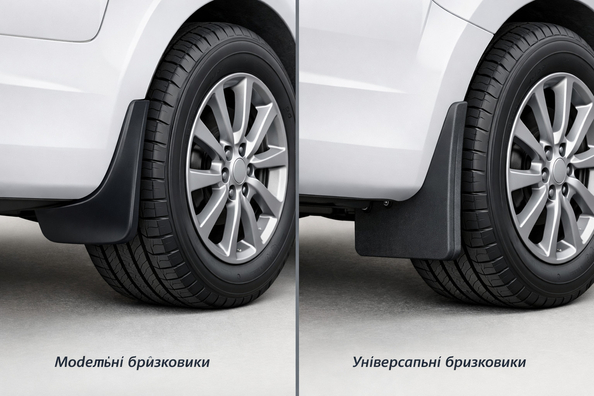
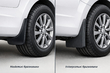
If you need a precise fit with no gaps, for most regular passenger cars and crossovers, vehicle-specific mud flaps are the better choice. They follow the wheel-arch contour, more often use factory mounting points, and rub against the body less often. Universal ones make sense when there’s no ready-made kit for your exact vehicle, or when the car has already been modified: different wheels, spacers, a lift, non-standard trims.
The key difference isn’t in the name, but in geometry and installation. One kit lasts a long time because it sits in the right place and blocks the stream of dirt coming off the tire. Another starts scratching the paint, bending away, or catching almost nothing because it doesn’t match the arch, is too small, or sits at the wrong angle.
A mud flap works only when its shape and position match the real trajectory of water, sand, and small stones thrown off the wheel. If there’s a gap between the arch and the flap, if the flap itself is shorter or narrower than the splash zone, some of the dirt goes past it.
A vehicle-specific set usually wins because it’s made for a particular body and mounts without unnecessary misalignment. A universal set can be just as durable, but only if it’s correctly sized, properly test-fitted, and not installed under tension.
DD Tuning expert comment: Most often people don’t get the material wrong—they get the geometry wrong. They buy a universal set “to be bigger,” but don’t check whether it will fit without skewing and whether it will contact the wheel or the wheel-arch edge. Before drilling, always do a dry test fit, check steering lock, and look at the car under load.
| Symptom | Likely cause | What to do |
|---|---|---|
| Large gap between the arch and the mud flap | The flap shape doesn’t match the body | Switch to a vehicle-specific kit or choose a different universal one by shape and size |
| Dirt hits the doors and rocker panel even though a mud flap is installed | The mud flap is too short or too narrow for your tire | Choose a longer or wider option, especially if the wheels are wider than stock |
| Scratches near the fastener or on the wheel-arch edge | There is body contact due to the wrong angle or misalignment | Reposition the fasteners, adjust the fit geometry, add protective film in the risk area |
| The mud flap catches the wheel or the road | Mounted too low, large tires, lifted vehicle | Check mounting height, change offset/spacers, or switch to a different flap format |
| Cracks or stiffness after winter | Material not designed for frost and salt | Replace with higher-quality thermoplastic or polyurethane |
| Looks factory, but protection is weak | OEM or short kit doesn’t block the stream from the wheel | Look for a longer option rather than reinstalling the same one again |
For a standard daily driver, a vehicle-specific kit works best. It installs faster, needs trimming less often, and usually survives winter better precisely because it isn’t installed under tension.
For modified vehicles, what matters isn’t the label on the box but choosing the right overall dimensions. For regular passenger cars and compact crossovers, people often look at universal formats around 279 × 187 mm or 279 × 254 mm; for larger vehicles, 400 × 225 mm or 457 × 264 mm. Pickups and full-size SUVs need even larger flaps, otherwise they simply won’t cover the tire.
A proper test fit before drilling also really helps: check the gap, the angle to the wheel, behavior on steering lock, and under load. If the vehicle is lifted or the wheels sit further out, you may need an extended/offset bracket; otherwise even a good mud flap will rub or sit too close to the tire.
A bad idea is buying the cheapest universal kit without measurements, hoping you’ll “make it fit later.” Usually it ends with either big gaps, extra holes in the inner fender, or weak protection.
Installing it “as low as possible to catch more” barely helps. On a lifted vehicle or with big wheels, it increases the risk of hitting the flap on uneven roads. Likewise, a random mix of washers and self-tapping screws won’t solve anything if the mud flap’s contour is wrong from the start.
And don’t assume any vehicle-specific kit will still fit after changing wheel offset or adding spacers. If the wheel sits further out, a short OEM flap may no longer block the dirt stream.
If the vehicle has no suspension or wheel changes, it makes sense to start with vehicle-specific mud flaps: they provide the most accurate fit and fewer installation issues. If there’s no ready-made set for your specific vehicle, or you have non-standard wheels, a lift, or widened arches, then universal mud flaps are appropriate—but only after taking measurements. If you need the closest possible factory-style solution and OEM mounting geometry matters, you can consider original mud flaps, although they aren’t always the longest and don’t always cover a wider tire best.
| Solution | When it works | When it’s not worth spending money |
|---|---|---|
| Vehicle-specific kit | Stock vehicle, factory wheels, need a precise fit without extra tweaking | If there’s a lift, spacers, or different wheel geometry the kit wasn’t designed for |
| High-quality universal polyurethane kit | No ready-made solution for the body, or you need a larger flap for a modified vehicle | If you’re not ready for test fitting, trimming, and precise installation |
| Longer universal flap | The OEM mud flap is too short and doesn’t cover the tire width | If it’s installed without checking suspension travel and wheel clearance |
| Offset bracket or changing fit geometry | When the flap itself is fine, but clearance isn’t enough due to larger wheels | If the issue isn’t clearance, but the mud flap is simply too small or poorly shaped |
| Protective film in the risk area | As extra paint protection when clearance is minimal but there’s no contact | If the mud flap already rubs the body: film won’t fix an incorrect fit |
| Cheap thin universal kit | Only as a temporary or light seasonal solution | For winter, salt, bad roads, and heavy vehicles |
From a customer’s experience: after switching to wider tires, a crossover owner noticed that the short OEM mud flaps looked fine, but the doors and rocker panels still stayed dirty. A test fit showed the issue wasn’t the mounting, but insufficient flap width relative to the wheel. After upgrading to a larger option with the correct fit, protection became noticeably better, while avoiding any rubbing on the body.
In short, for most daily vehicles, vehicle-specific mud flaps work better: they fit more precisely and usually last longer thanks to correct geometry and simpler installation. Universal ones can also be a good solution, but mainly when there’s no ready-made kit or the vehicle has moved away from stock configuration.
Don’t spend money on any option without checking shape, size, clearance, and mounting method. This material is based on real selection experience, hands-on practice, and real-world use cases: when the car is stock, a precise vehicle-specific fit wins; when geometry is changed, correct measurements, material, and competent installation are what matter.
| ✔ | Model-specific mud flaps usually follow the wheel arch contour more precisely, so they fit without large gaps and are less likely to rub against the body. For standard vehicles, this reduces the risk of incorrect installation. |
| ✔ | They are more often installed in the factory mounting points, so installation is simpler and faster. This leaves less chance of making a mistake with the angle or alignment. |
| ✔ | With proper fitment, the model-specific set covers the dirt flow from the tire better, and therefore protects the doors and sills more effectively. This is especially noticeable on a daily vehicle without changes to the suspension or wheels. |
| ✔ | The article states directly that model-specific mud flaps usually last longer. The reason is not the name itself, but that they sit in the right place and do not work under tension. |
| ✔ | If the vehicle is standard, the model-specific set is less likely to need trimming or adjustment. This makes it a more practical option for most regular cars and crossovers. |
| ✘ | If the vehicle has a lift, spacers, larger wheels, or a changed wheel offset, the model-specific mud flap may no longer match the new geometry. In that case, it may not cover the tire or may start rubbing. |
| ✘ | Not every model-specific set fits after the vehicle’s setup has been changed. The author clearly notes that after tuning, a short factory shield may turn out too small for a wider tire. |
| ✘ | Universal mud flaps require precise selection, trial fitting, and sometimes trimming. If this is not done, gaps, misalignment, or weak protection from dirt appear. |
| ✘ | A cheap thin universal set handles winter, salt, and dirt impacts poorly. Such an option may quickly crack or lose its shape. |
Shipping to EU
Wholesale and retail
Own warehouse
Опис продукту
Подарунки не надаються при оформленні покупки у кредит під 0,01% або при покупці частинами.