09.06.2026
302
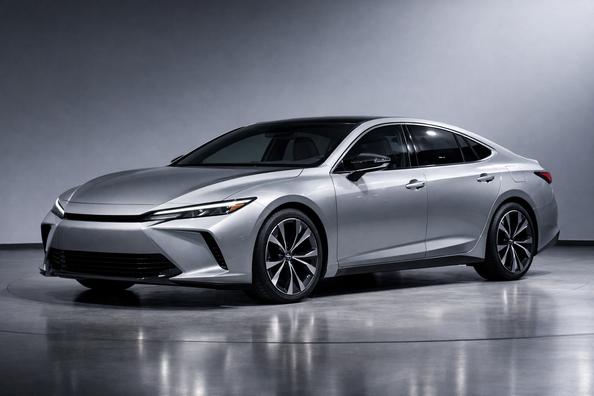
The name Toyota Camry XV90 usually refers to the ninth-generation Camry for 2025. At the first-rumor stage, the talk was about road prototypes and manufacturer teasers, but the model received official status on November 14, 2023, when it was fully unveiled in Los Angeles; the public reveal for a broader audience took place on November 16.
An important clarification: in the available official Toyota materials, the company does not use the XV90 designation. So the index itself should be treated as an unofficial label from media and forums, not as a factory-confirmed model code. For this topic, that’s critical: the rumors were one thing, while the confirmed specification turned out to be much more specific and in some areas more modest than expected.
At the earliest rumor stage, this was not a concept car, but a prototype of the future production model. Toyota officially started building interest with a teaser on October 19, 2023, without disclosing the technical details. On November 9, the debut date was announced directly, and on November 14, 2023, the official reveal of the ninth-generation Camry took place.
So it’s important not to mix the stages. Until mid-November 2023, you could only talk about prototypes, spy shots, and assumptions. After the official premiere, this is no longer an “almost ready car,” but a presented production model for the start of sales in a confirmed market.
Officially, Toyota’s press materials do not name the platform separately. Based on preliminary data and specialist explanations, the new Camry retained the TNGA-K architecture in a revised form—meaning it’s more an evolution of the existing design than an all-new base.
This explains the model’s overall character well: a classic midsize five-seat sedan with no change in form factor. This approach usually means less technical risk at launch, but also fewer reasons to expect radically different behavior simply due to a generational change.
Officially confirmed: the new Camry for the debut market became fully hybrid. The manufacturer stated a 2.5-liter four-cylinder gasoline engine paired with a fifth-generation hybrid system, as well as two drivetrain options—front-wheel drive and all-wheel drive with a separate electric drive for the rear axle.
Confirmed total output is 225 hp for the front-wheel-drive version and 232 hp for the all-wheel-drive version. Meanwhile, rumors about a 2.4-liter turbo engine, a higher-performance powertrain, retaining the V6, or the arrival of a plug-in hybrid were not confirmed. A fully electric version has not been officially announced either.
DD Tuning expert comment: a typical mistake with models like this is taking early leaks as the final spec and then planning parts purchases or even competitor comparisons based on that. With the Camry, it’s very clear: people expected a turbo or other power options, but the manufacturer delivered a completely different, purely hybrid lineup logic. Practically, it’s best to rely only on what is already confirmed for a specific market and a specific body style.
Official photos show that Toyota didn’t break the Camry concept, but made the sedan look sharper: the front end, lighting, and the graphic of the body lines were revised. This isn’t an experimental show car, but a fully production-ready design aimed at the mass market.
For the cabin, Toyota officially states a 7- or 12.3-inch digital instrument cluster depending on the version, an 8- or 12.3-inch multimedia system, a head-up display up to 10 inches, and five USB ports. On safety, blind-spot monitoring, rear cross-traffic alert, safe exit warning, and the Toyota Safety Sense 3.0 package are confirmed right away.
Unlike the early rumor phase, Toyota disclosed the baseline numbers for the production Camry fairly quickly. But even here, you need to separate the parameters already announced for the U.S. and what may differ in other markets.
| What is known | What is expected | What is unknown |
|---|---|---|
| Powertrain layout: hybrid only, 2.5-liter gasoline engine plus the electric component. | For other markets: local differences in trims and tuning are possible. | Other powertrain versions: officially, neither a plug-in hybrid nor an EV has been announced. |
| Power: 225 hp with front-wheel drive and 232 hp with all-wheel drive. | Real-world performance: a predictable focus on smoothness and efficiency rather than sportiness is expected. | Full acceleration figures: not emphasized officially at launch. |
| Efficiency: at launch, around 4.6 L/100 km was stated for one of the base versions; later specifications clarified the figures slightly. | Real-world consumption: will depend on season, tires, and city driving share. | Figures for all markets: still unknown. |
| Dimensions: length 4915 mm, width 1840 mm, height 1455 mm, wheelbase 2825 mm. | Cabin practicality: the usual Camry focus on everyday comfort is expected. | Local interior equipment variants: not detailed officially for all countries. |
| Launch trims: LE, SE, XLE, XSE. | Lineup expansion: special packages for specific markets may likely appear later. | Special versions like TRD: not officially announced. |
Camry remains in the midsize sedan segment, where buyers look not only at design, but also fuel consumption, the hybrid system’s reputation, everyday usability, and cost of ownership. That’s why it should be compared not with niche EVs, but with direct mass-market competitors in the same class.
| Model | Market status | How it pressures Camry | Camry’s position |
|---|---|---|---|
| Honda Accord | Production model | Strong segment reputation and a clear hybrid format | Camry responds by fully dropping non-hybrid versions in the debut market |
| Hyundai Sonata | Production model | Bolder design and rich equipment | Camry bets on a more conservative, mass-market formula |
| Kia K5 | Production model | More emotional styling and a driver-focused image | Camry looks more pragmatic and stronger on hybridization |
| Nissan Altima | Production model | Availability of all-wheel drive in the class | Camry also offers all-wheel drive, but within a hybrid setup |
| Subaru Legacy | Production model | Traditional emphasis on all-wheel drive | Camry counters with efficiency and broader model recognition |
The officially confirmed launch market in the first wave is the U.S. Toyota stated that vehicles would arrive at dealers in late spring 2024, and series production started on May 8, 2024, at the Kentucky plant.
Starting prices for the U.S. were announced from $28,400 for the LE, then $30,700 for the SE, $33,400 for the XLE, and $34,600 for the XSE. For other countries in this wave of announcements, there were no official price lists, so you shouldn’t directly переносити American figures to the local market. If you need comparison material for the previous generation, it’s appropriate to check the Toyota Camry 2024 review.
It’s still unclear how exactly Toyota will distribute this Camry across global markets and whether all of them will receive the same powertrain layout, trim lineup, and equipment. Likewise, it has not been officially announced whether there will be a separate plug-in hybrid, a sportier version, or another special variant.
There’s also terminological uncertainty: the XV90 designation is widely used in unofficial discussions, but it’s absent from the manufacturer’s official communication. Separately, it’s not worth rushing to loud conclusions about an “all-new platform”—this is not explicitly stated in the public press materials.
From customer experience: we had a typical request from someone who followed early rumors about the new Camry and wanted to understand in advance whether solutions from the previous body would fit. After the official premiere, the choice became simpler: instead of relying on spy photos, the person waited for the confirmed generation and avoided ordering incompatible items. The biggest satisfaction here isn’t from a fast purchase, but from buying everything for the actual body and the actual configuration.
Looking back at the first rumors about the Toyota Camry XV90, the main takeaway is simple: the model turned out not to be a platform for bold experiments, but a very pragmatic evolution of the Camry. Officially confirmed are the most important points—the premiere date, the hybrid lineup, output, the launch market, base pricing, and the start of production. Anything beyond these points should be labeled honestly: expected, according to preliminary data, rumored, or still unknown.
For the buyer, this is even helpful: less noise around unconfirmed engines and more clarity about the real product. Our conclusion is based on real selection experience, practice, and real usage scenarios, so the key advice is one—don’t replace officially confirmed specifications with attractive assumptions from the early wave of rumors.
Shipping to EU
Wholesale and retail
Own warehouse
Опис продукту
Подарунки не надаються при оформленні покупки у кредит під 0,01% або при покупці частинами.