27.08.2026
63
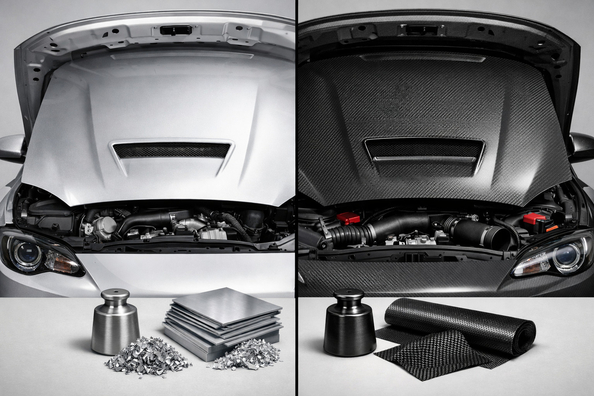

If you need to replace the factory hood on a car for daily driving, in most cases aluminum is the better value. It’s usually easier to match, easier to repair after minor damage, and doesn’t force you to immediately budget for extra installation nuances.
Carbon makes sense when you’re consciously paying not for savings, but for lower front-end weight and a pronounced tuning effect. But it often comes with tighter gap setting, mounting requirements, more attention to the clear coat, and a more expensive scenario after an impact or delamination.
You’re not choosing just a material here, but the entire ownership scenario. The cost should include not only the hood itself, but also fitting, painting or keeping the weave exposed, compatibility with the latch, struts, heat shield, and future repairs after typical city contacts.
For some drivers, a hood is a consumable body part that should survive highways, winter, and parking without drama. For others, it’s a way to drop a few kilograms off the front and change the car’s character. That’s why aluminum and carbon don’t directly compete in every case: they serve different priorities.
Separately, it’s worth checking compatibility with mounting points. For aluminum, isolating dissimilar metals in modified areas is important; otherwise you can get galvanic corrosion around holes and bolts.
| Option | Strengths | Weaknesses | Who it’s for |
|---|---|---|---|
| Aluminum hood | Reasonable weight, closer to factory fitment, usually an easier repair scenario, fewer risks in daily use | Doesn’t deliver the same weight savings as carbon; with modifications you must watch mounting and metal isolation | Those replacing a hood after damage or wanting a practical solution for city, highway, and winter |
| Carbon hood | Lower weight, visually noticeable tuning, can deliver a real front-end benefit on a project car | Higher price, more complex installation, sensitive to clear-coat and fitment quality, more expensive after structural damage | Those deliberately building a track or show project and willing to pay for lightness and looks |
DD Tuning expert comment: The most common mistake is looking only at the weight number and the part’s price. With carbon you should immediately budget hood pins, gap fitting, a heat shield, and checking strut compatibility. With aluminum people often forget to isolate mounting points after modifications, and problems show up later around holes and bolts.
This is the most sensible option if the car lives a normal life: daily trips, highway, rain, snow, random chips, and tight parking. Aluminum is lighter than steel, doesn’t rust the way steel panels do, and for many modern cars has long been an OEM solution rather than an exotic one.
The main advantage of aluminum is predictability. It’s easier to integrate into a standard body repair process, easier to paint to match the body, and calmer to run without constant worry about the clear coat or bonded seams. If the hood isn’t badly damaged, the fallout budget is usually lower than with a composite alternative.
There are downsides too. Aluminum by itself doesn’t cut as much weight as carbon, and rough intervention in mounting points can create corrosion issues due to contact between dissimilar metals. In other words, it’s not a material that forgives careless accessory installation.
The point of carbon is weight and visual effect. At the same volume, a composite is significantly lighter than aluminum, and on finished parts the difference is often noticeable in your hands and in front-end balance. In a real example of an aftermarket hood for a Mustang, the saving was about 6 kg—roughly a third of the hood’s weight.
But lightness comes with conditions. Not every carbon hood fits like OEM: you may need hood pins, micro-adjustment of the latch, отказ from stock gas struts, and the right heat shield. If fitment or bonding is below standard, vibrations can appear at speed or on rough roads.
Repair is also harder on the wallet with carbon. If only the clear coat or transparent layer is affected, cosmetic repair is sometimes possible. But with cracks, delamination, or a serious impact, the scenario often comes down to replacing the entire part. That’s why for a city car carbon rarely wins on economics.
For city use, winter, long trips, and a car that simply needs to work without surprises, aluminum looks more convincing. It doesn’t require explaining the part’s specifics to every body shop, it hurts the budget less after minor contacts, and it better suits those who calculate total cost of ownership.
Carbon is logical where the owner actually uses its strengths. That can be a lightweight sport build, a weekend car, or a build where exposed carbon is part of the concept. In that case, the buyer treats all related expenses as normal rather than an unpleasant surprise.
If the car is powerful but driven mostly in the city and on highways, saving a few kilograms on the hood rarely outweighs the difference in price, installation, and future repair risks. Then carbon is worth buying only when you know exactly what you’re paying for.
| Scenario | What to choose | Why |
|---|---|---|
| Daily city driving | Aluminum hood | Fewer installation risks, calmer repair after minor incidents, more logical economics |
| Winter, bad roads, frequent highway driving | Aluminum hood | Better suited to practical use, less sensitivity to vibrations and clear-coat condition |
| Replacing the factory hood after an accident | Aluminum hood | Easier to return the car to normal working condition without extra modifications |
| Track or sports project | Carbon hood | Makes sense due to lower front-end mass if installed correctly and the owner uses it |
| Show car or focus on appearance | Carbon hood | Delivers an effect that’s hard to replicate with a conventional painted solution |
| Car for resale to a broad buyer | Aluminum hood | Fewer questions about repair history, compatibility, and maintenance |
A more expensive option is justified when you get a concrete result rather than abstract status: lower front-end mass, the look you want, readiness for track use, or a no-compromise project build in terms of materials. In that case, it makes sense to first look at hoods, separately understand how dry and wet carbon differ, and figure out where carbon in tuning truly serves the goal—and where it just increases the bill.
If the main goal is to replace a damaged factory hood without long downtime and without extra future costs, the more expensive solution usually doesn’t offer better value. The exception is when the car is already being built around lightweight body panels, proper mounting, and regular condition checks.
From a customer’s experience: after minor front-end damage, a coupe owner initially wanted a carbon hood to both complete the repair and add tuning. After calculating hood pins, fitting, the risk of future damage, and the budget difference, he chose an aluminum solution for daily driving. As a result, the repair went faster, and the money went not into effect, but into parts that actually improved day-to-day operation.
If you measure value rather than tuning эмоtion, for most daily scenarios the aluminum hood wins. It’s more rational to replace, calmer in the city, less ties the owner to specific installation requirements, and usually handles everyday use better from a budget standpoint.
A carbon hood is worth buying not because it’s more expensive, but because it solves a specific task: lightness, front-end balance, project-level looks. This material choice is based on real selection experience, practice, and real use cases: if you need a sensible replacement for life—go with aluminum; if you’re deliberately building a lightweight or visually accent-focused project—then carbon makes sense.
| ✔ | An aluminum hood is usually easier to source and install without additional modifications, so it is a better fit for a standard replacement of the factory part. |
| ✔ | In everyday use, aluminum is easier to repair after minor damage, and the overall restoration cost is usually lower. |
| ✔ | For city driving, winter, highways, and daily trips, aluminum looks more practical: fewer risks with installation, gaps, and maintenance. |
| ✔ | A carbon hood provides a real reduction in front-end weight, which can be useful for a track or performance build. |
| ✔ | Carbon has a pronounced tuning effect and works well when the look is part of the concept, not just a part replacement. |
| ✘ | A carbon hood is more expensive not only to buy: the budget often also needs to include safety pins, gap adjustment, a heat shield, and compatibility with mounting points. |
| ✘ | After structural damage, carbon is more often replaced entirely, while aluminum is often easier to repair. |
| ✘ | Carbon is more sensitive to the quality of the clear coat, bonding, and installation precision; otherwise, vibrations or flutter at speed may appear. |
| ✘ | Aluminum does not offer the same weight savings as carbon, and with careless modification of the mounts, corrosion issues may arise due to contact between dissimilar metals. |
Shipping to EU
Wholesale and retail
Own warehouse
Опис продукту
Подарунки не надаються при оформленні покупки у кредит під 0,01% або при покупці частинами.