05.08.2026
189
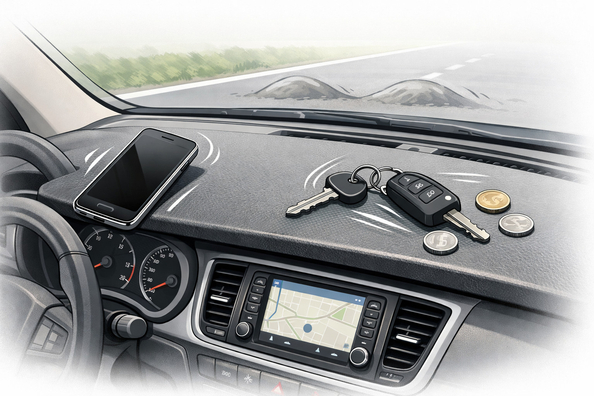

If your phone, glasses, coins or keys fly off the dashboard when you hit potholes, the problem is almost never the potholes themselves. Most of the time there’s simply not enough grip: the surface is too smooth or, наоборот, too textured and porous; there’s dust, grease or a trace of interior polish; or the mat/mount was installed and loaded immediately.
The good news is that it’s easy to break this down by causes. If a holder works fine on the windshield but falls off the dashboard, the dashboard’s shape or texture is to blame. If a mat grips again after washing, dirt was the reason. If everything starts sliding specifically after heat, you need to look at the condition of the sticky base and the type of surface.
On a pothole, an object gets a short jolt and shifts forward or sideways. For it to stay in place, the friction between it and the dashboard—or between the dashboard and the mat—must be higher than that jolt. When the panel is sloped, smooth, or coated with a slippery care product, there’s simply no friction margin left.
For mounts and suction cups the requirements are even stricter: they need a clean, dry, flat, smooth, non-porous spot. On a curved, leather-like, or rough textured dashboard, a bare suction cup often lets go not because the mount is weak, but because the surface isn’t suitable for it.
DD Tuning expert comment: The most common mistake is “degreasing” the panel not with alcohol but with interior polish—and then immediately loading the mount. The second typical mistake is trying to make a bare suction cup work on a rough texture. In these cases it’s better to switch the mounting type or use an intermediate base right away, rather than moving the holder all over the dashboard.
| Symptom | Likely cause | What to do |
|---|---|---|
| The holder works on the windshield but falls off the dashboard | Textured, porous or curved surface | Look for a smoother spot or switch to a different base type |
| The mat holds at first, then everything starts sliding | Dust, grease, silicone film on the panel or on the mat itself | Wash the mat, degrease the installation spot, let everything dry completely |
| The base comes off in the first minutes after installation | Not pressed firmly enough or the setting time wasn’t observed | Press for 30–60 seconds and don’t load it for at least 20 minutes—ideally a full day |
| The problem is worse in summer | Cabin overheating weakens grip | Reinstall the base on a clean, dry spot and don’t rely on an old dirty sticky surface |
| The phone falls, but the holder base stays in place | Weak clamp, poor magnet, or a slippery case | Replace the phone-retention part instead of fighting the dashboard |
| Coins and glasses slide specifically over bumps | Too little friction on a sloped panel | Use an anti-slip pad or move small items into a storage pocket |
If you simply need to stop a phone, glasses or small items from sliding across the panel, it makes sense to look at sticky mats. If you need a targeted solution without extra size, an anti-slip dashboard mat will work. And when the phone needs to sit for navigation or calls, it’s better to first go through the guide to choosing a phone holder rather than buying the first option you see.
Replacing or restoring a dashboard element makes sense when the top layer is already worn, sticky, cracked, or so textured that any base works unstably on it. In that situation, another accessory often only masks the problem instead of solving it.
| Solution | When it works | When it’s not worth spending money |
|---|---|---|
| Cleaning and degreasing the dashboard | When the surface is simply dirty or covered with care-product residue | When the panel itself is rough, porous, or strongly curved |
| Rinsing the suction cup or mat | When tackiness disappeared due to dust and grease | When the material has already hardened, cracked, or deformed from heat |
| Anti-slip mat | For a phone, glasses, coins, keys and other small items on a relatively flat area | For a heavy phone on a very sloped or hot textured dashboard |
| Holder on a smooth base | When there’s a flat, non-porous mounting point and you need the phone in view | When the entire dashboard is rough, soft or curved and there’s no intermediate base |
| Replacing or repairing a panel element | When the issue is the dashboard’s worn coating itself | When simple cleaning or a properly chosen accessory is enough |
From a customer’s experience: A typical scenario looks like this: someone complains that a holder “doesn’t hold at all,” but on the windshield it works fine. After checking, it turns out the dashboard is textured and buffed with a gloss product, and the base was loaded immediately after installation. After degreasing and switching to an anti-slip pad for small items, the problem disappears without unnecessary spending on a second or third holder.
In most cases, things fly off the dashboard due to a combination of three factors: an unsuitable surface, dirt or grease on it, and incorrect installation with no time to set. First, it’s worth ruling out the cause with simple checks, and only then buying a new accessory. This approach saves money and delivers a predictable result. This material is based on real selection experience, hands-on practice, and real usage scenarios—not theory detached from the interior of a specific car.
Shipping to EU
Wholesale and retail
Own warehouse
Опис продукту
Подарунки не надаються при оформленні покупки у кредит під 0,01% або при покупці частинами.