25.08.2026
207
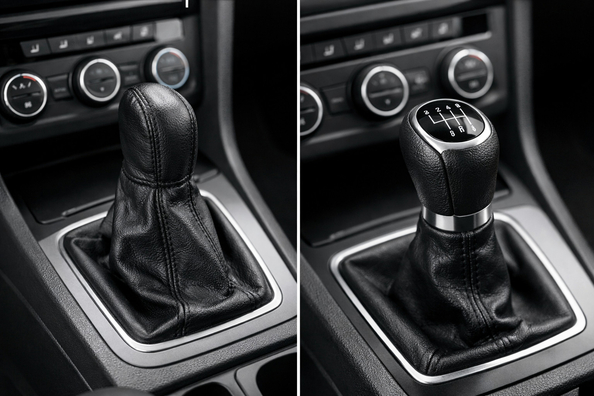
If the task is simple—remove scuffs, cracks, or a tired look around the lever—it’s more practical to start with the gear shift boot. It quickly refreshes the interior, covers wear, and usually doesn’t require complex selection.
A gear knob makes sense when it’s not the look that annoys you, but the actual hand contact: shape, weight, height, a slippery surface, or temperature discomfort. But then the thread, adapter, mounting type, and how the new knob mates with the boot matter, so you don’t end up with a gap, sagging, or rattling.
The gear shift boot is first and foremost a visual and practical refresh of the assembly. It hides worn material that suffers from sun, cold, heat, and constant flexing, but it barely changes the actual shifting feel.
The gear knob affects how it feels while driving. Different weight, diameter, and profile can make shifting more pleasant—or, on the contrary, a miss if the shape isn’t for you. So the question here isn’t “what looks better,” but what exactly you want to change: the appearance or the way the assembly feels in your hand.
Installation. With a boot it’s relatively straightforward, but you should look not only at the product height, but also at the frame, the mounting method, and the clearance for the lever shaft diameter. Universal solutions may fit shafts up to 15 mm and length around 203 mm, but that doesn’t cancel the need to verify the fit in your specific car.
Noise and play. A boot by itself doesn’t add noise if it’s properly stretched and secured. With a knob, the risk isn’t the material as such but compatibility: the wrong adapter, a loose fit, or no boot retainer often leads to a gap, sagging, and small rattles over bumps.
Service life and practicality. A boot is constantly flexing, so material and stitch quality matter. A knob wears less, but in a daily car thermal comfort is important: bare metal in winter and heat doesn’t suit everyone, while leather, Delrin, or thermally insulated options are noticeably more comfortable.
Price. A boot usually delivers more visual impact for less money. A knob justifies the higher price only when you actually get a better grip, the right weight, correct thread, and proper mating with the boot.
| Option | Strengths | Weaknesses | Who it’s for |
|---|---|---|---|
| Gear shift boot | Quickly refreshes the interior, covers wear, installation is usually simple | Barely changes grip, weight, or shifting feel | For those whose stock knob is fine and the issue is only appearance |
| Gear knob | Most strongly changes hand contact: shape, weight, height, material | You need to check thread, adapter, reverse lockout, and how it mates with the boot | For those who dislike the ergonomics and shifting feel |
| Boot + knob | Gives a finished result without old parts next to new ones | More expensive and a higher chance of compatibility mistakes | For those whose boot and knob are both worn or clearly mismatched in condition |
DD Tuning expert comment: the most common mistake is buying a nice-looking gear knob without checking the thread, seating height, and how it mates with the boot. In the end, you don’t get an interior refresh—you get a gap by the knob or a sagging boot. If you’re unsure, first decide what annoys you every day: the look of the assembly or the shifting itself.
This is the smartest first step when the assembly looks tired but the stock knob doesn’t raise complaints. A boot is cheaper than noticeable tuning, easier to install, and almost never creates side issues if the dimensions and mounting match.
Its weak point is obvious: it doesn’t affect shift precision or shortness. If the knob is slippery, too light, cold in winter, or hot in summer, a new boot won’t solve that.
Here the changes are felt immediately. Medium-weight and heavy knobs can change how the shifter feels in different ways: roughly 185 g vs 360 g is already a different character in your hand. Low-profile models sometimes also lower the grip point; in some setups this can feel like a shorter throw, but don’t confuse that with an actual change in shifter geometry.
The main risk is compatibility. In practice you’ll see threads like M8x1.25, M10x1.25, M10x1.5, M12x1.25, and on some cars an adapter is required at all. If there’s also a reverse lockout, a wrong choice makes the purchase useless. The second typical problem is that after replacing the knob, the boot no longer has proper retention and starts to sag.
Material-wise, for a daily car the most practical options aren’t bare metal, but leather, Delrin, or heat-resistant designs. They’re less irritating in frost and heat, especially if the car is parked outside.
For a regular daily car where you just want to remove signs of age, the boot wins. It’s less expense, fewer compatibility doubts, and a fast visible result.
For a driver who truly feels the shortcomings of the stock knob, it’s more logical to replace the knob itself. Especially if you don’t like the shape, you want more weight, or the lever is too tall. But this upgrade is worth doing only after checking the thread and how it mates with the boot.
For long trips, knobs with good thermal comfort work better than simply attractive metal. For city driving, taxi, or commercial use where hassle-free operation matters, the calmer scenario often wins: a fresh boot and a stock or OEM-like knob.
| Scenario | What’s best to choose | Why |
|---|---|---|
| Scuffed, cracked assembly in the cabin | Gear shift boot | Delivers the fastest visual effect without complex selection |
| Stock knob is slippery or uncomfortable | Gear knob | It’s what changes grip, weight, and shifting feel |
| Daily driver, parked in sun and frost | Boot or a knob made of a thermally comfortable material | Less discomfort in everyday use |
| Bad roads, sensitive to rattles | A neatly fitted boot or a tightly matched knob | What’s critical isn’t exotic parts, but no play and no gaps |
| Both the knob and boot are worn | As a set | Otherwise the new part will highlight the old one next to it |
Paying extra is justified not when a part simply looks impressive, but when it solves a specific problem. If only the lower part of the assembly is tired and you need a neat refresh, it’s enough to look at gear shift boots and not complicate selection.
A more expensive knob makes sense when you truly need different weight, better grip, a lower profile, or a material that doesn’t torture you in frost and heat. In that case, it’s worth looking at gear knobs and immediately thinking about how it will sit together with the boot.
If you’re unsure whether the problem is even the knob, it’s useful to first match the symptoms against the boot wear scenario. For that there’s a separate breakdown about a cracked gear shift boot. The most expensive solution becomes the right one only when it delivers not a prettier picture, but a finished, comfortable assembly without play or gaps.
From customer experience: a typical story is that someone wanted “the cabin to look fresher” and first looked at a new knob. After a proper check it turned out the stock knob was comfortable, and it was the boot that was worn—so they replaced only it and got the desired result without adapters or modifications. In the opposite scenario, the boot was still fine, but the stock knob was slippery and too light, so replacing it made a noticeable difference in daily driving.
If you need a practical interior refresh with minimal risk, in most cases the first thing to replace is the gear shift boot. If what annoys you is how the lever sits in your hand and how shifts feel, then the more correct step is a gear knob—but only after checking compatibility and how it mates with the boot.
The key is not to confuse a cosmetic problem with an ergonomic one. This material is based on real selection experience, practical work, and real use cases where what matters most isn’t the catalog photos, but installation, absence of play, everyday comfort, and a sensible result for your money.
| ✔ | The gear shift boot quickly refreshes the look of the cabin: it covers scuffs, cracks, and the worn lower part of the assembly without complicated matching. |
| ✔ | In most cases, the boot is easier to install and less likely to cause compatibility issues if the dimensions and mounting points match. |
| ✔ | The boot delivers a noticeable visual effect for less money, making it a practical option for a cosmetic refresh. |
| ✔ | The gear shift knob really changes the feel of shifting: you can improve grip, weight, height, and thermal comfort if the factory knob is inconvenient. |
| ✔ | For a daily car, knobs with proper thermal comfort are more convenient — for example, made of leather, Delrin, or other materials that are not hot/cold. |
| ✘ | The gear shift boot has almost no effect on grip, weight, or the shifting feel itself, so it does not address ergonomic complaints about the lever. |
| ✘ | The boot wears out over time at the folds, so its lifespan depends heavily on the quality of the material and seams. |
| ✘ | The gear shift knob requires careful checking of the thread, adapter, mounting type, and features of the factory design, otherwise the purchase may not fit. |
| ✘ | After replacing the knob, a gap or sagging of the boot may appear, and on rough roads there may be slight rattling if the fit is poor. |
| ✘ | A bare metal knob is not the most comfortable for everyday use: it can be cold in winter and hot in the heat. |
Shipping to EU
Wholesale and retail
Own warehouse
Опис продукту
Подарунки не надаються при оформленні покупки у кредит під 0,01% або при покупці частинами.