13.08.2026
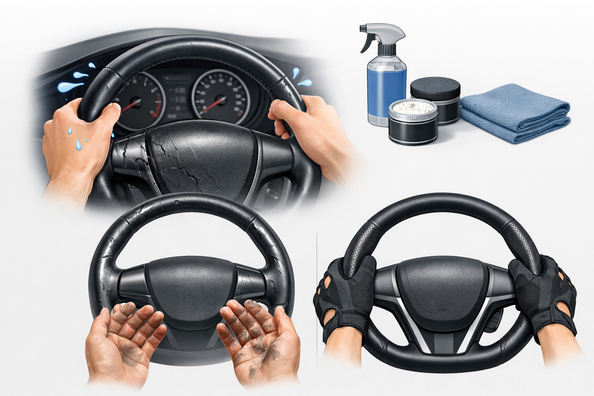

A steering wheel usually slips not because of a “weak grip,” but because friction between your palm and the rim is reduced. In practice, one of three factors is almost always to blame: moisture on your hands, an oily film on the surface, or worn steering wheel trim. Sometimes a fourth factor is involved — a poor cover that shifts on the rim by itself.
The good news is that this issue can be broken down by cause fairly quickly. If you correctly distinguish sweat from residue, and wear from a bad wrap, the fix is straightforward: clean it, remove the source of moisture, adjust your grip, and only then install an accessory.
Normal steering control depends on a combination of dry skin, surface texture, and a stable finger grip. When your palm is damp, the finish is polished smooth, or there’s a thin oily film on it, your hand stops “biting” into the material and starts sliding over it. On a hot steering wheel it feels worse, because sweat and leftover creams work faster.
The problem can be constant or occasional. If it slips only in summer, after hand sanitizer, or after sunscreen, that’s one story. If it’s slippery even after washing and in cool weather, more often the top layer of leather or leatherette is already worn.
Start with a simple test. Wash your hands without any cream, wipe the steering wheel with a mild soapy solution, dry it, and drive for 10–15 minutes. If it’s noticeably better, the main issue was surface buildup or product residue on your skin.
Next, compare how the wheel behaves in different conditions. If it slips mostly in heat, in traffic jams, or during tense driving, it points to sweating. If it’s slippery all the time and the rim has glossy, worn patches, the cause is most likely wear. If the slipping started after installing a cover, try gently rotating it with your hands while parked: any play already shows the fit is wrong.
A separate indicator is palms that sweat not only at the wheel, but also in everyday life, even in cool weather. Then it’s not about the steering wheel material, but a sweating tendency — and masking it with a single accessory makes little sense.
DD Tuning expert comment: the most common mistake is to immediately buy a thick universal cover without cleaning the wheel and checking whether it’s slipping because of an oily film. The second typical mistake is choosing a size that’s “roughly the same,” which makes the cover move independently of the rim. If you’re going to fit a wrap, it should be tight — and only after basic surface diagnostics.
| Symptom | Likely cause | What to do |
|---|---|---|
| The steering wheel is slippery after heat or a long drive | Sweaty palms | Dry your hands, cool the cabin, and if needed address the cause of sweating |
| The surface seems clean, but your hand “floats” after cream or sanitizer | Oily residue on skin and rim | Wash the wheel with a mild cleaner; don’t apply cream before driving |
| The steering wheel shines, with areas smooth like lacquer | Polished or worn finish | Don’t expect miracles from chemicals; consider a cover, re-wrapping, or replacement |
| Slipperiness appeared after installing a cover | The cover is loose or too thick | Remove it or replace it with a tight, correctly sized option |
| It slips only when gripping with the palm from the top | Poor grip technique and weak finger engagement | Hold the rim gently but firmly, more with your fingers than your whole palm |
| Palms are wet even without heat and load | Pronounced sweating | Try anti-sweat products for palms; if persistent, consult a doctor |
If the problem is severe and repeats not only in the car, don’t pin everything on the steering wheel material. In that case an accessory may slightly improve things, but it won’t remove the main cause.
An accessory makes sense when the root cause is already clear. If the rim is intact but slippery due to a smooth surface or a thin profile, a tight cover helps. If you want options by texture and thickness, check out steering wheel covers. If you want a thinner, more composed solution without extra bulk, consider a leather steering wheel cover.
The key word here is fit. Before buying, you need to measure the rim diameter, because even good material won’t help if the cover sits loose. There’s a separate option for the common size 37-38 cm, and the exact size often solves the problem better than a more expensive but poorly sized accessory.
If the wheel is already polished, tacky in places, or worn down to a changed texture, a cover will only be a compromise. For cars with steering wheel heating or hands-on-wheel monitoring systems, any wrap should be checked individually: sometimes it weakens the heating performance or interferes with the electronics.
| Solution | When it works | When it’s not worth spending money |
|---|---|---|
| Washing the steering wheel with a mild cleaner | There’s oily buildup, tackiness after cosmetics, a dirty dull film | The finish is already physically worn or polished to gloss |
| Anti-sweat product for palms | Palms are genuinely wet, especially in heat or under stress | The issue is only a dirty or worn steering wheel |
| Thin, tight cover | The wheel is too smooth or thin, but the rim itself is still intact | You need to hide heavy wear, or the cover isn’t compatible with the car’s functions |
| Cheap loose cover | Almost never the best solution | When precise control and a safe grip matter |
| Re-wrapping or replacing the steering wheel | The finish is worn, cracking, or has become permanently smooth | If you haven’t checked the issue with basic cleaning and the hand test first |
From a customer’s experience: the typical scenario is this — a driver complained about a slippery wheel in summer and was already planning to replace the rim. After proper cleaning it improved, but not completely, because the upper grip zone was already polished. In the end, a tight cover in the exact size worked: no play, no extra thickness, and no feeling that the wheel lives separately from the hands.
In most cases, a slippery steering wheel isn’t a mystery — it’s a combination of moisture, buildup, or a worn surface. You shouldn’t start by buying the first accessory you see, but by checking: clean the wheel, see whether your palms sweat, and assess the condition of the finish. If the cause is the material or rim profile, a tight cover really helps; if it’s heavy sweating or a worn surface, you need a different solution. This material is based on real fitting experience, practice, and real usage scenarios — not theory that hasn’t been tested on the road.
Shipping to EU
Wholesale and retail
Own warehouse
Опис продукту
Подарунки не надаються при оформленні покупки у кредит під 0,01% або при покупці частинами.