11.08.2026
167
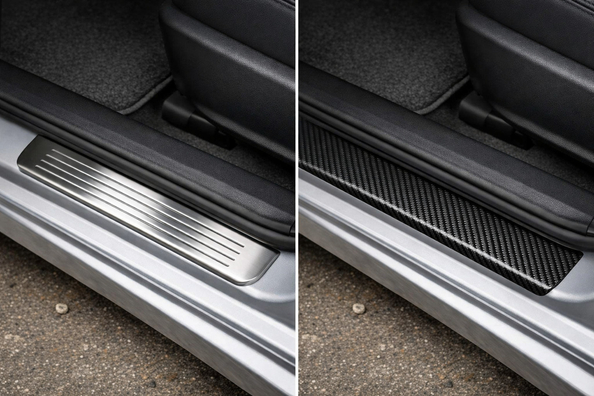
If the car is a daily driver and often sees dirt, kids, bags, and winter boots, stainless steel is usually the more practical choice. Its job is simple: take the daily scuffs from getting in and out, require no complicated fitting, and live спокойно in salt and sand.
Carbon makes sense when you knowingly pay for the look and lower weight, but there’s a catch: the word “carbon” can refer to three different things—real composite, plastic with a pattern, or a vinyl sticker. For door sills this is critical, because in a catalog they can all look premium, but in real life they perform very differently.
For door sills, what matters most isn’t the material’s spec-sheet strength, but how the cover survives daily contact with shoe soles, sand, moisture—and whether it starts interfering with the door seal. That’s why for a regular car stainless steel more often wins: it’s designed as working protection, not just a decorative insert.
Real carbon is objectively lighter and rigid, but on this part the weight saving brings almost no everyday benefit. More important is something else: how accurate the shape is, what adhesive is used, whether the edge is straight, and whether the “carbon” turns out to be just a decorative film.
| Option | Strengths | Weaknesses | Who it’s for |
|---|---|---|---|
| Stainless steel | Real protection from daily scuffs, corrosion resistance, straightforward installation, easy cleaning | Higher weight, a poor edge can rub the base surface, the look is more utilitarian | Daily drivers, family cars, crossovers, cars for winter and city use |
| Real carbon | Low weight, rigidity, striking appearance, appropriate for project cars | Higher price, sometimes requires fitting and professional installation, practical payoff isn’t always higher | For those who knowingly pay for style and already have carbon accents in the car |
| Decorative carbon-look | Most affordable, lightweight, quick to refresh, minimal cost | Not rigid carbon, weaker protection, service life depends heavily on installation and temperature | For an inexpensive visual refresh or a temporary solution |
DD Tuning expert comment: The most common mistake is buying “carbon” without уточнивши whether it’s a composite part, patterned plastic, or just film. The second typical problem is installing a cover without a dry edge test-fit and without proper degreasing. In that case even good material starts lifting at the edges or works like an abrasive on the clear coat.
This is the most down-to-earth and predictable option. Metal is heavier than composites, but on the scale of a sill cover the difference for the car is tiny. In return you get a rigid shape, a surface that’s easy to wash, and the logic of using it as a protective part rather than a decorative applique.
The weak point of stainless steel isn’t the metal itself, but the edge and the fit. If the shape is inaccurate or the installation is sloppy, the cover can rub the paint or conflict with the seal. That’s why model-specific geometry and proper full-area bonding matter.
As a material it’s very light and rigid, and its strength-to-weight ratio looks convincing. But for door sills that doesn’t automatically mean better everyday protection. In a real product, everything depends on thickness, the resin layer, the finish coat, edge accuracy, and whether the part is designed for постоянного contact with обувью at all.
In expensive kits you may get a better look and lower weight, but fitting and higher installation demands are often added. In other words, you pay not so much for practicality as for the material, design, and complexity of execution.
This is a separate product class that’s often mistakenly put in the same category as real carbon. If it’s film or a thin decorative layer, it works well as a visual refresh, but not as full-fledged rigid protection for the sill.
Its плюсы are low price and easy replacement. Its минус is stronger dependence on installation temperature, surface cleanliness, and careful application. For intensive daily use it’s more of a compromise than a primary solution.
If the car is used every day, carries a family, and is parked near stores, school, or the office, stainless steel looks like the most sensible choice. It better forgives the dirty season, frequent shoes with hard soles, and regular washing.
If the car is being built “for yourself,” has other carbon accents, and you’re ready to pay close attention to compatibility and installation, real carbon can be justified. There the decision comes from style, not from the need to cover a working area as cheaply and for as long as possible.
If you only need a quick visual effect without big spending, decorative carbon-look is appropriate. But it’s worth buying with exactly that expectation, without attributing to it the properties of a rigid composite.
| Scenario | Best choice | Why |
|---|---|---|
| Daily city car | Stainless steel | Provides clear protection from постоянних scuffs and doesn’t require overpaying for decor |
| Winter, salt, грязь, frequent washes | Stainless steel | Handles working conditions more calmly and is easier to care for |
| Project car or focus on interior style | Real carbon | Makes sense when the material, weight, and visual cohesion with other parts matter |
| Budget cosmetic upgrade | Carbon-look | Minimal cost and easy refresh without expectations of rigid protection |
| Complex sill shape or a sensitive seal | Model-specific thin cover with precise fit | Here product geometry matters more than the material name itself |
Paying extra is justified not when the box says “carbon,” but when you’re actually buying a precise fit, a neat edge, and predictable installation. If you need a proper choice for specific tasks, it’s worth starting with door sill covers as a product class, not with a loud material name.
When the task is purely practical—cover the working area on 4 doors and not complicate your life—it’s logical to look at a stainless 4-door set. If you want to compare rigid metal with a softer-feeling alternative in terms of touch and appearance, it’s also useful to check plastic door sill covers.
Real carbon only makes sense when you know for sure you’re buying a composite part, you’re ready for the higher price, and you’re not chasing protection at any cost. For a regular daily car, it’s not a базова need anymore—it’s a knowingly more expensive stylistic choice.
From a customer’s experience: for a daily crossover, we first looked for carbon because of the appearance, but after seeing the options it became clear the main problem was shoe marks, dirt, and constant rubbing along the sill edge. In the end we chose model-specific stainless covers because they protected the working area and didn’t require сложного fitting. The result pleased us not with a “wow” effect, but with the fact that after a few months the sills didn’t ask for attention.
For a daily car, stainless steel is more practical: it better solves the protection task, is easier in predictable installation, and usually wins in benefit-to-price ratio. Real carbon is worth taking when you knowingly overpay for the material and visual accent, not when you simply want to stop scratching the sill. Carbon-look remains a decorative compromise. This material is based on real selection experience, practice, and real usage scenarios—not just the material name alone.
| ✔ | Stainless steel is better suited to a daily car: it handles dirt, salt, sand, and frequent contact with shoes well. For city driving, winter, and family use, this is the most predictable option. |
| ✔ | Such trims are easier to install and do not require complex fitting if it is a model-specific part. This reduces the risk of the edge starting to rub the paint or interfere with the door seal. |
| ✔ | Stainless steel is easy to clean, and the surface works as a practical protector rather than a decorative insert. For sills, this is more important than the material’s lightness. |
| ✔ | In terms of price-to-value ratio, stainless steel looks the most rational. It covers the basic task without overpaying for appearance. |
| ✔ | Real carbon makes sense if style, rigidity, and visual consistency with other carbon parts in the car are important. For project cars, this can be a justified choice. |
| ✘ | Stainless steel is heavier than composites, although for a trim piece this difference is small. If you expect it to be as “light” as carbon, that will not be the case. |
| ✘ | Stainless steel’s weak point is the edge and fit, not the metal itself. Poor geometry or bad installation can start rubbing the paint or interfere with the seal. |
| ✘ | Real carbon is more expensive, and for an everyday sill it often offers no more practical benefit than metal. Often, you are paying for the material and the look. |
| ✘ | Under the name “carbon,” very different things can be sold: composite, patterned plastic, or film. Because of this, it is easy to overpay for a decorative effect while expecting the strength of a hard material from it. |
| ✘ | Carbon-look is not a full rigid protection and depends more heavily on temperature, surface cleanliness, and careful application. For intensive daily use, it is more of a compromise than a primary solution. |
Shipping to EU
Wholesale and retail
Own warehouse
Опис продукту
Подарунки не надаються при оформленні покупки у кредит під 0,01% або при покупці частинами.