22.09.2026
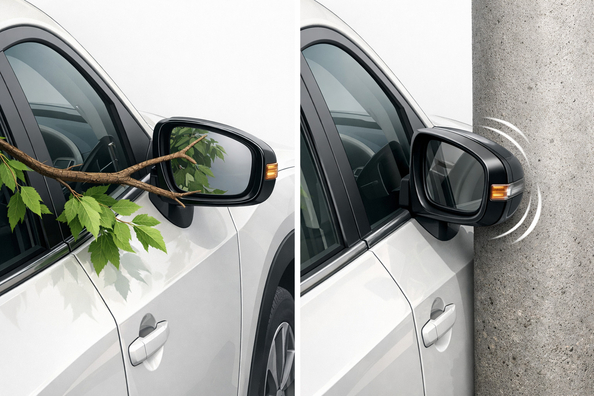
If side mirrors regularly catch on branches, posts, or gate edges, the problem is usually not the mirror itself. In most cases, it’s because the mirrors become the widest point of the car in a particular narrow passage—and there simply isn’t any side clearance.
There isn’t just one working fix here: you need to separately check the passage geometry, mirror adjustment, maneuvering technique, and the condition of the mirror assembly itself. Then it becomes clear where a habit change is enough, and where an accessory or repair is already needed.
In tight courtyards the body often fits fine, but the mirrors stick out farther than the doors and fenders. Because of that, the driver ориентates by the hood or the side of the car, while the real contact risk appears exactly at mirror height. This happens especially often where the passage narrows due to a post, gate, building corner, or a tree.
The second reason is that during a slow reverse maneuver or an angled approach it’s harder to accurately judge side clearance. If you rely only on the camera or sensors, it’s easy to miss a thin bollard, a gate edge, a stiff branch stub among leaves, or another obstacle at mirror height.
Start simple: measure the narrowest point of the passage and compare it to the car’s actual width measured across the mirrors in the unfolded position. If only a few centimeters remain on each side, the cause is almost certainly geometry, not “inattention.”
Next, look at repeatability. If the same mirror gets hit in the same spot, the problem is your line or approach angle. If contacts happen only while reversing, it’s worth checking mirror adjustment, your habit of shoulder-checking, and maneuver speed.
Separately check the driver aids: are the camera and sensors clean, are they blocked by dirt or snow, do they stay silent around thin posts. If the car has mirror folding or reverse tilt, test these functions specifically in your yard. After any impact, also check for play, misalignment, or a tight mechanism—especially in winter.
DD Tuning expert comment: The most common mistake is trying to fix everything with “more attention” when the passage itself simply doesn’t leave normal side clearance. The second mistake is trusting sensors more than your eyes, even though branches, thin posts, and dirty sensors often create a false sense of safety. If the mirror has already been hit, check not only the cap, but also the hinge and the folding assembly.
| Symptom | Likely cause | What to do |
|---|---|---|
| Right or left mirror catches in the same place every time | Too little width clearance or a poor approach angle | Measure the narrow section, change your line, and if needed fold the mirrors before starting the maneuver |
| The problem occurs only when reversing | Poor control of side clearance, poor mirror adjustment | Readjust mirrors, move very slowly, add a quick shoulder check |
| Sensors stay silent, but the mirror touches an obstacle | Thin post, branch, dirty sensors or camera | Clean the system, don’t rely only on electronics, visually monitor the space |
| Sometimes the mirror clears, sometimes it hits branches | Branches move; there’s a hard stub among soft foliage | Remove the branch from the path or change your line; covers only reduce scratches |
| In freezing weather the mirror folds jerkily or won’t unfold properly | Ice in the folding mechanism | Don’t force the actuator, remove ice, and if needed temporarily disable auto-folding |
| After an impact the mirror shakes or sits crooked | Damaged hinge, bracket, or the entire assembly | Inspect not only the cap but also the mirror base; if there’s play, repair or replace the assembly |
What works best is reducing the car’s effective width during the maneuver. If your vehicle allows folding the mirrors before entering a tight courtyard or garage, this is the most direct way to remove the cause of contact rather than fight the consequences.
The second effective solution is a different approach angle. When the mirror catches not throughout the whole passage but at one specific point, even a small trajectory change often does more than any electronics. It’s useful at least once to do the maneuver with an assistant outside and see exactly where the clearance disappears.
Properly set mirrors, very slow movement, and visual control—not just screens—also genuinely help. If the car has automatic mirror tilt in reverse, it’s useful for seeing the edge of the passage near the wheel, but it doesn’t replace monitoring side space at the height of the mirror itself.
The camera and parking sensors help too, but as assistance. They work well at low speed to control the rear and the general position of the car, provided the sensors are clean and conditions are normal.
Simply driving more carefully without changing your route or mirror position is a weak solution. If the passage is objectively too tight, caution alone doesn’t create extra centimeters.
Relying only on a camera or sensors also isn’t a good idea. Thin posts, low barriers, dirt, snow, fog, or ice can greatly reduce system usefulness—while the mirror remains the most vulnerable point.
Soft wall pads, foam, or other buffers make sense only to reduce damage. They don’t solve the narrow-passage problem. Likewise, cheap crude parking aids are of little use where clearance isn’t tens of centimeters, but literally just a few.
Another bad idea is forcing a frozen folding mechanism to work. That’s an easy way to add a broken actuator or hinge on top of a scratched cap.
Accessories make sense when they address a specific weak link—not when you expect a miracle from them. For this problem, the logic is:
Replacing parts is justified after an impact if the mirror has play, vibrates, sits crooked, folds unevenly, or no longer locks properly. In that case, a new cap alone isn’t enough: you need to check the bracket, hinge, folding drive, and housing mounts.
| Solution | When it works | When it’s not worth spending money |
|---|---|---|
| Folding mirrors before a narrow section | When the main issue is lack of width clearance | If the obstacle hits another part of the body, or the folding mechanism is faulty or frozen |
| Changing the approach angle and trajectory | When the mirror catches in one specific spot | If the passage is too narrow along its entire length even for folded mirrors |
| Proper mirror adjustment and a very slow maneuver | When the cause is partly a misjudgment of side clearance | If the passage geometry already leaves no practical clearance |
| Parking sensors or camera as assistance | When you need more precise low-speed control of the car’s position | If you expect them to detect every branch, thin post, or replace visual checks |
| Mirror covers | When you need to reduce damage from minor contacts and scratches | If the mirror regularly hits hard posts, gates, or a building corner |
| Repair or replacement of the mirror assembly | When after an impact there is play, misalignment, vibration, or folding issues | If the old mirror was fine and the cause isn’t fixed—so the new one will face the same scenario |
From a customer’s experience: a crossover owner regularly caught branches with the right mirror in a narrow courtyard and initially wanted to replace the mirror itself. After a simple measurement, it turned out the problem was extremely small side clearance and a poor approach angle. He started folding the mirrors before the maneuver, slightly changed his line, and added parking assistance to control the rear—after which repeated hits disappeared.
When side mirrors keep catching branches and posts, first check not the mirror but the real width clearance, approach angle, and maneuvering technique. Most often, folding the mirrors, moving very slowly, correcting the trajectory, and proper visual control help—while accessories and repairs make sense only after that.
In short: you can protect the cap, but you can remove the cause only when the car passes the narrow spot with sufficient clearance—or with the mirrors folded. This material is based on real selection experience, practice, and real-world usage scenarios, so the main advice is simple: diagnostics and geometry first, purchases second.
Shipping to EU
Wholesale and retail
Own warehouse
Опис продукту
Подарунки не надаються при оформленні покупки у кредит під 0,01% або при покупці частинами.