01.09.2026
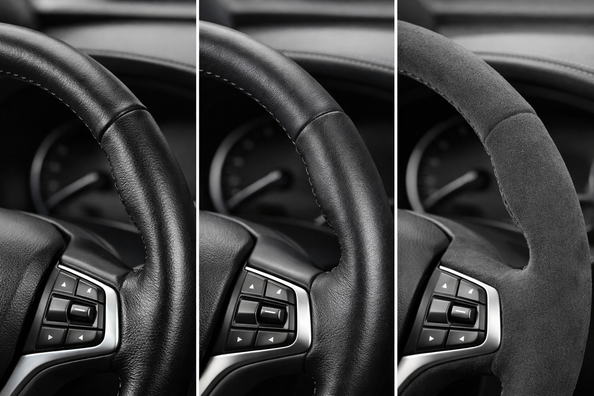
If you need a steering wheel cover for everyday use without unpleasant surprises, genuine leather most often wins. If the main thing is maximum grip and a sense of control in your hands, the stronger option is Alcantara. Eco-leather remains a workable budget compromise, but this is where the biggest difference is between a good product and a weak one.
The main mistake is choosing by material alone. Whether the cover will be quiet, won’t start slipping, and how long it will last is influenced just as much by size, fit accuracy, thickness, stitch type, and the quality of the base.
The difference between leather, eco-leather, and Alcantara isn’t limited to how they feel to the touch. Leather usually gives the best balance of durability, care, and appearance. Alcantara provides better grip but requires more regular maintenance. Eco-leather can be a good buy if the cover is high-quality, but the term itself doesn’t guarantee anything.
That’s why the right question is not which material is “best overall,” but which one works best for your scenario—daily city driving, spirited driving, winter use, a budget refresh for a worn steering wheel, or wanting a tight fit without squeaks.
| Option | Strengths | Weaknesses | Who it’s for |
|---|---|---|---|
| Genuine leather | Balanced grip, stable durability, looks more premium, with a tight fit usually without extra noise | Requires gentle care, can feel colder in winter, lace-up versions take longer to install | Those who drive daily and want one solid option for the long haul |
| Eco-leather | Lower price, easier care, often faster installation, decent grip in textured versions | Quality varies greatly; cheap covers may smell, slip, or peel quickly | Those who want to save money without completely giving up a neat look |
| Alcantara | Best grip, pleasant in the hands, less cold, well suited for active steering | Needs regular cleaning, the nap mats down, higher price | Those whose priority is grip, not minimal maintenance |
DD Tuning expert comment: Most often people first choose “leather or Alcantara,” and only then remember the steering wheel diameter. As a result, even a good material can squeak, rotate, or form waves near the seam. Check the rim size and shape first, and only then decide what exactly you’re willing to pay for—durability, grip, or easier care.
This is the most rational choice for most drivers. It feels natural in the hands, handles daily use well, and doesn’t need “refreshing” as often as Alcantara. If the cover fits tightly, leather usually performs quietly and predictably.
The weak point is maintenance. Leather doesn’t like aggressive chemicals, heavy soaking, harsh rubbing, hand oils, creams, and antiseptics. If you choose a cover that’s too thick, the steering wheel can feel unnaturally bulky.
This isn’t one specific material, but an entire group of synthetic coatings. That’s why the quality spread here is the widest. Good eco-leather can be pleasant, non-slip, and practical to maintain. Weak eco-leather will quickly lose its appearance, start peeling, or give a cheap glossy feel.
For everyday use, its advantage is easier cleaning. But if the cover is thin, smooth, or poorly matched in size, this is where slipping, noise, and early seam wear most often appear.
Alcantara provides the best grip with the palm and feels less cold in cool weather. That’s why it’s often valued by those who like more active driving or simply can’t stand a slippery steering wheel.
But this material doesn’t tolerate neglect. The nap picks up oils and dirt and mats down over time, so the cover needs regular cleaning and upkeep. If you don’t do this, it may still be functionally fine, but visually it will lose its freshness quickly.
For normal city use—when you get in the car often, park, and touch the wheel hundreds of times a week—leather is the easiest to live with. It’s not as demanding of frequent care as Alcantara and is usually more consistent than average eco-leather.
If you drive actively, your palms sweat quickly, or you’re simply sensitive to slipping, Alcantara makes the most noticeable difference. If the task is simple—refresh a worn wheel cheaply, and the car isn’t used hard every day—you can look at quality eco-leather, but without blindly betting on the material name alone.
| Scenario | What to choose | Why |
|---|---|---|
| Daily city driving | Genuine leather | The best balance of grip, durability, care, and appearance |
| Limited budget | Quality eco-leather | Delivers a neat result for less money if you don’t cut corners on tailoring and size |
| Active steering | Alcantara | Better hand grip and less feeling of slipping |
| Minimum maintenance | Genuine leather or good eco-leather | Alcantara loses here because it requires regular nap cleaning |
| Cold winter mornings | Alcantara | Feels less cold at the start of a trip |
| Heavily worn factory steering wheel | Lace-up leather cover or a rewrap | Gives a tighter fit and better thickness control than a simple stretch-on option |
Paying more is justified when you’ll actually feel the difference every day. It makes sense to pay extra for Alcantara if grip and control are critical to you. For good leather—if you want longer service life, calmer maintenance, and a more consistent result in daily use. And if a cheap cover has already slipped or made noise twice, the more expensive solution often turns out to be simply cheaper in the end.
To avoid overpaying for the wrong format, it’s useful to check the steering wheel cover materials overview, separately go through the topic of choosing a steering wheel cover, and if you want the tightest possible fit without extra thickness, compare the option of a steering wheel rewrap.
From a customer’s experience: A driver was looking for a replacement for a budget cover that started rotating and became annoying at the seam after just a few months. After accurately measuring the steering wheel, he отказался от another cheap eco-leather and chose a lace-up leather option because he drives in the city every day. In the end, what he appreciated most wasn’t the material itself, but the tight fit without constant readjustment.
If you need one short answer, it’s this: for most drivers, the most sensible choice is genuine leather; for maximum grip—Alcantara; for saving money—only quality eco-leather after checking the size, seam, and texture. That’s the simplest way to avoid buying a cover that looks good at first, but starts to irritate you a month later.
This conclusion is based not on pretty descriptions, but on real selection experience, installation practice, and real use cases: daily commuting, active steering, winter operation, and budget refresh of a worn steering wheel.
| ✔ | Natural leather offers the best balance of durability, care, and appearance. For everyday driving, it is a practical option that, with a snug fit, usually works quietly and predictably. |
| ✔ | Alcantara provides the best grip for the hands. It is especially useful for spirited driving and when it is important to feel less slipping. |
| ✔ | Eco-leather is the most affordable option and is often easier to care for. If the cover is high-quality and correctly sized, it can be a decent budget solution. |
| ✔ | A leather cover is better suited to city driving and frequent contact with the steering wheel. It is less demanding than Alcantara and is usually more stable than average eco-leather. |
| ✔ | For winter use, Alcantara feels less cold at the start of a trip. This can be a noticeable advantage on cold mornings. |
| ✘ | Leather has a weak point when it comes to care: it does not like harsh chemicals, heavy soaking, grease from hands, or rough rubbing. Also, a cover that is too thick can make the steering wheel feel unnaturally bulky. |
| ✘ | The quality of eco-leather is very uneven, so cheap options can quickly peel, smell, or slip. The term “eco-leather” itself does not guarantee a proper result. |
| ✘ | Alcantara requires regular cleaning, because the pile collects grease and dirt and becomes matted over time. Without care, it quickly loses its fresh look. |
| ✘ | For covers in general, the risk of problems is often tied not to the material, but to an improper fit or a sizing error. This can cause spinning, noise, and seams that wear out quickly. |
Shipping to EU
Wholesale and retail
Own warehouse
Опис продукту
Подарунки не надаються при оформленні покупки у кредит під 0,01% або при покупці частинами.