06.09.2026
194
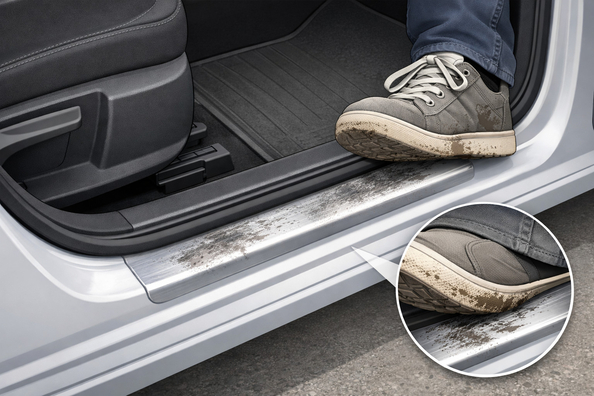
If passengers scuff the door sill with their shoes every day, the problem is almost never just “weak” paint. Usually it’s repeated contact in the same spot, abrasive sand and dirt on the sole, and sometimes an awkward entry/exit trajectory too: a high sill, a deep seat, winter footwear.
The right sequence is simple: first figure out what you’re actually seeing—rubber transfer, dirt, a scratch in plastic, or coating worn through to bare metal. Only then does it make sense to choose protection, because in some cases cleaning and a barrier are enough, while in others you need local restoration first.
The sill is one of the most heavily loaded entry/exit areas. When a foot slides along the body edge or a plastic trim piece, it’s not just pressure at work but abrasion too: fine sand, salt, dirt, and hard outsole rubber. That’s why even careful passengers can leave a noticeable dull stripe within a few months.
The issue is worse on crossovers, minivans, and cars with a wide sill: your foot has to travel farther, and many people subconsciously brace on the edge. In winter the risk is even higher because soles are rougher and carry more sand and road chemicals.
Start with the simplest test: wipe the area with a damp microfiber cloth, then use a gentle cleaner for plastic or painted surfaces. If the white or gray mark noticeably fades, it’s often rubber transfer or contamination rather than a deep scratch.
Next, inspect the area under angled light. If the plastic texture has become smoother, there’s a dull groove, or your fingernail catches an edge, that’s real surface wear. On a painted sill, warning signs are clear coat loss, dark dots, primer, or exposed metal.
If the damage line runs along the weatherstrip or door frame, look at the door rather than the passengers: the seal may be rubbing in one spot. Another clue is seasonality. If the problem spikes in winter, the cause is often footwear and abrasive contamination, not a part defect.
DD Tuning expert comment: The most common mistake is applying protection to a cold, dusty, or still-damp sill. Then the edge lifts quickly, sand gets underneath, and instead of protection you get a new friction zone. The second typical mistake is masking already worn-through paint with cosmetics without actually sealing the damaged area.
| Symptom | Likely cause | What to do |
|---|---|---|
| A white or gray mark that partially comes off after wet wiping | Rubber transfer, dirt trapped in the texture | Carefully wash with microfiber and a mild cleaner, then decide on protection |
| A dull stripe on textured plastic that won’t wipe off | Actual wear of the texture | Don’t sand aggressively; either install protection over it or plan to replace the part |
| A scratch on a painted sill with no exposed metal | Daily shoe friction in one spot | Clean it, touch up locally if needed, then cover the area with film or a trim plate |
| Primer/metal is visible or rust spots appear | The coating is worn through | Treat the damage and repaint first, then install protection |
| A long narrow line along the weatherstrip | Door seal rubbing or door geometry | Check the seal and door fit; sill protection alone won’t remove the cause |
| Most wear is only on one door and mostly in winter | A specific passenger, stiff footwear, awkward exit path | Install a mechanical barrier exactly in this area and monitor whether the contact point shifts |
What works is either removing the abrasive or putting a physical barrier between the shoe and the sill. The first step is to wash the area properly, because dirt often makes the damage look worse than it really is.
If the paint hasn’t been worn through to metal, the most effective option is a clear polyurethane protective film or a dense sill scuff plate. For an already visibly worn area, thicker or textured solutions are more practical: they not only take the friction themselves, but also partially hide old marks.
When metal is already exposed, the sequence must be different: local coating restoration, curing time, then protection. Otherwise you’ll just cover the issue from the top, and wear or corrosion will continue under the barrier. A separate point is installation: adhesive protective pieces are best applied in a warm space on a clean, dry surface, and you shouldn’t wash the car immediately after installation.
Plastic polishes and dressings often only darken the scuffed area. They don’t restore lost texture, so the mark returns in a few days or after a wash.
A melamine sponge, harsh abrasives, and aggressive sanding on textured plastic are risky: you can make the white spot even more visible. On painted sills, aggressive polishing is also questionable because the coating layer in the door opening can be thin.
A heat gun sometimes gives a short cosmetic effect on plastic, but it can just as easily ruin the texture or overheat the part. Temporary tapes, quick masking products, and “I’ll touch it up later” also don’t last long if someone keeps stepping on the same spot every day.
If the sill is being rubbed daily, it makes sense not to wait for deep wear, but to cover the load zone right away. For metal or painted sills, a practical solution is door sill scuff plates: they take the contact on themselves and make care easier. If the working area is wider or the contact is on the plastic part of the entry, take a look at plastic scuff plates, which are easier to live with in daily use.
If you haven’t decided on a protection format yet, it’s useful to separately figure out what sill protection from mechanical damage fits your exact scenario. Replacing the element is justified when the plastic has lost its texture so much that masking doesn’t help, or when the painted area is worn through to primer or metal.
| Solution | When it works | When it’s not worth spending money |
|---|---|---|
| Gentle cleaning | When the mark is mostly dirt or transferred rubber | When you can already see real texture wear, clear coat loss, primer, or metal |
| Plastic dressing | As short-term cosmetic masking after cleaning | When you need a long-lasting result or the surface is physically worn |
| Clear protective film | When the coating is still intact or has been restored, and you need to stop repeat wear | When it’s applied to a cold, dirty, or already rusty area |
| Dense sill scuff plate | When contact is constant, the area is heavily loaded, and a strong barrier is needed | When the cause isn’t shoes but a seal or door misalignment |
| Touch-up paint, then protection | When there’s already a breakthrough in the coating on a painted sill | When the paint is intact and the problem is only dirt—unnecessary work |
| Replacing the plastic part or local repair | When the texture is deeply worn and appearance won’t return with cleaning | When the damage is superficial and it’s easier to cover it with protection |
From a customer’s experience: on a family crossover, the front right sill suffered the most because the passenger stepped out while turning the foot over the edge. After cleaning, it turned out part of the light mark was rubber, but right on the ridge the coating was already starting to wear. First they covered the damaged area, then installed a scuff plate—new marks stopped accumulating, and the zone became much easier to maintain.
If passengers are scuffing the sills every day, don’t start with masking. First distinguish dirt and rubber transfer from real wear, check whether the weatherstrip is rubbing, and only then choose a solution. In most cases, the combo that truly works is “cleaning or local restoration → mechanical protection,” while cosmetics without removing the cause only buys you a pause.
This material is based on real-world experience selecting protection, installation practice, and everyday usage scenarios where the sill suffers not from one hard impact, but from hundreds of identical contacts.
Shipping to EU
Wholesale and retail
Own warehouse
Опис продукту
Подарунки не надаються при оформленні покупки у кредит під 0,01% або при покупці частинами.