12.09.2026
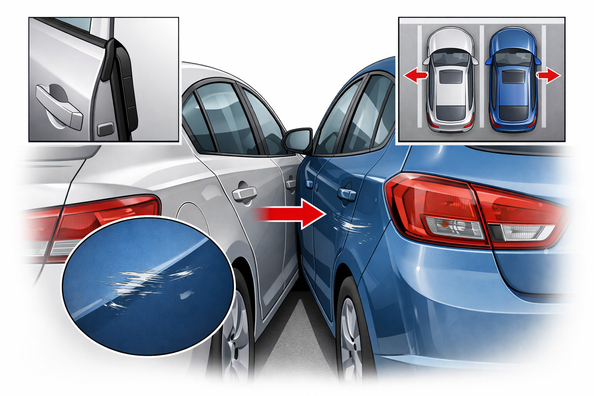

Daily scratches on side doors don’t appear only because of carelessness. In tight parking spaces, doors hit walls, posts, railings, neighboring cars and carts, and different types of marks require different protection. If you don’t distinguish an edge chip from an impact on the door panel, it’s easy to buy an accessory that simply won’t cover the risk area.
In most cases, the best result isn’t one product but a combination: door edge protection for the edge, a side molding for the panel, and a thicker protective film on the most vulnerable spots. Parking farther from other cars helps, but it’s not a full guarantee, and ceramic coatings or wax don’t replace a physical barrier.
In tight parking, doors almost always operate in limited space. When you open them next to a wall or post, the edge is what suffers. When another car is parked рядом, the door panel at a certain height is more likely to get hit. That’s why scratches that look similar can have different causes.
The second reason is repetition. If you park in the same garage every day, the mark often appears in the same place. That’s why a one-time polish without changing the protection usually doesn’t solve the issue: the defect simply comes back.
Look at where exactly the mark appeared. If it’s on the door edge, the cause is almost always opening in a confined space. If the scuff or dent is on the door panel, especially as a horizontal line, it’s more likely from someone else’s door or a cart.
Assess the height of the damage. A mark above the line of the factory or added molding means the protection is placed wrong or isn’t enough. Another simple check is to run a fingernail over it: if it doesn’t catch, it may be surface transfer of paint or rubber; if it catches or you can see metal, the clear coat is damaged or it’s a deeper chip.
Also check whether there is a dent without paint cracking. In that case, paintless dent repair makes sense first, and only then protection. If there’s an open chip on the edge, it’s better to touch it up locally before applying film so you don’t leave a spot for corrosion.
DD Tuning expert comment: the most common mistake is buying a molding without checking the height of the real impact. If the marks run above its line, even a quality accessory won’t take the hit. The second typical mistake is sticking protection onto cold or waxed metal: the edges start to lift, and the problem returns after the first wash.
| Symptom | Likely cause | What to do |
|---|---|---|
| A chip or scratch right on the door edge | Edge contact with a wall, post, or neighboring car | Touch up the chip locally, then install door edge protection |
| Horizontal scuff in the middle of the door | Hit from another car’s door or a cart | Choose a molding based on the actual contact height; if needed, add film on the risk area |
| Light stripe without texture; fingernail doesn’t catch | Transfer of someone else’s paint, rubber, or dirt | Carefully clean; if needed, lightly polish; then install physical protection |
| Small dent but paint is intact | Point impact from another car’s door | Do paintless dent repair first, then protection to prevent recurrence |
| New marks appear above an already installed molding | The contact zone is higher than the protection covers | Shift focus to a higher molding or a localized thick film |
| The edge of the film or trim started lifting | Installed on a cold or dirty surface; early aggressive washing | Reapply with proper surface prep and follow the post-installation curing guidelines |
First—door edge protection. For the door edge, this is the most precise solution: a narrow film about 12.7 mm wide covers the exact zone that most often gets chipped. But it’s thin, around 50 microns, so its job is to take minor edge contacts—not to save the door panel from a strong удар.
Second—a side molding. It works on the door panel and can реально take some of the parking contacts. The key is getting the height right. If taller vehicles often park next to you, a low molding may be almost useless.
Third—a thicker protective film on high-risk areas. For the front edge of the door, the recesses under the handles, and other vulnerable spots, a film around 200 microns works better. It holds up well against fine abrasion, sand, salt, and daily micro-contacts, but it won’t remove a dent from a strong impact.
Installation is critically important. Door edge protection is best applied at 13–32 °C, thick protective film at about 16–30 °C, and moldings at a minimum of 16 °C. After installation, you shouldn’t wash the film for at least 72 hours, and high-pressure washing should be moderate—otherwise you can lift an edge.
Ceramic coatings and wax make maintenance easier, add slickness, and reduce minor hazing, but they don’t create a sufficient barrier against a door удар. You shouldn’t expect them to protect against chips or dents.
Parking far away from everyone also isn’t a solution by itself. It reduces risk but doesn’t control other drivers’ behavior: someone may still park next to you later. Simple polishing also doesn’t provide a lasting effect if the contact scenario hasn’t changed.
Cheap self-adhesive protection without surface prep often lifts at the edges. If there’s dirt, wax, or the metal is cold, the adhesive system weakens, and after a short time the accessory stops working as intended.
If your doors regularly catch obstacles with the edge, it makes sense to start with door protectors or edge protection. When marks повторюються at one height across the panel, it’s more logical to look at door moldings. And if the lower adjacent area also suffers from shoes, curbs, or a tight garage, door sill plates are relevant too.
Accessories make sense when you need to prevent повторення. If there’s already an open dent, cracked clear coat, or corrosion on the edge, repair comes first. If an old molding is cracked, has lost rigidity, or constantly peels off, it’s better not to try to save it with re-gluing—replace the part completely.
| Solution | When it works | When you shouldn’t spend the money |
|---|---|---|
| Door edge protection | There are chips and touches exactly on the door edge | Scratches run across the door panel, or there’s already severe corrosion without repairing the base |
| Side molding | Repeated hits at one height from neighboring doors or carts | Contacts happen above or below its line |
| Thick protective film for localized areas | You need to protect the front edge of the door, the area under the handle, spots exposed to fine abrasion | You expect it to prevent a dent from a strong impact |
| Ceramic coating or wax | You want easier maintenance and less minor hazing | You need protection from door hits, chips, and point contacts |
| Paintless dent repair | There is a small dent but the paint isn’t damaged | The clear coat is cracked, there’s a chip to bare metal, or a deep crease |
| Just park farther from others | As an additional habit to lower risk | As the only protection strategy for daily parking in tight spaces |
From a customer’s experience: a typical situation—on an underground parking garage, a scuff kept appearing again and again on the rear door at the same height. At first the owner limited it to polishing and tried parking farther from neighbors, but new marks returned. After choosing a molding based on the real impact height and adding separate edge protection, new contacts stayed on the protection rather than on the paint.
To protect side doors from daily scratches, first you need to accurately identify the location and type of contact: edge, panel, just a surface mark, or already a dent. In most cases, the best result comes from a combination of edge protection, correctly positioned moldings, and localized thick film on risk areas. Ceramic coatings and wax are useful for maintenance, but they don’t replace a physical barrier. This material is based on real selection experience, installation practice, and real everyday-use scenarios—not on theoretical promises.
Shipping to EU
Wholesale and retail
Own warehouse
Опис продукту
Подарунки не надаються при оформленні покупки у кредит під 0,01% або при покупці частинами.