09.07.2026
397
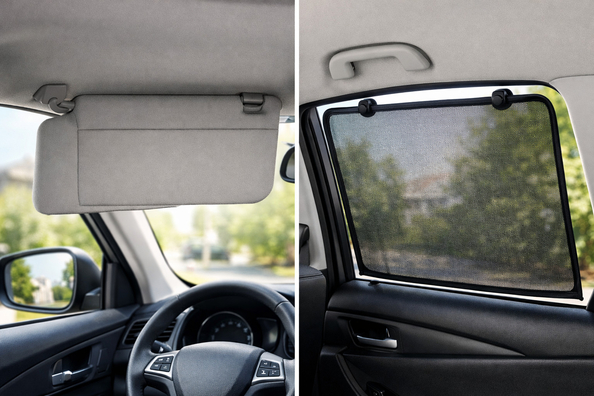
If the problem is specifically low side sun while driving, the add-on visor extender for the factory sun visor usually wins. It works at eye level, installs in seconds, and doesn’t block the entire window. A universal sun shade is better in a different scenario: when you need to darken the whole window area, cast shade for a child, add privacy, or leave the car in the sun.
There’s another nuance: side windows in different cars filter UV differently, so some people need extra protection almost every day, while others only during the low-sun season. Below I’m comparing the visor extender and universal side-window shades specifically, without mixing in other accessories.
There’s no single winner for every case, because these accessories solve different tasks. A visor extender fights a narrow beam of light hitting the driver’s eyes. A shade works across the glass area: it darkens, covers the passenger, and partly helps the cabin heat up less.
So the question should be: does the sun bother you specifically while driving, or do you want to create shade in the cabin overall. For the driver’s front side window it’s often one answer, and for the rear row it’s a completely different one.
Also look at the shade type. Mesh, blackout, and a simple suction-cup model behave differently, even though they’re often lumped into one category.
| Option | Strengths | Weaknesses | Who it’s for |
|---|---|---|---|
| Visor extender | Fast installation, works at eye level, doesn’t cover the entire side window, convenient for daily driving | Doesn’t cover the whole sector, may interfere with the mirror, helps passengers and parking less | Drivers bothered by low side sun while moving |
| Universal mesh shade | Covers the entire window area, shades the passenger, some models allow opening the window without removal | Needs the right size, can move at speed, not always comfortable on the front doors | Families, taxis, hot-weather trips, rear row |
| Magnetic or blackout shade | Maximum darkening, privacy, better for parking, resting, and camping | Too closed-in for the driver’s door, depends on frame compatibility, less universal while driving | Those who want full shade on the rear doors or while parked |
DD Tuning expert comment: The most common mistake is buying any universal shade for the front doors and expecting it to solve low sun for the driver. In practice it either blocks visibility or gets removed after a few trips. If the main issue is beams at eye level, look at a visor extender first, and only then at full window coverage.
Its main advantage is that it works exactly where the problem occurs: at the driver’s eye level. These models are usually compact, have angle adjustment, and mount quickly to the factory visor, so they’re easy to use every day, not only on long trips.
The weak point is cabin geometry. If the rear-view mirror sits low, the visor is short, or the driver’s seating position is high, the extender may bump, shift, or block a different angle than you need. And it’s important not to expect full darkening from it: it protects passengers from sun noticeably worse than a shade.
This is not a point solution but an area-based one. It’s better when the sun hits the entire side window, when there’s a child in the cabin, or when the car sits in the sun for a long time. The winners here are models that hold steady: magnetic, well-fitted mesh, or other options with a proper fit.
But a shade heavily depends on door shape and the type of mounting. Suction cups can come loose in heat, a universal size doesn’t always follow the contour, and on the front doors overly dark fabric can simply be annoying in heavy traffic. If you need ventilation, look specifically at mesh options: blackout gives more shade but is less convenient while driving.
A separate point is the numbers in product descriptions. Claimed 97%, 99%, or 100% aren’t always measured the same way, so you shouldn’t compare them directly. Much more important is whether the accessory covers the exact zone that bothers you, and whether it doesn’t wear you out with daily use.
For city driving, short trips, and routes where the sun often hits from the side at a low angle, a visor extender is more practical. It doesn’t require unfolding a shade every time, doesn’t take up the entire window, and quickly adapts as your direction of travel changes.
For kids in the rear row, long-distance trips, taxis, parking near the office, or resting in the car, a shade is better. Here it’s not only about beams in the eyes, but also shade across the whole window area, less heating of the trim, and more privacy.
If you need both driving comfort and sun parking protection, a combination often works: extender up front for the driver, shade in the back for passengers. It costs more, but in practice it’s the least conflicting setup.
| Scenario | What to choose | Why |
|---|---|---|
| Daily city route, sun hits from the side into your eyes | Visor extender | Works at eye level, quickly changes angle, and doesn’t block the entire window |
| Child or passenger in the rear seat | Mesh or magnetic shade | Provides shade across the whole window area, not just one spot |
| Parking in open sun | Blackout or magnetic shade | Darkens the cabin better and adds privacy while parked |
| Highway driving and the need to occasionally open the window | Mesh shade | Provides protection and conflicts less with ventilation if the design allows it |
| Winter or evening low sun for the driver | Visor extender | In this scenario, targeted blocking is more useful than fully darkening the window |
A pricier solution makes sense when the car spends a lot of time in the sun, children ride in the cabin regularly, or cheap universal options have already become annoying because they tilt and come unstuck. In that case it’s logical to look not at the simplest fabric, but at more stable sun protection shades with a better fit.
If you’re unsure which formats actually deliver benefits, it’s worth separately reviewing the material which shades really work. And when the main issue isn’t glare while driving but cabin overheating while parked, it helps to check separately what shades do against overheating.
For the driver, paying extra for a shade on the front doors is justified less often than for the rear row. Up front, convenience and speed usually win; in the back, full window coverage, stable fixation, and proper passenger protection.
From a customer’s experience: A driver was looking for protection specifically from evening sun on a daily route and first bought a cheap suction-cup shade. It partially blocked the mirror and was quickly removed, so for the front door he switched to a visor extender and kept the shade on the rear window for the child. As a result, the glare problem disappeared without losing visibility, and the rear passenger got proper shade.
In short, for side sun while driving, a visor extender more often helps the driver. If the task is broader—darken the glass, protect children, reduce heating, and add privacy—a universal shade is more practical, but only with a proper fit and the right type.
This material is based on real selection experience, hands-on practice, and real usage scenarios: city, highway, parking, trips with kids. So the main rule is simple: for the driver, choose based on the sun’s path and visibility; for passengers, choose based on window coverage area and everyday usability.
| ✔ | The visor extender attaches quickly to the factory sun visor and works exactly where the side sun is blinding the driver — at eye level. For everyday city driving, it is more convenient than unfolding a sunshade every time. |
| ✔ | It does not cover the entire side window, so it is less likely to spoil the view of the mirror, pillar, or turn area. This is important for the front doors and heavy traffic. |
| ✔ | A universal sunshade covers the entire window area, so it is better suited for the rear row, children, and situations when shade is needed across the whole glass. It also provides more privacy in the cabin. |
| ✔ | For parking in the sun or resting in the car, a sunshade is more practical than an extender because it darkens the cabin better and partially reduces trim heating. |
| ✔ | Mesh models can remain convenient even when the window needs to be opened occasionally. This makes them more suitable for the highway or trips in hot weather. |
| ✘ | The visor extender does not cover the entire side area, so it cannot replace a sunshade if you need to shade a passenger or the whole cabin. It should not be expected to provide complete blackout. |
| ✘ | Its effectiveness depends heavily on the cabin geometry: a low mirror, a short factory visor, or a high driving position can make the accessory inconvenient or of little use. |
| ✘ | A universal sunshade often requires precise size and mounting selection, and cheap versions may fit poorly, move at speed, or come loose in the heat. In other words, the universality here is only relative. |
| ✘ | On front doors, a sunshade can interfere with visibility and be annoying in city traffic, especially if the fabric is dark or the design covers an extra area. For the driver, this is not always a comfortable solution. |
Shipping to EU
Wholesale and retail
Own warehouse
Опис продукту
Подарунки не надаються при оформленні покупки у кредит під 0,01% або при покупці частинами.