02.08.2026
253
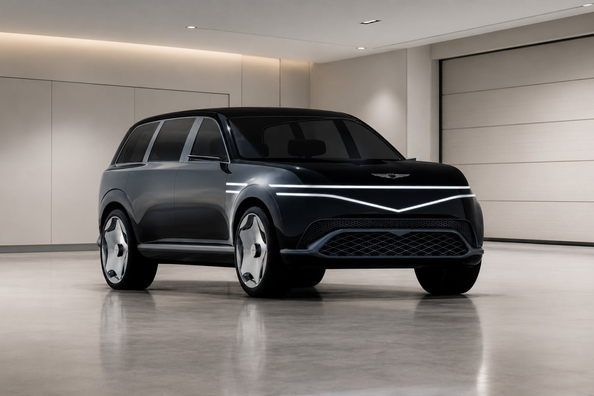
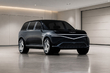
Genesis GV90 is currently on the line between a design concept and a late-stage road prototype. The manufacturer has officially confirmed only the foundation of this story: on March 25, 2024, at Genesis House New York, the brand showed Neolun, its first full-size electric SUV concept. The production GV90 itself has not yet received a publicly disclosed factory specification, so the cars being tested are more correctly called prototypes or pre-production rather than a finished production premiere.
For the buyer, this matters from a practical standpoint: the styling and architecture are already fairly easy to read, but the battery, output, range, interior configuration, and price still partly live in the realm of expectations. The loudest topic is the rear-hinged doors, like on a Rolls-Royce, but this is exactly where you need to keep the line especially strict between what has been officially shown and what is still only being predicted.
Officially, Genesis has already shown the Neolun Concept—this is the design and conceptual base for the future GV90. For the concept, pillarless coach-style doors, swiveling front seats, a radiant cabin heating system, a vertically moving display, and an emphasis on second-row executive comfort are confirmed.
As for the GV90 itself, the correct status right now is: the concept has already happened, there has been no production official reveal yet, and the cars spotted on public roads look like late prototypes or pre-production. That means the body and proportions are already close to the market-ready vehicle, but some expensive solutions may still be simplified before sales begin.
| What is known | What is expected | What is unknown |
|---|---|---|
| Neolun was officially shown as a full-size electric Genesis SUV concept | GV90 will retain most of the core proportions and its flagship status | How much of the concept solutions will reach production without simplification |
| For the concept, doors without a central pillar are officially confirmed | The production version may keep rear-hinged doors at least on higher trims | Whether these doors will be standard, optional, or disappear entirely |
| GV90 appears in the group’s future product plan | Debut is expected in 2026 | The exact premiere date and country-by-country sales launch schedule |
| Test vehicles are already driving on public roads | The production body and interior are close to the final look | Final interior materials, wheels, trims, and equipment level |
Officially, a platform for the GV90 has not yet been named, but Hyundai Motor Group documents already describe a new electric architecture called eM for passenger EVs. I consider it the most likely basis for the GV90, because by flagship logic it needs a large battery, better range, and faster charging than an older-generation architecture can provide.
From a design standpoint, the GV90 should be more complex than a typical large crossover. If the production car truly gets doors without a central pillar, engineers will have to work very hard on the sills, roof, door latches, and overall body torsional rigidity. In my view, this part will decide whether the model keeps the dramatic opening layout or whether it is partially simplified for safety, NVH comfort, and weight.
Here the picture is fairly clear: the officially confirmed image of the future flagship is electric—rather than gasoline or hybrid. There are no signs of an ICE or hybrid version at the moment, so the GV90 should be seen as a fully electric crossover with a dual-motor AWD setup in most versions.
According to preliminary data, we’re talking about a battery around 110 kWh, output of 500+ hp, an 800-volt architecture, and charging up to 350 kW. But these are expected figures, not factory confirmation. Officially, neither the exact battery capacity, nor the charging curve, nor the rated range has been announced.
DD Tuning expert comment: the most common mistake around such prototypes is treating the concept as a finished trim level. People see unusual doors or a pillarless cabin and immediately plan real-world use without thinking about getting in on a tight parking spot, door opening width, and door mass. In real подбор we always advise waiting for the production opening dimensions, floor height, and winter charging data—because that’s what affects daily comfort.
On the outside, the GV90 likely won’t move far from Neolun in the main points: very clean sides, a long wheelbase, a high hood, minimal visual noise, and a strong focus on a monolithic silhouette. The rear-hinged doors became the model’s key visual signature, but I wouldn’t rule out that they’ll be refined for production or kept only for the most expensive versions.
For the cabin, only conceptual ideas have been officially confirmed: heating not only for the seats but also for panels, swiveling seats, a vertically moving display, and an unusual audio system architecture. In production, some of the showpiece solutions will most likely be simplified, while the main priorities remain—lots of second-row space, quietness, a smooth ride, and more premium materials than in the brand’s current large crossovers. If you want to understand the starting point Genesis uses in the premium SUV segment, it’s worth checking the Genesis GV80 review.
For now, you should read the GV90 numbers carefully: the factory hasn’t fully disclosed them, but the market has already formed fairly stable expectations for the vehicle’s class.
In practice, this paints not just a large family electric crossover, but a car for those who want to go far, quietly, and with the feeling of a dedicated space for the second row—not just quick straight-line acceleration.
By positioning, the GV90 should land in a niche between technocratic electric crossovers and truly executive models. It’s not an off-road SUV, but a flagship road-going EV focused on comfort, dramatic design, and a higher-class interior.
| Model | What it offers today | How GV90 could respond |
|---|---|---|
| BMW iX | Strong electronics, performance, tech-premium image | A larger body, a third row, and a more upscale cabin feel |
| Mercedes-Benz EQS SUV | Very comfortable ride and strong segment status | Bolder design, possible coach-style doors, and likely a sharper value proposition |
| Lucid Gravity | Promises space and strong efficiency | Materials, second-row seating, and a more traditional premium presentation |
| Tesla Model X | Speed, software, brand network effect | More quietness, better finishing quality, and a more mature executive character |
| Rivian R1S | Practicality, family focus, utilitarian versatility | Higher road comfort and an emphasis on luxury rather than adventure |
Officially, for now there’s only a general reference that the GV90 is part of the brand’s future plan for the second half of the decade. Rumors suggest a public debut could take place in September 2026, with first U.S. sales as a 2027 model year. Likely first markets include South Korea, North America, and some key export countries, but this has not yet been confirmed by the manufacturer.
Pricing has the widest spread. Different leaks mention both a relatively “low” entry point and a six-figure upper level. In my view, if the GV90 keeps the complex doors, a large battery, and a truly premium second row, it’s more realistic to expect a base price closer to the top of the premium segment, with top versions potentially approaching $120–130k when converted.
The key points still haven’t been stated officially: the exact production platform, battery capacity, rated range, the full lineup of power versions, weight, towing capability, real seat count, whether the pillarless doors will remain, and how the cabin will be arranged in base trims. It’s also still unknown whether the GV90 will get a truly radical interior with maximum similarity to the concept, or whether Genesis will go for careful simplification for cost and reliability.
From customer experience: in requests for large premium crossovers, people most often look not for a “spectacular new thing,” but for a quiet car for long trips with comfortable second-row seating. In similar scenarios, customers usually filter out models with overly stiff suspension or awkward rear access and keep the ones where comfort is felt every day, not only at a presentation. That’s why the biggest interest in the GV90 right now isn’t because of the headline doors, but because of expectations of a truly flagship cabin and a large driving range.
My conclusion is simple: the Genesis GV90 looks like a very serious bid for a flagship electric crossover, but for now it should be evaluated through the “late prototype” filter. Officially, a strong conceptual base is confirmed, while the most interesting parts—battery, range figures, output, price, and the final door design—still await factory disclosure. If the brand preserves at least half of Neolun’s ideas without compromising body rigidity, quietness, and ease of entry, the GV90 could hit as an executive EV rather than just another expensive electric crossover. This material is based on real подбор experience, practice, and real usage scenarios, so the main reference point here isn’t the show effect, but how convenient and logical the production car will be in everyday operation.
Shipping to EU
Wholesale and retail
Own warehouse
Опис продукту
Подарунки не надаються при оформленні покупки у кредит під 0,01% або при покупці частинами.