08.07.2026
367
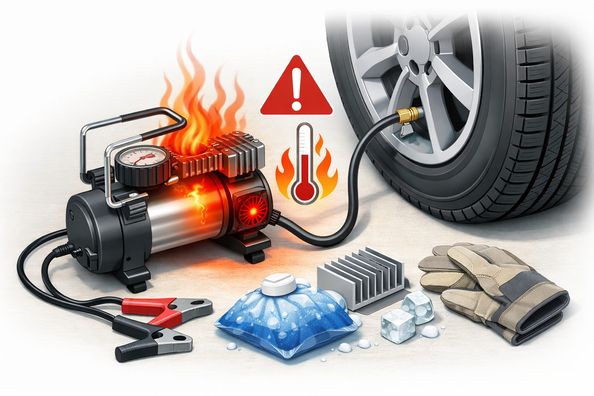
A compressor overheats while inflating tires most often not because of a single failure, but because of a combination of causes: it runs too long without breaks, suffers a voltage drop, loses air at the connections, or sits without proper cooling. On large crossover or SUV wheels, in hot weather, or when inflating several tires in a row, this shows up especially quickly.
If the unit heats up sharply, inflates more and more slowly, or shuts itself off, don’t assume right away that it’s broken. First, you need to distinguish normal thermal protection operation from weak power supply, a leak, or simply a compressor that doesn’t match your task.
A car compressor always gets warm because the motor and piston assembly operate under load. The problem starts when more heat builds up than the housing and ventilation can remove. That’s why compact models have a limited continuous-duty cycle, and after a long session they need a cooling break.
Overheating is often not a failure, but a protective response. If the compressor inflates one small tire, that’s one load. If you need to raise the pressure in four wheels in a row, especially with a larger diameter, or in winter after temperatures drop, the workload is completely different, and a weak model quickly reaches its limit.
Start with the basics: start the engine, connect the compressor to a working socket rated for at least 15 A, or to the battery terminals if the design allows it. If after that it runs noticeably more steadily and faster, the main issue was power supply.
Next, watch how it behaves over time. If the compressor inflates sluggishly from the first seconds, look for weak power or a leak. If it works normally at first, then after a few minutes sharply loses pace and goes into protection, the cause is more often overheating, poor ventilation, or exceeding the continuous-duty cycle.
Separately check the connection to the valve stem and the hose. Hissing, poor sealing, or the wrong chuck easily eats up performance. One more point: use the cold pressure from the vehicle placard, not the maximum printed on the tire sidewall. If you inflate “with a margin,” the compressor will simply run longer and heat up more.
DD Tuning expert comment: the most common mistake is plugging the compressor into a random socket, not starting the engine, and then wondering why it barely inflates and overheats. The second typical story is someone replaces fuses or blames the motor, when in reality the chuck is leaking at the valve. If performance is weak from the very first minute, check power and airtightness first—don’t look for “magic cooling.”
| Symptom | Likely cause | What to do |
|---|---|---|
| The compressor gets very hot and shuts off after a few minutes | Continuous-duty cycle exceeded | Let it cool for 10–15 minutes, then continue in shorter intervals |
| Immediately inflates slowly, the motor sounds strained | Voltage drop, weak 12V port, engine off | Start the engine and check that you’re connected to a socket with the required capacity |
| You can hear hissing near the valve and pressure rises poorly | Loose chuck, leak in the hose, or wrong adapter | Re-seat the chuck, check tightness, and verify compatibility with the valve |
| After a break it works normally again, but quickly repeats the shutdown | Poor ventilation or the compressor is operating at its limit | Don’t cover the housing, clean the intake, and reduce the duration of each cycle |
| It still copes with one wheel, but overheats on the third or fourth | The model is too small for repeated inflation | Move to a higher-output compressor with a higher duty cycle |
| In winter it inflates longer, although in summer it was fine | Tire pressure dropped more due to cold, the amount of inflation is larger | Plan a longer session, inflate one by one, and don’t exceed the vehicle’s cold pressure |
Restarting immediately after a thermal shutdown almost never fixes the cause. You simply let the unit reach a critical temperature again. The same applies to trying to “push for two more minutes” with clearly weak power or a hissing chuck.
It’s a bad idea to inflate to the maximum pressure printed on the tire sidewall instead of the value on the vehicle placard. That makes the compressor run longer, heat up more, and brings no benefit. If the model is too small for your wheels, small manipulations only delay buying the right tool.
Accessories make sense when the compressor itself is still fine, but loses efficiency at the connections. If the issue is the chuck, hose, or adapter, replacing them is cheaper and more logical than buying a new unit. But if you regularly inflate large wheels and the compressor reaches overheating every time, the problem isn’t in small parts—it’s the equipment class.
For such tasks, it’s worth looking not at “any compact pump,” but at tire inflators with a larger performance reserve. If you’re unsure about the class of the device, it’s useful to check which pump is better for a car for your wheel type and usage scenario. And when you need a model without constant battles with overheating, the article about a pump that doesn’t die after a season will help.
| Solution | When it works | When it’s not worth spending money |
|---|---|---|
| Start the engine while inflating | When the compressor is slow due to voltage drop | When it overheats even with normal power and a small session |
| Take a cooling break | When thermal protection trips after a long continuous run | When the cause is a leak or weak contact, not just temperature |
| Replace the chuck, seals, or hose | When there’s hissing, poor sealing, or the wrong adapter | When output drops only after a few minutes and there’s no leak |
| Clean the intake and provide proper ventilation | When the compressor sits in dust, heat, or without airflow | When the model is simply too small for large wheels and four tires in a row |
| Buy a higher-output compressor | When you regularly inflate large tires or several wheels at once | When the current unit is fine and the problem was only weak power or a leaky chuck |
From a customer’s experience: a compact compressor on a crossover kept going into overheat already on the second wheel after a cold snap. After checking, it turned out it was being used with the engine off and the chuck was also leaking. When power was provided from a proper 12V socket with the engine running and the connection was sealed, the issue became smaller, but for four large wheels it still required switching to a higher-output model.
In most cases, compressor overheating is explained by three things: running too long without breaks, weak power supply, and air losses or poor cooling. If you start the engine, eliminate leaks, don’t block ventilation, and follow cooling pauses, a compact compressor often returns to normal operation. But if it consistently overheats on your regular task, don’t waste money on temporary tricks—you need a more powerful model with a higher duty cycle. This material is based on real selection experience, hands-on practice, and real-world usage scenarios.
Shipping to EU
Wholesale and retail
Own warehouse
Опис продукту
Подарунки не надаються при оформленні покупки у кредит під 0,01% або при покупці частинами.