25.08.2026
187
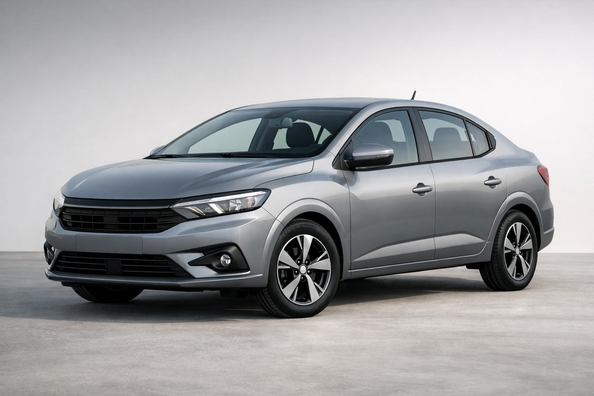
Dacia Logan III is one of the few new budget sedans where the main focus isn’t on wow-factor, but on costs, space, and simple day-to-day use. For family needs, work, city driving, and relaxed highway trips, it’s a very sensible car: a large trunk, uncomplicated engineering, and straightforward ergonomics.
At the same time, you shouldn’t buy Logan III expecting upscale trim, punchy performance, or cabin quietness on the level of higher classes. It’s a car for those who need honest transportation without extra expenses, not an emotional purchase.
Logan has always filled the niche of a practical, affordable sedan, and the third generation does it in a more grown-up way. Against a market that’s increasingly dominated by hatchbacks and crossovers, Logan III remains an option for those who specifically want a classic four-door body, a large trunk, and predictable running costs.
The model fits private owners, company fleets, taxis, and anyone who often travels with cargo. Logan III makes less sense for a driver who wants brisk highway acceleration, generous standard equipment, or an interior that feels like a more expensive class.
The first generation Dacia Logan launched in 2004 and became known for its simplicity and affordability. The second generation debuted in 2012, looking neater on the outside and being more comfortable in everyday use. Logan III was unveiled in 2020, and sales start depended on the market and stretched across 2020–2021; at the same time, Logan II continued to be sold in parallel in some markets for a while.
The third generation matters because it moved to the more modern CMF-B platform, increased body rigidity, added better sound insulation, and offered a wider set of electronics. At the same time, the philosophy didn’t change: it’s still a rational sedan without complicated tech, where practicality matters more than status.
The powertrain lineup in Logan III depends on the market and model year, but for most European versions, 1.0-liter three-cylinder engines are typical. That’s why, when choosing, it’s important to look not only at the model name but also at the exact specification.
| Engine | Displacement and power | Fuel | Transmission | What matters |
|---|---|---|---|---|
| 1.0 SCe | 999 cm³, 65 hp | Petrol | 5-speed manual | Base option for calm city driving, without much reserve of pull |
| 1.0 TCe | 999 cm³, 90 hp | Petrol | 6-speed manual or CVT | The most versatile version for city and highway |
| 1.0 ECO-G | 999 cm³, 100 hp | Petrol and LPG | 6-speed manual | An interesting choice for high mileage and a lower cost per kilometer |
If you want the smartest compromise, it’s usually worth looking at the 1.0 TCe 90. The naturally aspirated 65 hp engine is fine for a relaxed pace without heavy loads. The ECO-G version is appealing for those who drive a lot every day. Diesel for Logan III was no longer a main story in most markets, so looking for it specifically in the third generation usually doesn’t make much sense.
Logan III feels more mature, but it hasn’t become bulky. It’s still a compact sedan that’s easy to park, yet it offers a lot of usable space. The chassis layout is logical for the class: MacPherson struts up front, a semi-independent torsion beam at the rear, and front-wheel drive.
| Parameter | Value |
|---|---|
| Generation production years | since 2020, sales start depended on the market |
| Body | sedan, 4 doors |
| Platform | CMF-B |
| Length | 4396 mm |
| Wheelbase | 2649 mm |
| Body width | 1733 mm without mirrors |
| Height | 1501 mm |
| Ground clearance | about 161 mm |
| Trunk volume | 528 l |
| Drive | front |
On the road, Logan III prioritizes comfort rather than sharp responses. The suspension handles rough asphalt well, the steering is tuned without sporty ambitions, and the suspension design remains simple to service. For everyday driving that’s a plus; for a fast highway pace, it’s already a compromise.
Compared to its predecessor, the interior has become more modern in its layout, but Logan doesn’t hide its budget nature. The materials are simple, yet everything is clear and user-friendly: a comfortable seating position, good visibility, plenty of practical storage, a large trunk, and enough second-row space for its class.
Comfort level depends heavily on the trim. Higher versions may include multimedia with smartphone connectivity, a camera, parking sensors, air conditioning or climate control. Safety follows the same logic: the basic set is one thing, while driver-assistance systems such as automatic braking, blind-spot monitoring, or lane keeping depend on the specific market and version. Don’t expect premium-level cabin quietness, especially at speed.
In daily life, Logan III is strong where the owner really feels it: easy access, low service costs, sensible fuel consumption in the 1.0-liter versions, a large trunk, and the absence of complex expensive solutions. For city use, good visibility and compact length matter too; for a family, a decent second row and a roomy trunk.
Among the weaker points in everyday use, the most noticeable are road noise on the highway, modest performance of the base engine, and the overall simplicity of the trim. If the car often runs fully loaded or spends a lot of time on faster roads, it’s better to choose the turbo version right away rather than the base naturally aspirated engine.
From an owner’s point of view, Logan III is valued not for one standout feature, but for a collection of many small, smart decisions. But the compromises are very straightforward too, so it’s better to see them in advance.
| Strengths | What it gives you in real life | Weaknesses | What it means for the owner |
|---|---|---|---|
| Large trunk | Easier to carry suitcases, kids’ items, work equipment | Average sound insulation | On the highway, the cabin isn’t as quiet as in more expensive models |
| Simple engines and suspension | Lower risk of expensive service surprises | The base engine is a bit weak | Overtakes and full loads require extra time |
| Good cabin space for the class | The car suits family use and everyday work | Simple trim | Plastic and fabric show signs of hard use sooner |
| Factory gas version available in some markets | Lower cost per kilometer at high mileages | Equipment depends heavily on the trim level | Two Logan III cars can feel very different |
The main takeaway from this table is simple: Logan III should be chosen with a pragmatist’s eyes. If you clearly understand its limits, disappointments usually don’t happen.
For Logan III, the most sensible upgrades are not decorative, but protective and practical. This model is easy to mix up by generation when choosing parts, so before ordering it’s worth double-checking the version via the page /ekonomichnij-i-nadijnij-oglyad-dacia-logan.html. In practical use, the most useful items are those that protect the interior and body and make daily operation easier.
Among additional items without extra showiness, it’s worth thinking about protecting the trunk loading area, because that’s exactly where Logan quickly picks up signs of real life. For this model, accessories make sense when they extend the life of the interior and body, rather than trying to turn the sedan into something it isn’t.
Dacia Logan III is a sedan for those who need a large trunk, simple engineering, and predictable expenses. It’s best suited to calm daily driving, family tasks, work, and high mileage—especially in the turbo version or with petrol and LPG. If your priorities are highway quietness, dynamics, and rich standard equipment, it’s worth looking at other models.
The material is based on real selection experience, practice, and real usage scenarios, so Logan III is assessed here not by marketing promises, but by what the owner gets every day.
| ✔ | The large 528 l trunk and decent interior space make the Logan III convenient for family use, work, and trips with luggage. For its class, it is a practical option without a noticeable lack of space. |
| ✔ | The simple design with front-wheel drive, a rear torsion beam, and uncomplicated hardware should be cheaper and more predictable to maintain. This is especially important for taxis, company cars, and high-mileage use. |
| ✔ | The 1.0 TCe and 1.0 ECO-G versions look the most rational: the first offers a better balance for city and highway driving, while the second can lower the cost per kilometer on frequent trips. For everyday use, this is a more practical choice than the basic 65 hp engine. |
| ✔ | The suspension handles rough asphalt well, and the ground clearance of around 161 mm helps in normal city conditions and on bad roads. The car does not require carefully avoiding every pothole. |
| ✔ | Good visibility, compact length, and intuitive ergonomics make the Logan III easy to use in the city. This is complemented by low service costs and the absence of complex, expensive solutions. |
| ✘ | The base 1.0 SCe with 65 hp is weak for a full load and does not provide enough reserve for brisk overtaking. On the highway, this means a calmer and slower driving style. |
| ✘ | Sound insulation is average, and at speed there will not be the quietness of more expensive models in the cabin. This is especially noticeable on long highway trips. |
| ✘ | The interior trim is simple: the materials are inexpensive, and the cabin does not hide the model’s budget origins. After active use, signs of wear may appear fairly quickly. |
| ✘ | Equipment depends heavily on the trim level and market, so two Logan III cars that look identical can be very different in comfort and safety features. In base versions, you should not expect a rich list of options. |
Shipping to EU
Wholesale and retail
Own warehouse
Опис продукту
Подарунки не надаються при оформленні покупки у кредит під 0,01% або при покупці частинами.