24.08.2026
This upgrade plan is for a Mercedes Vito/V-Class W447 owner who carries family, passengers, or clients and wants not a “nice interior for photos,” but an interior that’s genuinely easy to keep clean. In this scenario, the key is not decor but floor and cargo-area protection that fits the body precisely, doesn’t interfere with the rails, and can be washed quickly away from the vehicle.
In the W447, dirt builds up not only under the front feet, but also near the sliding doors, in the rail area, under the second and third rows, and in the trunk. So the logic is simple: first cover the floor for your cabin configuration, then the cargo section, and only after that decide whether you need seat covers, mud flaps, or small organizers.
For a passenger W447, the goal of the upgrade is not just “no dust.” It should make daily cleaning easier, prevent sand and water from spreading through the cabin, and not create problems with seat transformations. If the vehicle often runs in frequent pickup/drop-off mode, the rail and aisle zones become the weakest point.
A key feature of this model is that compatibility depends heavily on body type A1/A2/A3, the rail type, cabin codes such as V44, T19, YE2, as well as specific seats and footrests. That’s why the right upgrade here starts not with material choice, but with a precise understanding of the cabin configuration.
Step one is model-specific mats covering the full working footprint of the cabin: the front row plus the passenger area of the second and third rows for your rail layout. For a “clean cabin” scenario, solutions that are easy to shake out and wash are more practical than velour. The underfoot coverage delivers the biggest effect for the money.
Step two is a trunk mat or a mat for the section behind the third row. If you carry a stroller, suitcases, bags, or kids’ items, dirt enters fastest from there. It’s only important not to expect a cargo mat to cover every single millimeter: with some configurations, narrow exposed areas may remain on the sides.
Seat covers, trim pieces, and other small items don’t deliver the same effect if the floor and rear area are still exposed. A typical mistake is buying expensive seat covers or decorative elements first—and then cleaning rails and door sills by hand every day.
| Upgrade | Why it’s needed | Who it really benefits |
|---|---|---|
| Model-specific mats for the front and passenger area | Collect water, sand, and small debris where it appears daily; make interior cleaning easier | Practically all W447 owners in passenger mode |
| Trunk mat or the area behind the 3rd row | Prevents dirt from suitcases, boxes, and strollers from getting into the floor and rails | Families, transfer services, anyone who often carries luggage |
| Seat covers | Protect upholstery from wet clothing, kids’ marks, and pets | Those whose cabin really gets dirty on the seats, not only on the floor |
| Mud flaps | Reduce the amount of wet grime on the sills and lower body area | Those who drive in snow, on dirt roads, through puddles; only after checking compatibility |
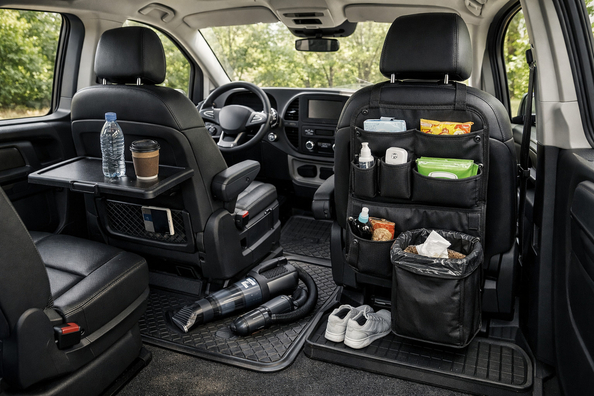
| Simple trunk basket or organizer | Keeps bottles, wipes, and small items from rolling around the cabin | Family cars and anyone who dislikes chaos in the trunk |
DD Tuning expert comment: The most common mistake happens at step one—ordering mats “for W447” without уточнення the rails, A1/A2/A3, and cabin codes. The second typical mistake is overpaying for looks when what you need is not a pretty material, but coverage that’s easy to remove, wash, and reinstall without fighting fasteners and seats.
Once the floor and cargo area are covered, the second stage includes upgrades that reduce how quickly dirt is brought back in. First of all, mud flaps—if the vehicle regularly drives on wet highways, in snow, or in sandy courtyards. But you can’t choose at random: the W447 has limitations depending on AMG Line, body type, and parts of the exterior packages.
The second sensible direction is seat covers, but only if the interior really lives in a kids/work/dog mode. If you mostly have adult passengers and tidy use, seat covers often just add an extra layer to the cabin and more work when cleaning.
The third second-stage option is small trunk organization. A basket or simple organizer won’t make the cabin cleaner by itself, but it will keep small items from flying around and spilling debris into the seat rails.
In this group I’d include decorative trim pieces, interior chrome, additional tables, cooler boxes, and similar accessories. They can be nice on trips, but they hardly change the effort required for cleaning. For a “clean passenger cabin” scenario, this is definitely not first priority.
This also includes some solutions that make the vehicle look “richer” visually, but don’t cover the main contamination points. If your budget is limited, it’s better to invest in proper floor and trunk coverage than in accessories that don’t remove sand from the rails and water marks from the walkways.
Most often, people waste money on universal mats. On the W447, they rarely work well around the rails, sliding doors, and transitions between rows, so dirt still gets under them or remains in exposed areas.
The second mistake is thick textile in the trunk for a vehicle that carries wet items or kids. It quickly soaks up dirt, takes longer to dry, and can interfere with moving seats around. The third is a full set of seat covers “just in case” when the seats aren’t suffering anyway. In the end, people pay for looks, and real cabin cleanliness changes little.
| Conditions | What to install first | What can be postponed | What is not required |
|---|---|---|---|
| Normal passenger use | Model-specific mats for the front and passenger compartment | Trunk mat | Seat covers, decorative trim |
| Kids, stroller, frequent luggage | Cabin mats plus a mat behind the 3rd row or in the trunk | Organizer or basket | Cooler box, decorative interior tuning |
| Often wet, snow, dirty yards | All-season floor coverage | Mud flaps after checking compatibility | Velour solutions as the main set |
| Dirty clothing, pets, work trips | Cabin mats | Seat covers | Decorative elements that don’t make cleaning easier |
More expensive solutions make sense when the vehicle is genuinely in daily use and you want not just “something under your feet,” but a precise set for your cabin configuration. In that case, it’s logical to look at EVA mats for the full cabin: they match the quick-cleaning scenario better than a random universal set.
If the floor is already protected, and dirt gets onto the upholstery because of kids, pets, or work clothing, then it makes sense to pay extra for seat covers. And if the vehicle constantly drives on wet roads and through puddles, mud flaps can sometimes be justified too—but only after checking compatibility with your body type and exterior package.
From a customer’s experience: a W447 owner was looking for a way not to vacuum the passenger compartment after every family trip. He started with a precise set of mats for his rail layout, then added protection for the area behind the third row, and postponed seat covers. In the end, the biggest effect came from the floor: the interior is faster to clean, and the seats turned out to be practical enough even without extra covers.
For a Mercedes Vito/V-Class W447 in a clean passenger-cabin scenario, the right start is almost always the same: first, precise mats for your configuration; then the cargo area; and only after that seat covers, mud flaps, or small comfort items. This helps you avoid overpaying for appearance and buying things that have little impact on real cleanliness.
In short, what’s useful here is what can be removed, washed, and doesn’t conflict with rails and seats. That’s the logic behind this material: it’s based on real selection experience, practical know-how, and real-world usage scenarios—not decorative accessory lists.
| ✔ | Model-specific mats tailored to your cabin configuration cover the footwell well, where sand, water, and small debris collect every day. They can be shaken out or washed quickly, so cleaning becomes noticeably easier. |
| ✔ | The trunk mat or mat behind the third row helps keep dirt from suitcases, strollers, and bags from spreading into the rails and cabin floor. For family trips and transfers, it’s a practical way to contain the main source of dirt. |
| ✔ | The upgrade takes into account the specifics of the W447: body, rail type, and interior codes, so there’s less chance of buying a poor universal option. This is especially important when the seats are moved or the cabin has non-standard elements. |
| ✔ | A step-by-step upgrade approach lets you first cover the main dirt points and only then add seat covers, mud flaps, or organizers. This way, the budget goes toward things that really affect cleanliness, not decorative extras. |
| ✘ | Without an exact match for A1/A2/A3, rail type, and interior codes, there is a risk of buying a kit that won’t fit properly. In the W447, compatibility depends heavily on the configuration, so a mistake at the start costs money and time. |
| ✘ | The trunk mat doesn’t always cover everything perfectly: on some versions, open areas may remain on the sides. In other words, it reduces dirt, but doesn’t solve the problem 100%. |
| ✘ | Seat covers aren’t always necessary and can add an extra layer to the cabin and more work when cleaning. If the seats aren’t suffering much, their benefit will be limited. |
| ✘ | Mud flaps for the W447 have limitations based on the body type and exterior packages, so they can’t be bought without checking compatibility. This makes them a less universal solution than mats. |
Shipping to EU
Wholesale and retail
Own warehouse
Опис продукту
Подарунки не надаються при оформленні покупки у кредит під 0,01% або при покупці частинами.