08.09.2026
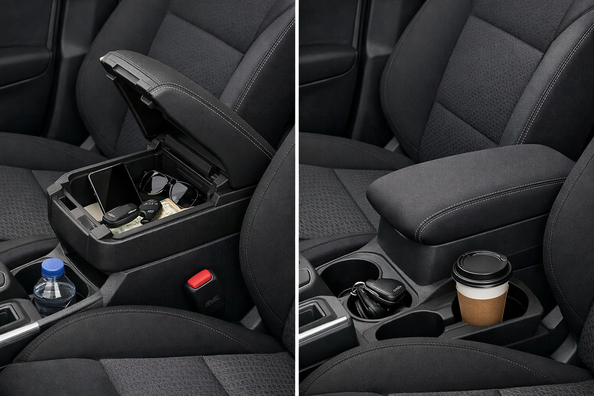
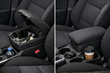
In short, for everyday trips an armrest with a storage box wins more often: it gives you proper elbow support and a place for your phone, keys, cards, and a small charger. But with a manual gearbox, in cars with a narrow center tunnel, or with a low handbrake, the box-free option is often more practical because it interferes less with movement and is easier to install.
The main mistake is looking only at photos. On the highway an armrest really helps, but if the body is too big, the lid has play, or the mounting is weak, you’ll end up with squeaks, handbrake interference, and extra hassle every day instead of benefits.
The essence is simple: you’re choosing not between a “nice-looking” and a “not nice-looking” accessory, but between two ways of using the cabin. An armrest with a box is for those whose small items constantly end up in cupholders, door pockets, and on the tunnel. A box-free option suits those who mainly want a soft support for the arm without noticeably affecting the car’s ergonomics.
One more nuance: “without a box” on the market can mean either a soft pad on the factory lid, or a separate armrest without a lower compartment. For daily driving these are different things. A pad barely changes the cabin geometry, while a separate armrest still needs to be checked for height, width, and mounting.
You should compare not by the seller’s description, but by five practical criteria.
Before buying, three measurements are enough: the width and length of the installation area, the distance to the handbrake and seatbelt, and a check that the body won’t block buttons on the center tunnel. For soft pads, a common reference is lids about 25–35 cm long, but that’s not a standard—just a typical area for many universal models.
| Option | Strengths | Weaknesses | Who it suits |
|---|---|---|---|
| With a box | Storage for small items, higher elbow support, cabin looks more organized | May interfere with the handbrake, seatbelt, and shifting; higher chance of play and noise | Those who drive highways a lot, carry small items, and have enough space on the tunnel |
| Without a box: soft pad | Fast installation, minimal intervention, low risk of damaging the interior | No storage added; may shift or sag if the mounting is weak | Those who only need elbow comfort and easy installation without drilling |
| Without a box: rigid armrest | Holds shape better than a pad, but not as bulky as a box | Still requires compatibility checks; if the fit is wrong, it will interfere just the same | Those who want support but don’t need a separate storage compartment |
DD Tuning expert comment: Most often people don’t make a mistake with the armrest type, but with its size. They see “universal” and don’t measure the tunnel, handbrake height, and seatbelt area—then wonder why the lid rattles or why it’s hard to pull the handbrake. If there’s any doubt about width or how far it sticks forward, it’s better to choose a lower and shorter option than a bulkier one.
In everyday use, a box is valued not so much for volume as for organization. Phone, keys, pass, cable, wipes stop living separate lives around the cabin. The second benefit is better support height: when the center tunnel is low, the box lid often lifts the elbow better than a thin pad.
The weak point of this solution is size and mechanics. A typical universal box already takes up noticeable space, so on a narrow tunnel or with a manual transmission it’s easy to end up with a conflict with the handbrake or shifting. Cheaper models also tend to be noisier: they have more hard parts, hinges, and joints that start to develop play over time.
A soft pad or a compact armrest without a compartment is an option for those who want a better driving position without major modifications. These solutions are usually lighter, install faster, and barely interfere with the factory interior. If the only problem is that your elbow “hangs” in the air, this is often enough.
But without a box you don’t solve storage. If small items constantly accumulate in the car, a pad will add comfort but won’t remove the clutter. The second point is service life. In simple models it depends on the quality of straps, seams, and filler; in rigid compact armrests—on fit accuracy. If the base wobbles, noise can appear no worse than with a box.
| Criterion | With a box | Without a box |
|---|---|---|
| Installation | Often more complex; sometimes requires precise selection and checking clearances | Usually simpler, especially in the soft-pad format |
| Noise | Higher risk of play if the body and lid are budget-made | Fewer parts, so fewer potential squeak sources |
| Durability | Hinges, latches, and upholstery wear; quality strongly affects longevity | Depends on straps, seams, and fit accuracy; simpler design |
| Practicality | Improves storage and cabin order | Improves freedom of movement and access to controls |
| Price | Usually more expensive due to design and functionality | Usually cheaper, especially among universal pads |
On the highway the advantage of a box is felt more strongly. You use the armrest often, so the difference between “just somewhere to rest your arm” and “comfortable height plus space for items” becomes noticeable within the first few days. This is especially relevant for automatic transmissions and cars where the handbrake doesn’t stick up high next to the seat.
In the city, ergonomics are tested more harshly. If trips are short and there’s lots of maneuvering, an overly wide box quickly becomes annoying. For manual transmissions, tight interiors, or a low center tunnel, a soft pad or a compact box-free option often gives a better balance: fewer obstacles, less noise, easier installation.
There’s also a third scenario: you already have a roomy factory console. Then a separate box isn’t always needed. If you already have somewhere to put things, it makes more sense to choose a solution for elbow comfort rather than duplicating storage.
| Scenario | Best choice | Why |
|---|---|---|
| Daily city driving with a manual | Without a box | Less chance of hitting the handbrake and shifter; easier to fit without conflicts |
| Frequent highway trips with an automatic | With a box | The support is used often, and the extra space for small items truly reduces cabin clutter |
| Taxi, delivery, lots of small items | With a box | Provides dedicated places for a phone, cable, cards, and receipts—wins on practicality |
| Car where you don’t want to drill or modify anything | Without a box | A pad or a simple option installs faster and doesn’t require interior вмешательство |
| Narrow center tunnel | Without a box | A smaller body is less likely to rub against seats and won’t block access to controls |
| Family car with a constant set of small items in the cabin | With a box | Helps keep the cabin organized as long as you don’t overload the compartment |
A more expensive armrest is worth it when the car is truly used every day, you’re sensitive to noises, and you don’t want compromises in seating position. The extra cost is justified by more accurate geometry, more rigid mounting, a better lid, and proper upholstery. This is especially important if you need a box but the interior is tight: a cheap universal option is most likely to miss there.
If you want to better understand the basic types, start with the armrest overview—it’s an easy way to distinguish pads from full constructions. For compatibility-based selection, the comparison of a vehicle-specific vs universal option will help, and if you’ve already decided on the type, take a look at the armrest category.
Separately, it makes sense to pay more for a vehicle-specific or rigidly fixed solution if you plan to keep the car for a long time. It usually fits better, has less play, and looks more natural in the interior. But even then, you need to check whether the design will limit seat travel or interfere with backrest folding.
| What a more expensive option gives you | When it’s truly justified | What to check before buying |
|---|---|---|
| More precise fit | When the car is used daily and a quiet cabin matters | Whether the tunnel shape matches, whether the base has any play |
| More reliable mounting | When you don’t want to constantly tighten or shim something under the body | Fixation quality, access to the handbrake and seatbelt |
| Better lid and upholstery | When your hand rests on the armrest for hours, especially on the highway | Softness, height, no sharp edges |
| Better look in the cabin | When you’ll keep the car for a long time and small discomfort accumulates | Whether it blocks buttons, cupholders, and the storage pocket |
From a customer’s experience: a driver of a compact manual hatchback initially wanted a wide universal box because there wasn’t enough space for a phone and small items. After a test fit it became clear the handbrake was too close, so the choice was changed to a more expensive but better-matched option with a shorter body and rigid mounting. As a result, he got stable support without play and access to the shifter without having to “go around” the armrest with his hand.
For everyday trips, an armrest with a storage box is useful in most cases if you need both hand comfort and a tidy cabin. But with a manual transmission, in a tight interior, or when you don’t want to risk access to the handbrake, a box-free option is often the smarter and more practical choice.
The best choice here isn’t made by description, but by measurements and your use scenario. Check compatibility and geometry first, and only then decide whether you really need a box or if a simple elbow support is enough.
| ✔ | An armrest with a storage box simultaneously provides elbow support and a separate place for a phone, keys, cards, and cables. For everyday trips, this really helps reduce clutter in the cabin. |
| ✔ | A box often raises the elbow higher than a thin pad, so it can be more comfortable on the highway. This is especially noticeable in cars with a low center tunnel. |
| ✔ | If small items keep piling up in the car, a box helps keep them in one place instead of spreading them across cup holders and door pockets. For taxis, delivery vehicles, or family cars, this is more practical than a simple pad. |
| ✔ | A rigidly mounted or vehicle-specific version usually fits better and has less play than a cheap universal box. This matters for those who drive every day and do not want squeaks or constant adjustments. |
| ✔ | A boxless version, especially a soft pad, hardly interferes with the factory interior and installs faster. It is useful when you only need arm support without complicated installation. |
| ✘ | An armrest with a storage box can interfere with the handbrake, seat belt, or gear shifting, especially in manual cars and cramped interiors. In such cars, it sometimes creates more inconvenience than benefit. |
| ✘ | Boxes have more parts, so looseness, squeaks, and rattling on rough roads appear more often. Cheap models also handle heat worse and wear out faster. |
| ✘ | A boxless version does not solve the issue of storing small items. If there are already many things in the cabin, it adds only elbow comfort, but does not eliminate the mess. |
| ✘ | Simple covers and compact armrests without a compartment also need proper seating and mounting. If the base wobbles or the straps are weak, they can shift, sink, or start making noise. |
Shipping to EU
Wholesale and retail
Own warehouse
Опис продукту
Подарунки не надаються при оформленні покупки у кредит під 0,01% або при покупці частинами.