04.10.2026
79
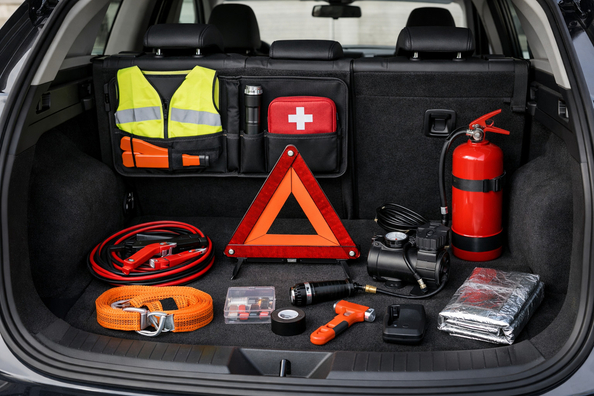
This plan is for a driver who wants to put together an emergency kit without extra clutter: to get through a nighttime stop, a dead battery, a minor breakdown, waiting for a tow truck, or a delay in the cold—without chaos in the trunk.
The main logic is simple: don’t buy a big “kit for every situation,” but build a short core around real risks. Start with the items that give you communication, light, visibility, warmth, and the ability to wait for help; then add what increases self-sufficiency; and finish with storage convenience and pricier add-ons.
A proper emergency kit shouldn’t turn your car into a warehouse. Its job is much more down to earth: give you communication, basic first aid, light, roadside visibility, a minimum of warmth and water, plus a chance to handle a typical small issue on your own—like a discharged battery or low tire pressure.
The kit depends on the scenario. For city driving, a compact base is enough. For highways, night trips, and winter, a blanket, a warm layer, an ice scraper, extra water, traction aids for slippery surfaces, and items that let you safely wait for help in the car—rather than walking—matter more.
Start with a core that covers most real situations: phone charging, a first-aid kit, a flashlight, water, a simple long-shelf-life snack, visibility gear, a blanket, basic tools, and a way to start the car. There’s no single “right” option for starting: if you often drive alone or at night, a jump starter is more convenient; if it’s mostly city driving and help is nearby, jumper cables are often enough.
Separately, assemble a personal pack: prescription meds, spare glasses, a contact list, copies of essential documents—and if you regularly carry kids or pets, a minimum set of items for them too. This isn’t an “add later”; it’s part of a kit that actually works.
| Upgrade | Why it’s needed | Who it really helps |
|---|---|---|
| Phone charger | To keep communication, navigation, and the ability to call for help | Everyone, without exception |
| First-aid kit | To handle minor injuries until help arrives | Everyone, especially family cars and those who drive on highways |
| Flashlight with working batteries | To illuminate a wheel, the engine bay, the cabin, or the shoulder at night | Those who drive after dark, park outside, or are often outside the city |
| Water and a simple snack | To get through a delay, cold, or long wait | Everyone; especially on long routes, in heat, and in winter |
| Safety vest, warning triangle, or other visibility aids | To make a stop visible to other drivers | Anyone who goes on highways or stands on the shoulder in the dark |
| Jumper cables or a jump starter | To start the car after a weak battery | Cables for the city; a jump starter for those who often drive alone |
| Basic tools | To tighten a terminal, access fasteners, and do a simple task without a shop | Those who can use them at least at a basic level |
| Blanket or warm layer | To avoid getting too cold while waiting | Anyone who drives in the cold season or far from the city |
| Pack with meds and personal items | To avoid being without critical small essentials | People on regular medication, families, pet owners |
DD Tuning expert comment: The most common mistake is buying a jump starter, a compressor, and a nice case—but not having a simple flashlight, water, and a phone charger within reach. The second typical story is putting everything into one big box under the trunk floor, where you can’t get to it precisely when the car is stopped on the shoulder. The kit that works isn’t the most expensive—it’s the one you can grab in 30 seconds and that doesn’t require separate maintenance before every trip.
The second stage is items that increase self-sufficiency but aren’t needed by everyone every day. This includes a compressor, a puncture repair kit, a fire extinguisher, and an expanded winter pack. If you don’t have a full-size spare, often take long trips, or drive highways, a compressor and repair kit move from “nice to have” to “almost mandatory.”
For winter, the list is different: an ice scraper, gloves, a hat, warm clothing, a small shovel, and material to improve traction. Chains or traction boards only make sense where heavy snow actually happens and you regularly drive those routes. A fire extinguisher is useful too, but it’s not the first purchase: it’s an extra chance in a small fire, not the center of the whole kit.
In this topic, comfort isn’t decor—it’s accessibility. The most convenient setup is several small containers: one for the cabin, one for quick-access trunk items, and one seasonal pack. That way the kit doesn’t take up half the trunk and doesn’t spill all over the car.
An expensive hard case, an interior-matching color, or a designer cover won’t help on the roadside. If you invest in storage, do it only in what speeds up access: a bag that doesn’t slide, clear compartment separation, and sensible placement—not a pretty box for looks.
Most often, people waste money on large ready-made kits where half the items are never used, and what you actually need turns out to be the cheapest and weakest. The second common mistake is buying for the wrong scenario: a city car that doesn’t do winter trips doesn’t need chains, and a driver who rarely drives alone doesn’t always need an expensive jump starter.
Another miss is overpaying for looks and “survival” marketing. Military rations, emergency food bars, duplicate tool sets, overly complex multitools, or a fancy case rarely provide as much value as ordinary long-shelf-life snacks, a good flashlight, working cables, or a warm blanket. If an item requires a skill you don’t have, it also easily becomes dead weight.
| Scenario | What to prioritize first | What you can postpone | What isn’t required |
|---|---|---|---|
| Daily city driving |
|
|
|
| Long trips and highways |
|
|
|
| Winter, cold, snow |
|
|
|
More expensive items are justified where they genuinely reduce the risk of being left without help. If you often drive alone, at night, or far from the city, it makes sense to look not only at cables but also at a car jump starter. If controlling pressure and quickly inflating a tire matters in your driving, it’s worth reading separately about an car compressor rather than grabbing the first mini option.
Everything else is worth buying only after the base. To avoid inflating the budget with “just in case” items, first compare against the short emergency-kit checklist and then decide what’s truly weak for you: starting, tires, storage, or winter readiness.
From a customer’s experience: The owner of a city crossover initially wanted to buy a large ready-made set in a hard case, but ended up keeping only the base, a compressor, and a separate winter pack. Over the next few months, what actually came in handy were the flashlight, scraper, inflator, and cables—not expensive “universal” little extras. After that, he removed duplicates from the trunk and freed up space without losing usefulness.
For an emergency kit, what works best isn’t a big set—it’s a short, well-thought-out base. Prioritize what gives you communication, light, visibility, warmth, and minimal autonomy; in the second stage, add items for your route, season, and vehicle condition; confidently postpone anything decorative, duplicated, or overly specific.
This material is based on real selection experience, hands-on practice, and real-world use cases: a nighttime stop, winter, highway driving, waiting for help, a minor breakdown. That’s why the key criterion here isn’t a “complete set,” but whether you can quickly reach the item you need and whether it truly works in your scenario.
| ✔ | The approach to the kit is practical: first, they recommend putting together the basics from items that are really needed in most situations — charging, first aid kit, flashlight, water, visibility, and warmth. This helps avoid overloading the trunk with unnecessary things. |
| ✔ | The material clearly separates priorities by scenario — city, highway, winter. Thanks to this, you don’t have to buy everything at once, but can choose a kit based on your trips and risks. |
| ✔ | There are specific recommendations for starting the car: for the city, cables are enough, and for those who often drive alone or at night, a booster is more appropriate. This gives a clear choice without unnecessary spending. |
| ✔ | The personal kit is highlighted separately — medicines, glasses, contacts, items for children or pets. This is useful because it takes into account not only technical, but also the driver’s personal needs. |
| ✔ | There is a warning against expensive and attractive solutions that do not help in a real breakdown. The emphasis on the availability of items and simple storage makes the kit quicker to use. |
| ✘ | The material does not provide an exact minimum list with the number and specifications of items, so without additional research it is difficult to immediately understand what exactly to buy. This can make it harder for a beginner to assemble the kit. |
| ✘ | Some recommendations depend on the conditions and the driver’s experience, but the boundaries between “necessary” and “can be postponed” are not always clearly defined. Because of this, the decision to buy some items has to be made independently. |
| ✘ | Some useful items, such as a compressor, repair kit, or fire extinguisher, are presented as a second stage, but in some cases they may be needed sooner. For an inexperienced driver, this can create a false sense that they can be left unbought for a long time. |
Shipping to EU
Wholesale and retail
Own warehouse
Опис продукту
Подарунки не надаються при оформленні покупки у кредит під 0,01% або при покупці частинами.