17.05.2026
299
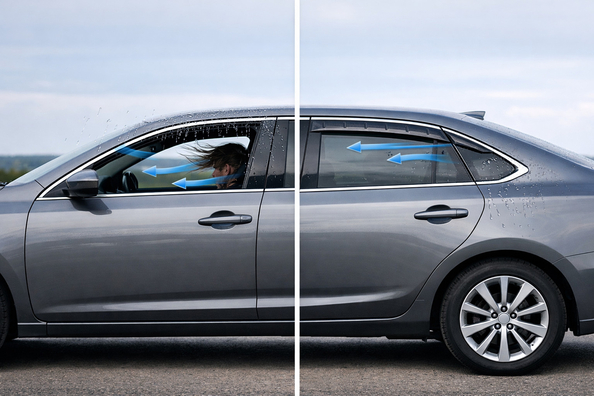

If on the highway you almost never open the windows, door visors for all doors usually won’t bring any noticeable benefit. They start to make sense when you regularly leave the windows slightly cracked: for ventilation, to prevent fogging, in rain, snow, heat, or just to let in fresh air. Then the visor doesn’t make the cabin completely different in terms of noise, but it reduces some spray and softens the air pulses.
The key question here isn’t whether to buy 4 pieces instead of 2, but whether you actually use open windows. If the rear row is almost always closed, a front pair is often enough. A full set makes sense for family trips—rear passengers, a child, or a dog—when you need gentle ventilation throughout the cabin.
The choice is between none, a front pair, or a full set. For highway driving, a visor is useful not by itself, but only when you actually open the window by a few millimeters or centimeters. Then it deflects some rain, snow, and insects and makes the airflow less harsh. If the windows are always closed, the difference will be minimal.
That’s why the “all doors” question is tied not to speed, but to how you use the cabin. Driving alone or as a couple—front ones are usually enough. If you often have rear passengers, a child seat, a carrier, or a dog—then rear visors aren’t just for looks, they help ventilate the second row. For a quick look at options, check window visors and compare them with what your car actually needs.
Installation. In-channel visors look more restrained, but they’re more sensitive to precise fit: if installed poorly, you can get tight window movement, squeaks, or conflicts with auto-up. Stick-on types are easier to install, they don’t press on the glass, but they heavily depend on a clean surface, temperature, and whether the adhesive was given enough time to bond properly.
Noise. With the windows closed, a visor hardly changes anything. Its benefit appears with a slightly cracked window: less spray and a softer airflow. But it won’t completely eliminate whistling—only reduce it to some extent.
Durability, practicality, price. A quality vehicle-specific set usually lasts longer than a universal one, fits better, and is less annoying in daily use. After installation, it’s better to keep the windows closed for at least 12 hours, and in cold weather—even longer. Price-wise, the logic is simple: a front pair is cheaper and delivers the main effect for the driver; a full set costs more, but is only justified when you actually use the rear windows. If you want to understand the differences between types, it helps to separately compare vehicle-specific vs universal window visors.
| Option | Strengths | Weaknesses | Who it’s for |
|---|---|---|---|
| No visors | No cost, no installation, and no risk of issues with the glass or tape | Harder to ventilate properly in rain; buffeting appears sooner with a cracked window | Those who almost always drive with the windows closed |
| Front doors only | Best price-to-benefit balance for the driver; fewer installation risk points | The rear row doesn’t get separate ventilation; limited effect for the whole cabin | Those who drive alone or as a couple and mostly open the front windows |
| All doors | More even cabin ventilation; more comfortable for rear passengers and a pet | More expensive; more demanding fitment; higher chance of installation mistakes | Family cars, long trips, and anyone who actually uses the rear windows |
DD Tuning expert comment: most often people overpay for a 4-door set “just in case,” even though the rear windows may not be opened for weeks. The second common mistake is installing visors in the cold or immediately running the glass with auto-up: after that you get misalignment, rubbing, and noise complaints—even though the cause is fitment, not the accessory itself.
This is a perfectly fine choice if on the highway you keep the windows closed and use the climate system. In this mode, visors don’t provide an effect that would justify the cost. You also avoid any nuances with installation, care, and compatibility with the glass.
Most often, this is the most reasonable scenario. The front windows are the ones the driver and front passenger usually crack on the highway for fresh air, in rain, or to clear moisture from the cabin faster. If the rear row is hardly used, rear visors simply won’t work for you.
Installation is also simpler with a front pair. If your car has a sensitive auto-up or anti-pinch, the stick-on type often behaves more safely. In-channel looks cleaner, but precise fit and settling time are critical. Before installation, it’s worth checking the basics in the article on proper visor installation.
A full set makes sense when on the highway you want to ventilate not only the front of the cabin. This is relevant for trips with a child, rear passengers, or a dog—when the rear windows are also left slightly cracked. In that mode, airflow distributes more evenly instead of hitting only from the front.
The downside of a full set is that you multiply not only the benefits, but also the fitment requirements. The more pieces, the more important it is to choose a vehicle-specific set, install on a clean dry surface or into a properly prepared channel, and let the accessory settle. If you rush the install—especially in cool weather—the rear pieces are often the ones that generate the most complaints.
For daily highway driving, the key isn’t how many doors you cover with visors, but how you ventilate the car. If you only occasionally need to dump moisture, freshen up the cabin a bit, or avoid spray on the front seats, a front pair covers most needs. A full set starts to win noticeably only when the rear row is really in use: people, a child seat, a pet, or cargo that benefits from airflow circulation.
A separate scenario is drivers who worry about extra noise. Here it’s important to understand: a visor isn’t designed for absolute quiet at high speed. It’s more about letting you crack the window a bit more civilly. If you’re chasing silence, it’s better to keep the windows closed rather than choosing a set on the principle of “maybe it will stop making noise.”
| Scenario | What to choose | Why |
|---|---|---|
| You drive alone or as a couple; windows are almost always closed | No visors | The practical payoff will be too small to justify the purchase and installation |
| You often crack the front windows in rain, heat, or to prevent fogging | Front doors only | You’ll get the main benefit without extra spending on the rear row |
| Long trips with rear passengers | All doors | Easier to create gentle ventilation throughout the cabin without strong airflow from the front |
| You often carry a child or a dog | All doors | The rear windows also do real work instead of being a decorative part of the set |
| You’re concerned about auto-up glass or a sensitive seal | Front or full set, but with a simpler installation type | Lower risk of rubbing or fitment errors in the window channel |
A more expensive set is justified when you need not just a dark plastic add-on, but a precise car-specific fit, stable window operation, and a clean look. In the window visor catalog, you should primarily look at vehicle-specific kits; it’s also useful to compare how they differ from vehicle-specific solutions and universal options, and before installation, check the basic rules via the article on proper installation.
In short: paying extra makes sense not for “premium,” but for a lower chance of whistling, misalignment, peeling, and unnecessary experimentation. For highway driving, this is especially important, because even a small fitment mistake becomes annoying specifically at speed.
From a customer’s experience: the request was for a set for all doors because the car often drives on the highway. After уточнення it turned out the rear row is almost always empty, and they only crack the windows in front in rain and when parked—so they chose the front pair. As a result, the person got the ventilation they needed without extra costs and without the feeling that half the set is there just for looks.
It’s worth installing visors on all doors not because the car is often on the highway, but because you actually use all the windows. If the main need is to slightly open the front windows in rain, heat, or to prevent fogging, a front pair is usually enough. A full set is logical for rear passengers, a child, a dog, and regular ventilation of the entire cabin.
The main thing is not to mix up the tasks: visors help with comfort when windows are slightly cracked, but they don’t replace a closed cabin in terms of quiet. So the simple rule is: buy exactly the amount you will use, not the one that looks more complete in the box.
| ✔ | The front pair of deflectors provides the main practical benefit for the driver: you can slightly crack the window in rain, heat, or to clear fogging without heavy splashes into the cabin. |
| ✔ | If the rear row is rarely used, you won’t have to pay for elements that won’t provide any noticeable benefit. |
| ✔ | A full set is truly convenient for family trips, a child, or a dog, as it allows gentler ventilation of the entire cabin, not just the front part. |
| ✔ | With proper installation, a model-specific set fits better and causes fewer glass-related issues than a universal one. |
| ✘ | On the highway, if the windows are almost always closed, deflectors are of little use, so the purchase may be unnecessary. |
| ✘ | A full set is more expensive and more demanding in terms of fit, and an installation mistake can cause stiff window movement, squeaking, or rubbing. |
| ✘ | Deflectors do not eliminate noise completely: with the window slightly open, they only partially soften the airflow, but do not solve whistling at speed. |
| ✘ | Stick-on and channel versions depend on installation conditions, temperature, and surface cleanliness, so installation requires care and time for settling. |
Shipping to EU
Wholesale and retail
Own warehouse
Опис продукту
Подарунки не надаються при оформленні покупки у кредит під 0,01% або при покупці частинами.